



“We’re not in our 20s anymore”: Deep Purple’s Roger Glover proves why rock and roll will never die

It’s hard to overstate the role of Deep Purple in defining classic rock music as we know it.
It started out with ‘Hush’ in 1968. Then, over the course of years and decades, it became ‘Highway Star’, ‘Child in Time’, and ‘Perfect Strangers’. This string of hits cemented the band as one of the most forceful and influential outfits in heavy metal, psychedelia, hard rock, and everything in between. Then, of course, there’s the iconic bass riff of ‘Smoke on the Water’.
That’s what makes it slightly unbelievable that the man who came up with that famous title, known in every corner of the world and hailed as a masterpiece in all elements of the rock canon, is sitting before me now over a Zoom. Roger Glover, to all intents and purposes, is much like most other 80-year-old men.
He peers down the camera at me with small glasses on the end of his nose, struggles to hear the question from time to time, but this is very much the opposite of someone who feels defined by their age. Sure, Deep Purple are more than aware that they are no longer the young, fresh-faced stars they were in the ‘70s. But that doesn’t mean they’re going to stop rocking.
This sense is very much epitomised by their latest album, Splat!, arriving as the 24th record in their storied history and the follow-up to 2024’s =1. And, just so we’re not under any illusions about this, it’s quintessential Deep Purple. Don’t expect any groundbreaking modernity here: it’s ‘70s prog rock through and through, just the way they like it.

That might give off an air of a band who have never mentally left the decade of their prime, but make no mistake, Glover is very much present in the here and now. “I have to say, it comes as a surprise to me that we’ve had a career this long,” he says earnestly.
“I wake up every morning and go, ‘My God, it’s still here’. It’s getting on for 60 years, and how could that happen? It’s a wonderful gift, really, but very few people get that gift, so we don’t want to slap that gift in someone’s face. We really appreciate it.”


My follow-up question to that might seem basic, but it’s essential to understanding the band where they are now. Why has it indeed lasted so long? “I have no idea,” Glover replies with even more sincerity than the first time, “I think possibly because there’s a certain honesty within us. I remember listening to The Doors years ago, and The Doors still sound fresh, because there’s no artifice about it. It’s just people playing music and writing music and performing it, and that’s all we do.”
“We don’t really go for overdoing things and designing things to sell. We design things to please ourselves, and maybe that’s the intriguing thing,” he says. If you were looking for a succinct answer on a postcard as to why Splat! is here in this moment, that would be it. Deep Purple are doing it, simply because that’s what Deep Purple do.
“It’s just a vision of a person who’s made it against the odds…”
Roger Glover
In many ways, that ties directly into the mode of writing that the band have worked in, like cogs in a well-oiled machine, for more than the past half a century. Ian Gillan is very much the mastermind behind writing all the songs, between the lyrics and the instrumentation. The rest of the band pitches in ideas, of course, but most of the time, they are happy to marvel at his creations.
Because of this, Glover perhaps isn’t the best voice of authority when it comes to disseminating the songs. “We never know quite how a song is going to end out. We don’t plan it,” he admits, “and the last thing that goes on is usually the vocal. In this case, Ian was very adamant that he wanted to write everything.”
This might seem perplexing or frustrating to members of other bands, but Glover clearly feels very content in his place. “Sometimes we write together, but this time he wrote stuff, and in a way it’s hard to argue against it. I don’t know necessarily what he’s talking about half the time, maybe that’s the good thing,” he laughs.
Take the example of the lead single ‘Arrogant Boy’, where Gillan laments the character of Billy in soaring wails. “I don’t know who Billy is,” Glover says quite freely, “I don’t care, really, because it doesn’t matter. It’s just a vision of a person who’s made it against the odds, I guess”. You could say this reflects the story of the band itself.
It’s a fascinating insight when the bassist then goes on to dissect Gillan as a writer. This is a man at whose right-hand side he has been for almost 60 years, and yet he comes across like there’s a certain artistic unknowability about the frontman. Calling Gillan “really unlike any other singer I can imagine,” Glover adds, “I couldn’t write his lyrics, nor could anyone else, and so he’s a bit mad in that respect. He follows his own muse, and wherever it takes him, we don’t have a lot of choice.”
As such, a similar pattern follows suit. I ask him about some of the album’s more dizzying tracks, like ‘The Only Horse in Town’ and ‘The Beating of Wings’, and while he offers up an honest insight into Gillan’s “very moving” but “not sentimental or slushy” reflections on losing his wife, Glover admits, “I can’t answer for it. I can only say as a listener, like you”.
In this sense, while it absolutely doesn’t make the album a redundant aspect of the conversation, we turn to focus on the things that Glover really is at the front and centre of, namely, the tour. Deep Purple are performing a not insignificant string of dates across Europe and the US this summer, before heading back home to go up and down the UK in November.
It’s not lost on Glover that this persistence to keep going at full throttle is something far less common in this day and age, particularly for acts of their certain vintage. “I noticed that bands do this thing about announcing the final gig, [like] Black Sabbath, and we won’t do that,” he says resolutely, “We’ll just go until we can’t go on, and the final gig won’t be announced, because I think, where would we do it? And the stress and the emotion of saying, ‘This is it’. None of us want to face that, so we just go on till we drop.”
Valiantly, I do broach the subject of farewell tours, only because it seems to be the current done thing for classic rock bands of the ‘60s and ‘70s era. Glover recalls that “maybe six years ago,” when their longest-serving guitarist, Steve Morse, was still in the band, he was brave enough to suggest that Deep Purple should consider a final blaze of glory.
“That didn’t go down particularly well with the rest of us,” the bassist deadpans, and that was the end of that.
“To me, it’s a bit of a cheap publicity thing,” he adds, making it more than clear that if we ever see Deep Purple and the word ‘farewell’ on the tour poster, then something must have gone terribly wrong. They have so much more to live and work for, and not even the annoyance of advancing age will keep them down.

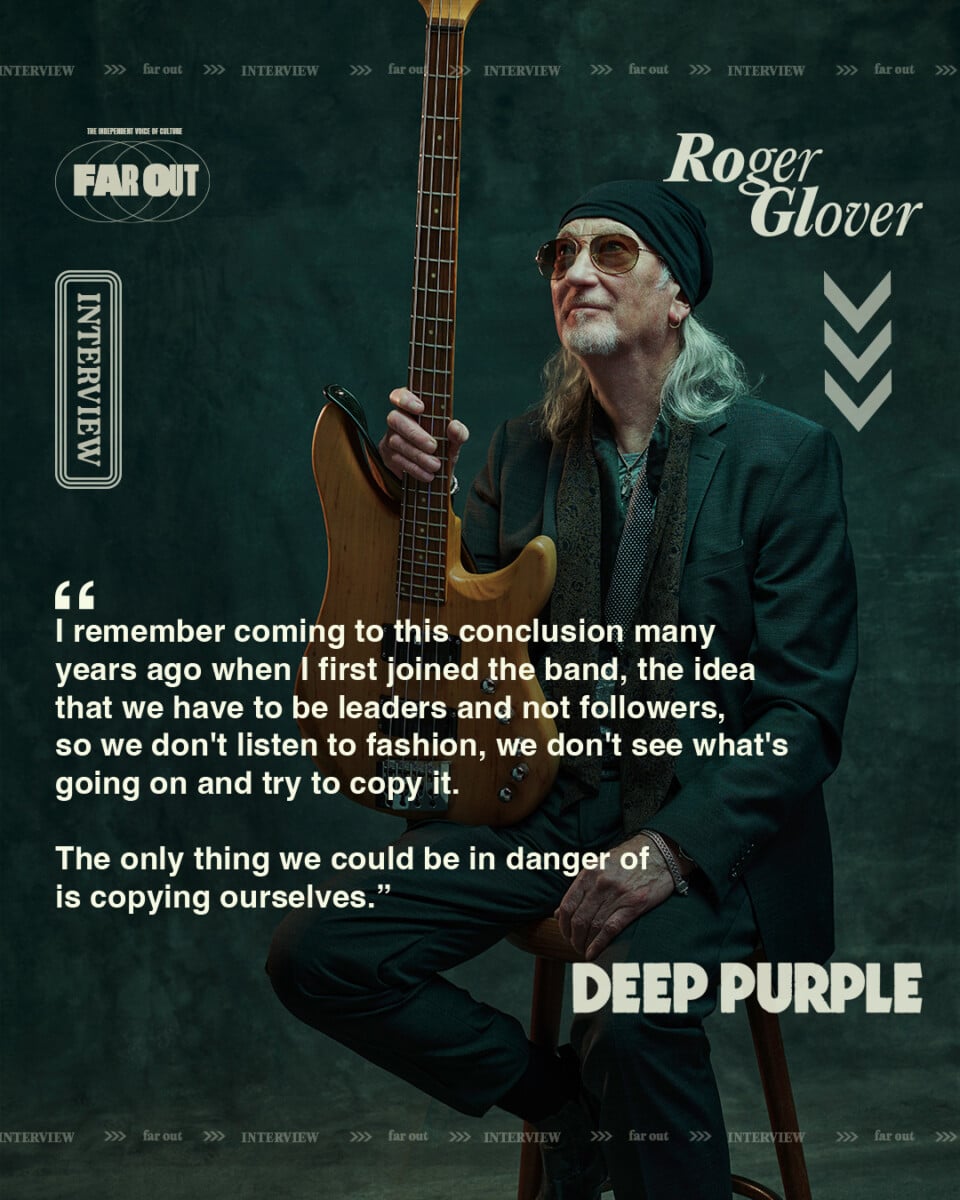
“I remember coming to this conclusion many years ago when I first joined the band, the idea that we have to be leaders and not followers, so we don’t listen to fashion, we don’t see what’s going on and try to copy it. The only thing we could be in danger of is copying ourselves,” Glover notes, before conceding, “This album was harder, I suppose.”
Harder in what sense? “Well, it’s just more energetic,” he explains, “We were in our 20s when we did Deep Purple in Rock, and now we’re not in our 20s anymore, but that desire still lingers, and it just turns out that way. We don’t plan it. We don’t plan anything, actually. Others do the planning for us.”
When I spoke to Glover in May for this interview, he was elusive when it came to plans for the tour, not intentionally, but because he genuinely didn’t know. Deep Purple are such seasoned hacks now that, according to the bassist, they can cobble together a setlist and show within only a few days of rehearsal.
“I know some bands will rehearse for two months before they go on the road,” he says with a look of disgust, “I can’t imagine rehearsing for two months, that’s like hard work! No, I think we’re good enough as a band that we can actually pull it off.” In terms of tracks fans can expect to hear on the road, Glover says a few emails of ideas have been flying around, but “Even if I knew, I wouldn’t tell you”.
He’s right to keep his cards close to his chest, whether for secrecy reasons or following the path of spontaneity that Deep Purple have always travelled. In this sense, bringing up future plans is a bit like asking him to predict the weather: there’s just no way of knowing. “I think the next year certainly is not going to be as hard as this year. This is a long touring year, but if we survive this tour, then I’d like to do another album, and I think if we tour in 2027, it’s not going to be as hard.”
As a group of older classic rock stars, they have seen many of their contemporaries come and go over the years. But there’s a spark, a deep-rooted presentness, and a tenacity in Glover and the rest of the band that will see them fight on. “It could be a little easier, but beyond that, as I say, we don’t plan. Take things as they come, day by day,” he concludes.
Maybe Deep Purple could teach us all a lesson. Boredom and predictability will be the death of us, so perhaps it’s better just to live life never knowing what’s around the corner.

Never Miss A Tale
The Far Out Classic Rock Newsletter
All the latest Classic Rock content from the independent voice of culture.
Straight to your inbox.