


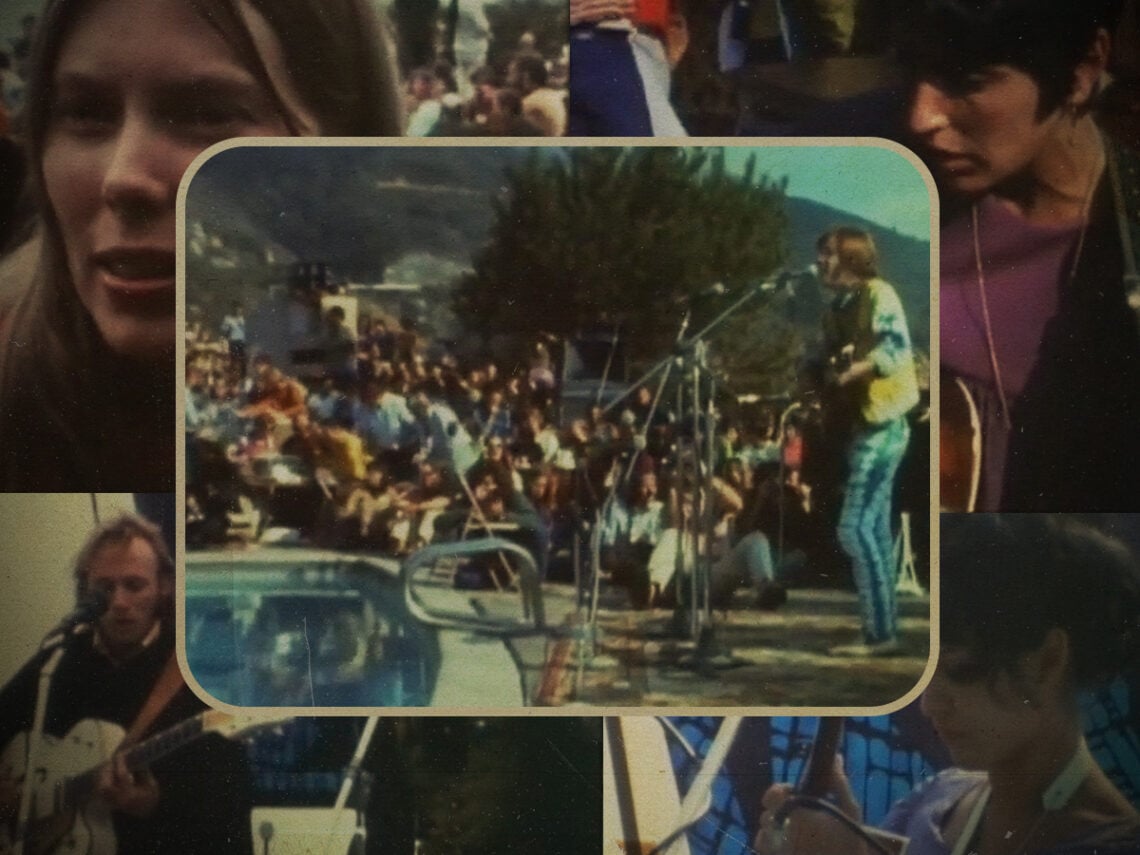
Big Sur Folk Festival: The 1960’s most anti-commercial event

Where festivals such as Woodstock and Monterey Pop dominated the music-centred idealism of the 1960s, a humble alternative came about in 1964, from the minds of a recent university graduate and an emerging folk icon in California.
In 1961, Joan Baez was quickly becoming the darling of the roots revival, a leading voice among the young folk artists of her era, from Joni Mitchell to the burgeoning Bob Dylan. In the coming years, Baez would adorn the cover of Time magazine, see her songs chart internationally across the decade and amplify her voice as she spoke in support of civil rights and in opposition to the ongoing Vietnam War.
But, before fame suddenly arrived at the young singer’s doorstep, she was making her voice known among the folk revivalists in Boston and the neighbouring Cambridge music scenes. It is in Boston that Baez would meet Nancy Carlen, then a student at Boston University, and the two would inspire each other to conceptualise a new kind of music festival.
Carlen was struck by Baez’s position as both a musician and activist, and admired the ways that she approached both in her work, so much so that once she finished school in Boston, she drove cross-country to Big Sur, California, and began living and working at the Esalen Institute, a non-profit focused on “humanistic alternative education” in 1961. About three years later, Baez, who lived in Carmel Valley, California, at the time, was invited by Carlen to lead a weekend seminar at Esalen, to be called ‘The New Folk Music’, which “started as a lark”, in her words, with the “Esalen Institute offering us a chance to take over that magnificent place for a whole weekend”.
Alongside Baez, Carlen invited the singer’s younger sister, Mimi, and her husband, Richard Fariña, to join in what would be the couple’s debut performance, and she began planning out the potential for a festival with Richard. “Well, any time you found Joan Baez, Richard and Mimi Fariña, and me in the same place, there had to be singing,” Carlen later recalled, “so instead of meetings and lectures, sing we did, in the sulphur baths, on the lawns, even during meals sitting at long wooden tables in the lodge.”
For the weekend, she also invited the folk/blues singer and activist Malvina Reynolds, a contemporary of Woody Guthrie and Pete Seeger, Mark Spoelstra, who performed with Bob Dylan in their mutual early days in the Greenwich Village folk scene, and another local folk singer, Janet Smith. With this lineup, the Big Sur Folk Festival began to take shape, in earnest, but it was not intended to be a ‘typical’ festival. For one, Carlen conceptualised it as an event for musicians to ease away from the chaos of summer’s festival season, emphasising a peaceful, tranquil energy over a wild one, and thus, the number of attendees would be kept small: only a few thousand (preferably less than 6,000) to retain the intimate vibe.

“Sunday afternoon, we invited the neighbourhood in general to join us, turned the deck of the Esalen swimming pool into a stage and sang to everyone,” Carlen continued, establishing the first of eight festival iterations to come. From its inaugural event in 1964, Richard and Mimi Fariña secured a recording contract with Vanguard, and Carlen described the duo as “a really unusual act” (quoted in David Jadju’s Positively 4th Street). “Most people were doing a traditional thing or a blues thing or a protest thing,” she continued, “They were combining folk music with Eastern music and poetry and rock and roll. They were completely original and creative.”
Originally, the artists saw the Big Sur Folk Festival as an antidote to festivals like Newport Folk and later, Woodstock, with a bigger focus on affording artists the space to perform with less pressure, while donating their time; the proceeds from ticket sales were donated, in turn, to Baez’s Institute for the Study of Nonviolence, established the same year as the festival, 1964.
Meanwhile, Baez would continue to perform at all eight annual festivals, from 1964 to 1971, and they continued to be intentionally informal, welcoming some of the era’s biggest names across folk and rock, but without an air of pretension or unfamiliarity. Names including Kris Kristofferson, The Beach Boys, Judy Collins, Linda Ronstadt and Crosby, Stills, Nash & Young graced the stage of Big Sur Folk over its eight-year run, while then-emerging musicians were featured, too, including Arlo Guthrie and The Flying Burrito Brothers. The audience sizes were still kept as compact as possible, but Carlen’s efforts did not stop fans who could not afford the admission charge (which ranged from $3.50 to $5.50, over the years) from watching from among the cliffs that loomed above Esalen and attempting to sneak in.
Big Sur Folk’s most successful year came in 1969, which saw the festival take place on the heels of the phenomenon of Woodstock on the other side of the country, in New York State. It was this year that Joni Mitchell made a surprise appearance, singing the debut of her song ‘Woodstock’, written as a secondhand account of the three-day weekend filled with “stardust”. The two-day event, September 13 and 14, was immortalised in the 1971 documentary, Celebration at Big Sur, which captures the festival from its opening with Joan Baez’s rendition of Dylan’s ‘I Shall Be Released’, to the closing number, ‘Oh Happy Day’, a gospel song with lead vocals from Dorothy Combs Morrison, a recurring performer at Big Sur Folk, with the Edwin Hawkins Singers.
As quoted in Rolling Stone, an attendee of the festival that year said, “I finally figured out the difference between this and a love in…four dollars.” As its final iteration was held in 1971, the Chicago Tribune summarised the Big Sur Folk Festival with the headline: ‘Rock Fete Without Dope, Mud, Tickets’.
The festival was, indeed, held with no advertising support or tickets, only invitations to the one-day event. The performers, eight in total, were compensated on a pay scale, receiving no more than $50. Over its eight years, Big Sur Folk managed to hold on to its anti-commercial values, keeping a focus on championing the performers and their music while promoting peace and nonviolence. The end of the festival may have been premature, but it made a permanent mark on folk music history in the long run.
