


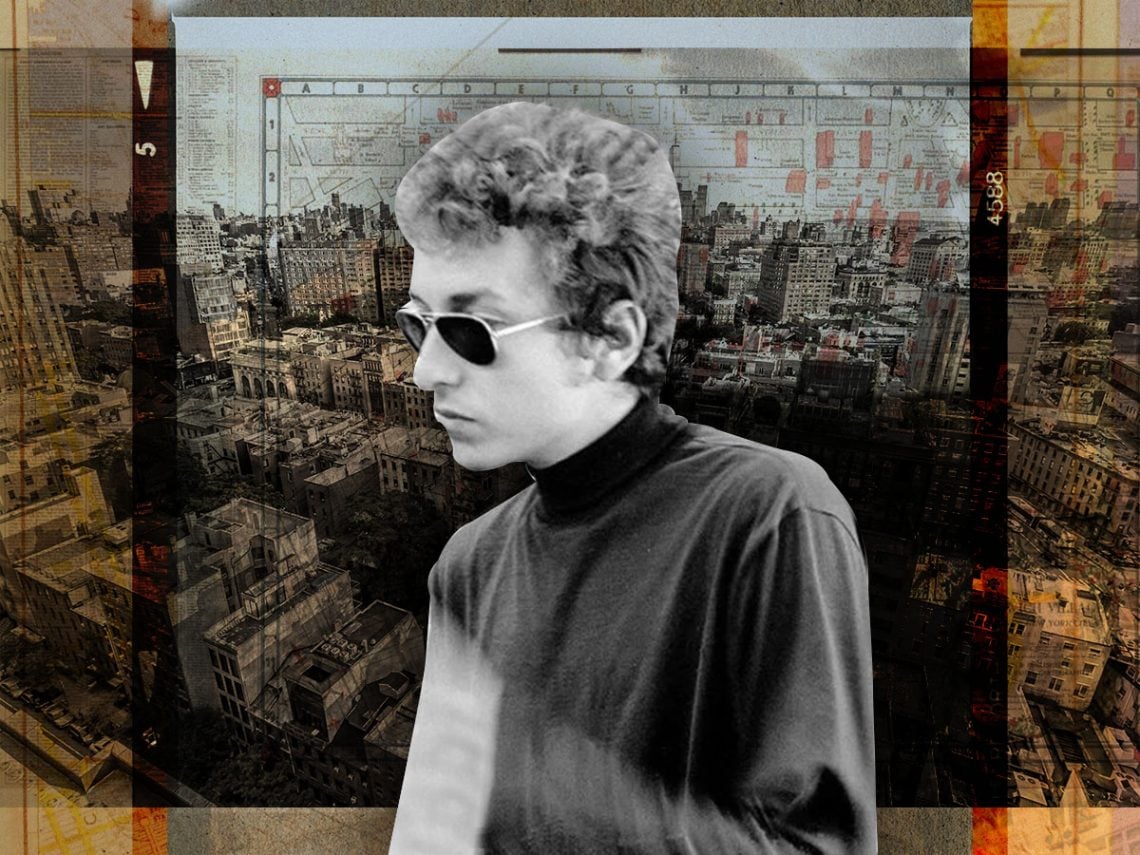
The Greenwich Village café where Bob Dylan wrote the most important song in history over breakfast

I cast my eye across the café, and I idly make broad strokes, prejudicial assumptions about what everyone is working on as they squint at their laptops. They narrow their eyes in a bid to convey to other people in the café that they’re doing something important.
The fellow in the plaid shirt, pretending to work, is clearly just clicking through an old flame’s holiday photos, and the disgruntled pug in the turtleneck has drafted and deleted 17 different opening lines of an email to their energy provider. Of course, all of these fanciful observations could be misguided, but it feels safe to presume that none of the latte sipping patrons are sat working on a song that will change the world.
Bob Dylan once did that over breakfast. But those days are gone.
105 MacDougal Street is a typical tenement building. It’s exactly the sort of place you’d imagine when you hear the words ‘Greenwich Village’. According to New York City realty reports, it’s been upright since 1900. It’s looked pretty much the same its whole life. Now, it’s a restaurant, and back in 2011, when it was Panchito’s, it removed the last strand of evidence that the world changed within its walls.
For decades, scrawled above the door was the slowly fading lettering of: The Fat Black Pussycat Theatre. This signage dates back to the days when 105 was always a hip venue. When the eroding signage was finally removed, the local papers all ran with some variation of the pun, The Signs Are A-Changin’. The headline would’ve worked better had that been the historic song Dylan actually wrote within the humble walls.
In fact, back when it was a beatnik café called The Commons in 1962, Dylan strolled in there and wrote a more significant song in ten minutes straight. Possessed by a “penetrating magic”, the young vagabond wrote ‘Blowin’ in the Wind’ over ten cent coffee. The song, in many ways, was the first of its kind, and that pioneering spirit transformed culture instantly upon release.

It’s not without a healthy dose of irony that the back-and-forth of opposing views regarding the removal of The Fat Black Pussycat Theatre sign pretty much typifies the virtues of the song itself. “This was a tangible connection to the Village’s great history as a place where musicians and artists changed the world,” Andrew Berman, the executive director of the Greenwich Village Society for Historic Preservation, told the NY Times back in 2011.
But the retort from Panchito’s 84-year-old owner, Bob Engelhardt, was swift and dismissive. “Why don’t we just take the whole world and set it in concrete?” he asked. “That would save everything.” His only regret was that he hadn’t got the painters in earlier, expressing that the defining spirit of The Village in its golden age was one of pioneership, not preservation. “The Village was freedom, it wasn’t a concreted-over straitjacket,” he bemoaned.
But the key, overlooked detail there is ‘golden age’. There’s little doubt that Dylan and his cohorts would’ve painted over practically anything without thinking back in the budding heyday of the early ‘60s. After all, The Commons swiftly became The Fat Black Pussycat Theatre without much second thought. But the difference is, these freewheeling artists were turning failing grocery stores into the headquarters of a revolution in a world gone weird, rather than erasing invaluable cultural connections for the sake of commerce.
Time changes stories, and the context of the freedom and liberation in Dylan’s day is far different now. Once more, the sentiment of time-changing stories is applicable to ‘Blowin’ in the Wind’, too. While Dylan might’ve claimed that he “probably” wrote it in ten minutes at The Commons with a coffee, a page, and a pen, that has since been proven to be an oversimplification.
He certainly wrote some of it there – who are we to doubt the man’s own account – but the masterpiece was constantly meandering and evolving until he settled on the version on his second album, The Freewheelin’ Bob Dylan, and, in the process, inspired a generation of artists to go a little further and dig a little deeper than they had done before.

Now, stripped of this heritage, you might see plenty of people typing away in 105 MacDougal Street, but you’d do well to see what the folk singer David Blue witnessed back in ‘62, when he looked up from his pancakes to observe the fateful sight of Dylan ceasing to sup his brew for a second and pulling out his guitar.
“He began to strum some chords and fool with some lines he had written for a new song,” Blue recalled in the book Bob Dylan All the Songs. Suddenly inspired by his own thoughts, in a spirited upsurge of Civil Rights defiance, he needed to move quickly. So, he handed Blue his guitar and asked him to play “so he could figure out the rhymes with greater ease.”
“We did this for an hour or so until he was satisfied. The song was ‘Blowin’ in the Wind’,” he said with a noted degree of humility, given that he had just assisted the creation of a track that would become the first anti-war anthem to rise through the charts. Bob and Blue couldn’t have known that at the time, but they were certainly struck enough by Dylan’s scribblings to race to Gerde’s Folk City to perform the song to the club’s emcee, Gil Turner.
“Bob sang it out with great passion,” Blue recalled. “When he finished there was silence all around. Gil Turner was stunned.”
It had a similar effect on the whole world. Not bad for a ten minute tune with coffee still on its breath. While its impact might have outstripped its actual quality, it certainly beats flicking through social media posts over a latte while pretending to work – and perhaps there’s a lesson in that for all of us.

Never Miss A Tale
The Far Out Bob Dylan Newsletter
All the latest stories about Bob Dylan from the independent voice of culture.
Straight to your inbox.