


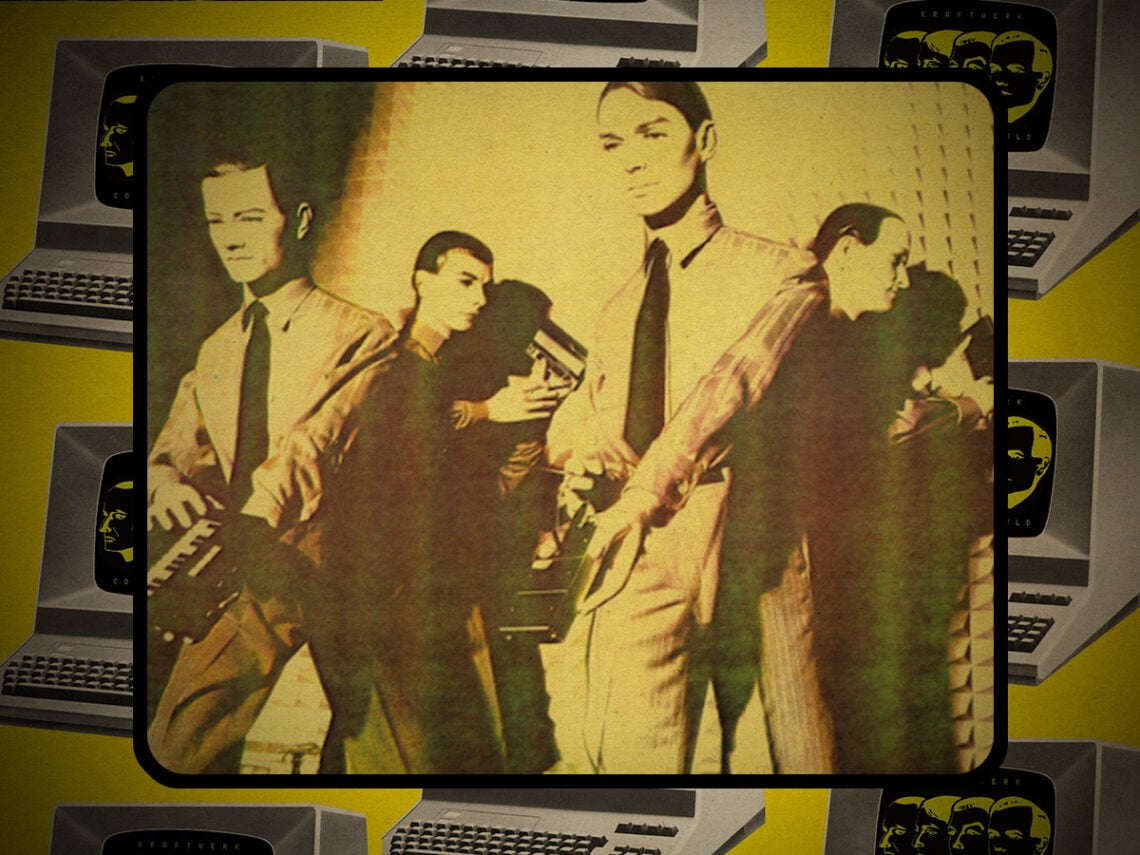
“Business, Numbers, Money, People”: 45 years of Kraftwerk’s landmark ‘Computer World’

It’s now 45 years since the prophetic Computer World was unveiled to the world’s charts, the last time Kraftwerk constructed their signature brand of electronic art-pop with such razor prescience.
It’s often forgotten how steeped in the past the Düsseldorf synth pioneers were during their 1970s breakthrough.
Before the cybermen automatons that would largely define their aesthetic for the last several decades, Kraftwerk were conceptually pinned to the mythos of their home country, looking back to the grand Bundesautobahns marking Autobahn’s highway traverse, the domestic crackle of the 1930s Volksempfänger airwaves adorning Radio-Activity’s stark cover, or the romantic gateway to Mitteleuropa’s glowing hinterland on their Trans-Europe Express opus.
By the end of the decade, band founders Ralf Hütter and Florian Schneider began to embrace the robots. It’s hard not to read some good, German mirth in The Man Machine’s mannequin poise, a wry riposte to the Teutophobic music press who dismissed their staid electronic schtick as emotionally void and faceless.
With the classic quartet adopting their iconic red shirt, black tie poise, along with Karl Bartos and Wolfgang Flür, they stood in immaculate uniformity. Deutschland’s beckoning yesteryear soon gave way to the technological present, providing further scope to explore their artificial personas as well as looking at the emerging digital revolution seizing the world ahead of the looming 21st century.
Back in the early 1980s, most people didn’t own a personal computer, including Kraftwerk, but the dawn of information networks and digital communications was well underway, as well as all the anxieties that came with it. Would humanity be in control of the computers, or became ruled by their automated might? It’s a question that’s only grown more pertinent in the smartphone age and the AI revolution.
Kraftwerk were never ones to present exact answers or definitive positions in their work, but for their eighth studio album – or fifth if deferring to their officially recognised back-catalogue – the electronic architects looked to the surrounding, data-driven wheels of ‘progress’ for conceptual guidance.
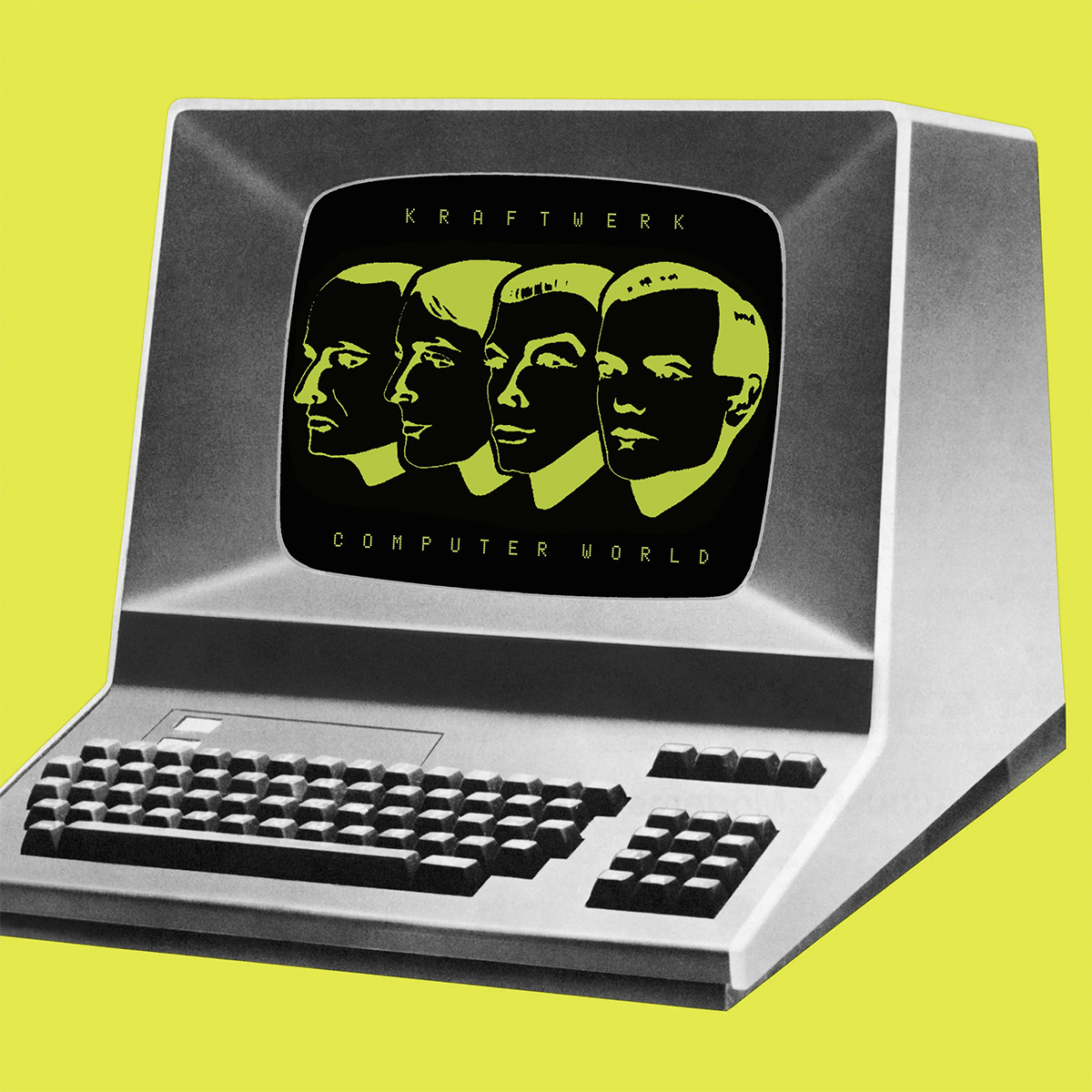

“We live in a computer world, so we made a song about it,” Hütter tersely stated to the press at the time. The Computer World sessions took three years in their Kling Klang studio, remarkably still using analogue synths, including the Minimoog, Polymoog, and ARP 2600, but were executing immaculate production all over Computer World’s futurist sheen, managing to shape a digitally sounding sonic character from what was fast becoming archaic hardware.
While The Man Machine dwelled in space-age landscapes, Computer World’s aural terrain shares a close proximity to the day-to-day, its clicks, chirps and beeps evoking the familiar sounds of the era’s Atari video games or Casio digital watches amid the album’s contemporary reflection.
Such domestic soundfonts bleep on the frothy ‘Pocket Calculator’, an almost provocatively dippy slice of sprightpop that gratuitously flaunts its button-pushing music making to a rock crowd still rejecting electronic music’s legitimacy: “By pressing down a special key / It plays a little melody.”
Computer World also looks at the professional realm. ‘Numbers’ harsh lyrical countdown in foreign tongues speaks to the day’s trade, market forces, and the shrinking globalisation, as well as the human activity reduced to individual digits like specks of data cascading down a computer monitor.
“Business, Numbers, Money, People,” sings Computer World’s title track. The crisp synth shimmers and intricate rhythms point both to a utopian idyll and a nagging uncertainty, veering between optimistic glow and cautious skulk as Kraftwerk imbues its sleek minimalism with that characteristic incertitude. The grand opus is ‘Computer Love’; however, the centrepiece work that depicts the lonely individual who seeks a “data date” for either companionship or a deeper, existential purpose.
Scored with its soaring melodies and subtly emotional valleys for the ostensible robots, Kraftwerk penned decades ago an enduring anthem for every lost soul clamouring at communal belonging or romantic escape via the illuminous glow of a phone screen in the 2020s.
Released on May 11th, 1981, Computer World was dropped amid a synthpop climate that Kraftwerk’s legacy had helped pave the way for. Yet, even after five official albums in, the Düsseldorf legends were still one step ahead, the likes of Depeche Mode, Orchestral Manoeuvres in the Dark, or The Human League following the template set by ‘The Model’ cut three years earlier, shooting to UK number one when issued with ‘Computer Love’ as a double A-side.
The hip-hop underground would mine further beats as they had with ‘The Man Machine’s mechanised groove, ‘Numbers’ forming one of the essential alchemic components to Afrika Bambaataa and the Soul Sonic Force’s ‘Planet Rock’ along with ‘Trans-Europe Express’, and the ‘Home Computer’ and ‘It’s More Fun to Compute’ double finale maps a blueprint for techno, house, and the wider dance culture set to explode by the decade’s end.
It would mark the last classic Kraftwerk LP where the quartet looked to the future with such a radiant, Gesamtkunstwerk vision. As the sessions that transpired to become 1986’s Electric Café became dragged out, the computer world soon found its way into the band’s inner creative sanctum, the E-mu Emulator II and NED Synclavier opening the doors to digital sampling and editing, which should have yielded new paths of sonic construction.
Yet, their electronic protégés had finally caught up with Kraftwerk, everybody from Skinny Puppy, The Art of Noise, Chicago house, and old class of ‘81 synthpoppers Depeche Mode, all pushing electronic music to new frontiers further afield than Kraftwerk’s sampling tinkerage. Coupled with a lack of cohesive theme, Electric Café, while a solid album, was the moment when the old German masters were finally surpassed by their students.
The Kraftwerk machine would trundle along from then on, reduced down to a solely Hütter-driven project and existing as a heritage act with little original music worth noting from the 1990s, but crafting an impressive, art-pop live spectacle. However, Computer World lives on in the contemporary era it predicted, a time of data harvesting, tech surveillance, limitless information, and AI’s terrifying vista, spotted in the distance with Kraftwerk’s uncanny cultural binoculars 45 years ago, marking the last time the Kling Klang studio seemed to socially and thematically point the way to where society was heading.
