


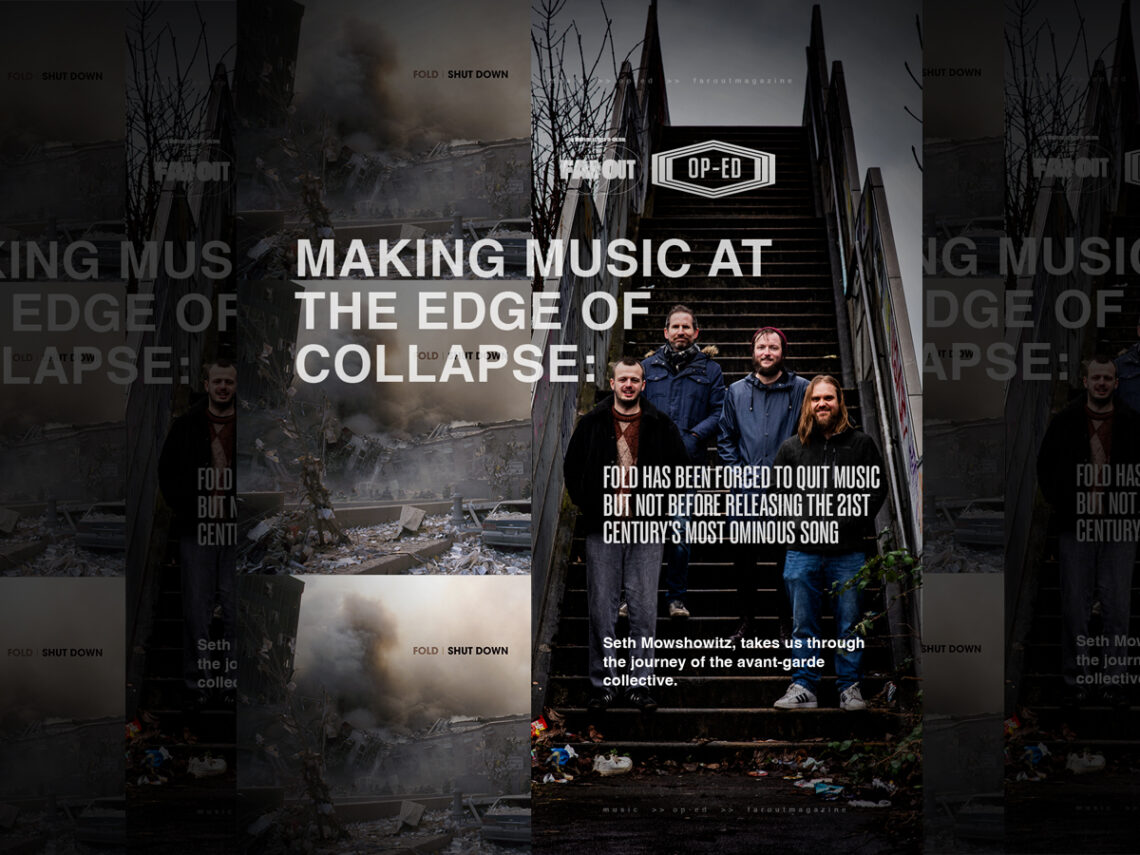
Making music at the edge of collapse: Fold has been forced to quit music but not before releasing the 21st century’s most ominous song

Editor’s Note: Fold have been releasing music since 2012, but recently, the following email header popped up in my inbox: “Something suitably ominous at very short notice”.
Therein, the group revealed that they have been forced to take a step back from the industry, but not before one final swansong. With that in mind, the band’s leader, Seth Mowshowitz, takes us through the journey of the avant-garde collective right through to their final song, ‘Shut Down’, in the exclusive op-ed below.
Seth Mowshowitz: “I’m the founder of Fold, a Leeds-based experimental music collective and community group. Since 2010, we’ve amplified humanitarian perspectives, challenged toxic narratives and abusive power structures, worked towards social uplift and built community. We incorporate all kinds of human vocal expression into our music, including poetry, spoken word, singing, rapping and public speaking. This involves numerous collaborations. We’ve worked with the poet and presenter Mr Gee, London protest rapper Potent Whisper, and Northern jazz maestro Emma Johnson.
We also use recordings of various luminaries, both living and deceased, from Lorraine Hansberry to EF Schumacher. These are often voices that have been written out of the public discourse.
Despite our somewhat challenging approach, we’ve been fairly successful in reaching a wide audience over the years. We’ve had ample support from radio, in particular, with consistent national, regional and internet station coverage for over a decade. We’ve performed on stages across the UK, including a live BBC 6 Music session for Lauren Laverne. We had a reach of tens of thousands across multiple social media platforms. Even the Spotify algorithms have amplified our tunes. We’ve been interviewed by Dave Rowntree of Blur, had several sizeable sync licenses and got dissed on the radio by Russell Brand, arguably our finest accolade.
Most importantly, we’ve found receptive audiences in many places with people who are marginalised by or simply fed up with the failing capitalist system of exploitation and domination. Some have told us that they feel represented by our music in a way that is otherwise absent in media spaces, and that means more to us than anything else.
However, all this has changed in recent years. Since the pandemic, we’ve all found ourselves on or below the poverty line. Austerity, the cost of living crisis, Brexit and the pandemic have all played a role. In early 2022, I reached total burnout.
Up until that point, I’d been working full time, co-parenting two neurodivergent children 50/50, with a sizeable mortgage, and somehow managing, writing, producing, promoting and playing live with Fold. I had to quit my job, seek therapeutic interventions and build a flexible portfolio career from scratch with all the same financial pressures and responsibilities.
I’d been through autism and ADHD diagnostic journeys for both of my children and navigated the complex world of securing SEND support in schools, including an EHCP for my son. Throughout the process, I recognised so many autistic traits in myself that I started asking my inner circle if they thought I was autistic: the answer was a unanimous yes. Now, at 48 years old, I’m still processing this awareness and reframing my life experiences through a new lens.
I came to realise just how huge an impact the masking, unmet needs, and lack of self-awareness have had on my core relationships and meeting the expectations of daily life. Things have gotten more difficult with age, too; the coping mechanisms aren’t as effective as they were with youthful energy behind them. The rest of the group is younger than I am, but no less neurodivergent. One has a Tourette’s diagnosis, one is seeking an ADHD diagnosis, another has suffered with depression and anxiety his whole life and identifies as autistic. All of us have similar struggles in life.
As the group leader, I’ve had to push myself to my limits since 2022 to keep releasing and promoting records regularly while building the live act back up to pre-pandemic gig readiness. Live performance has always been challenging for me. Although I get a lot out of it, my particular neurology makes being onstage a completely overwhelming experience. This, too, has increased with age.
These personal challenges were accompanied by a decrease in both reach on all of our platforms and music industry support. Fewer streams, playlist approvals, fewer physical sales, throttled reach on social media, and fewer supporters in music media. I don’t think this can be attributed to any one factor; the cost-of-living crisis affects the whole ecosystem. Also, since regularly speaking out against the military-industrial complex and what the UN has deemed a genocide in Gaza, we were ‘shadowbanned’ on X, Facebook, and Instagram.
All of the aforementioned sociopolitical factors have made being a professional musician in the UK today incredibly tough. Most venues and promoters are less inclined to take a chance on fringe groups like us. As they too struggle to survive in a challenging economy, they need to focus on safer acts that consistently sell tickets. Despite working hard to build our live show back up to a high standard, we found that the demand for our performances was suddenly at an all-time low.
At a certain point, we had to accept that we were just not getting enough back for the energy we were putting in. The energy supplies are also not what they once were.
“The joy of making music was dwindling. It has been disheartening at times. I’ve had to learn to let it all go”.
Sometimes I doubt my own self-worth. Although I can usually say I’m proud of the years of work, the situation has led us to reconsider why we’re doing this, and to reflect on where our energy should go next if we still want to make a positive impact through music.
A pivotal moment came in late 2023 with the brutal, senseless murder of a teen in my neighbourhood by another teen. There’s a nationwide lack of investment in young people, particularly teenagers, that’s built up over the past 16 years and is driving a huge increase in antisocial behaviour, gang activity and violence. Between 2010 and 2023, roughly 1,200 publicly run youth centres have been closed, with 4,500+ youth workers being sacked. In my area, there’s very little on offer for these kids, and they desperately need adults to step up. So I did.
Under the umbrella of Fold as a community group, I applied for funding to launch a music production workshop for young people facing barriers in my area. We were awarded the full amount and have been running the workshop ever since. At the end of last year, we started a second workshop in a more troubled area of Leeds and have applied for more funding to expand it.
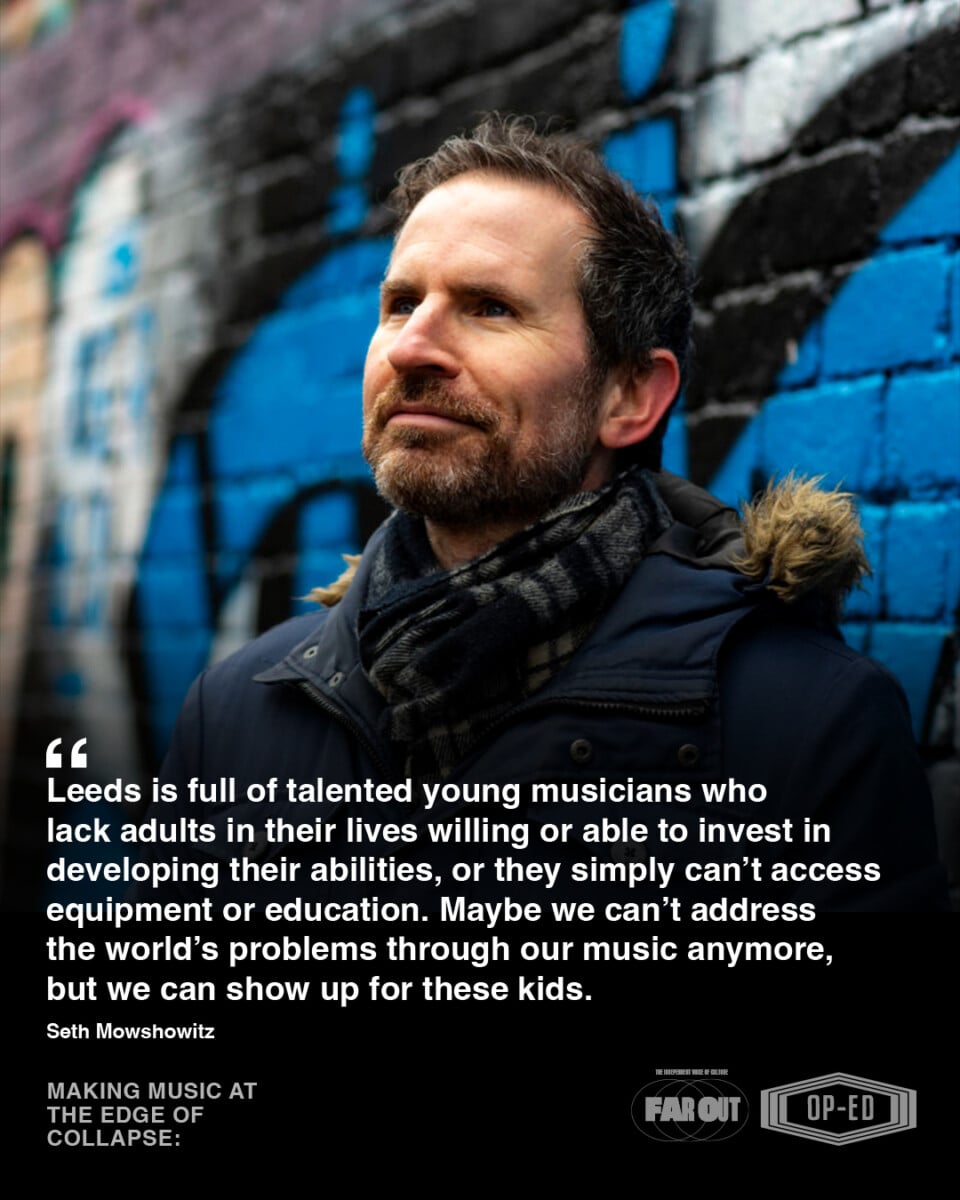
Leeds is full of talented young musicians who lack adults in their lives willing or able to invest in developing their abilities, or they simply can’t access equipment or education. Maybe we can’t address the world’s problems through our music anymore, but we can show up for these kids. The outcomes have been incredibly positive so far. We’re even planning to release some of the projects on our internal label. One kid’s already set up digital distribution for his own work. These outcomes provide a lot more meaning for us than all the social media validation ever did.
Having lived with the decision to step back from the release cycle treadmill for a while now, what we’ve found is that the joy of just making music for the sake of it is also returning. Despite limited time and energy, without all that pressure, there is space to both play and reflect, and at this moment in history, there is a lot to reflect on.
All the members of Fold have a natural tendency for big picture thinking and constantly analyse geopolitics. I have some background in political science and personal experiences of many people, places and events that have shaped the modern world. I was living and working in New York on 9/11, for instance. My first love’s family fled Pinochet’s dictatorship in Chile when Salvador Allende was assassinated. I was also living and working in London during the 2005 bombings.
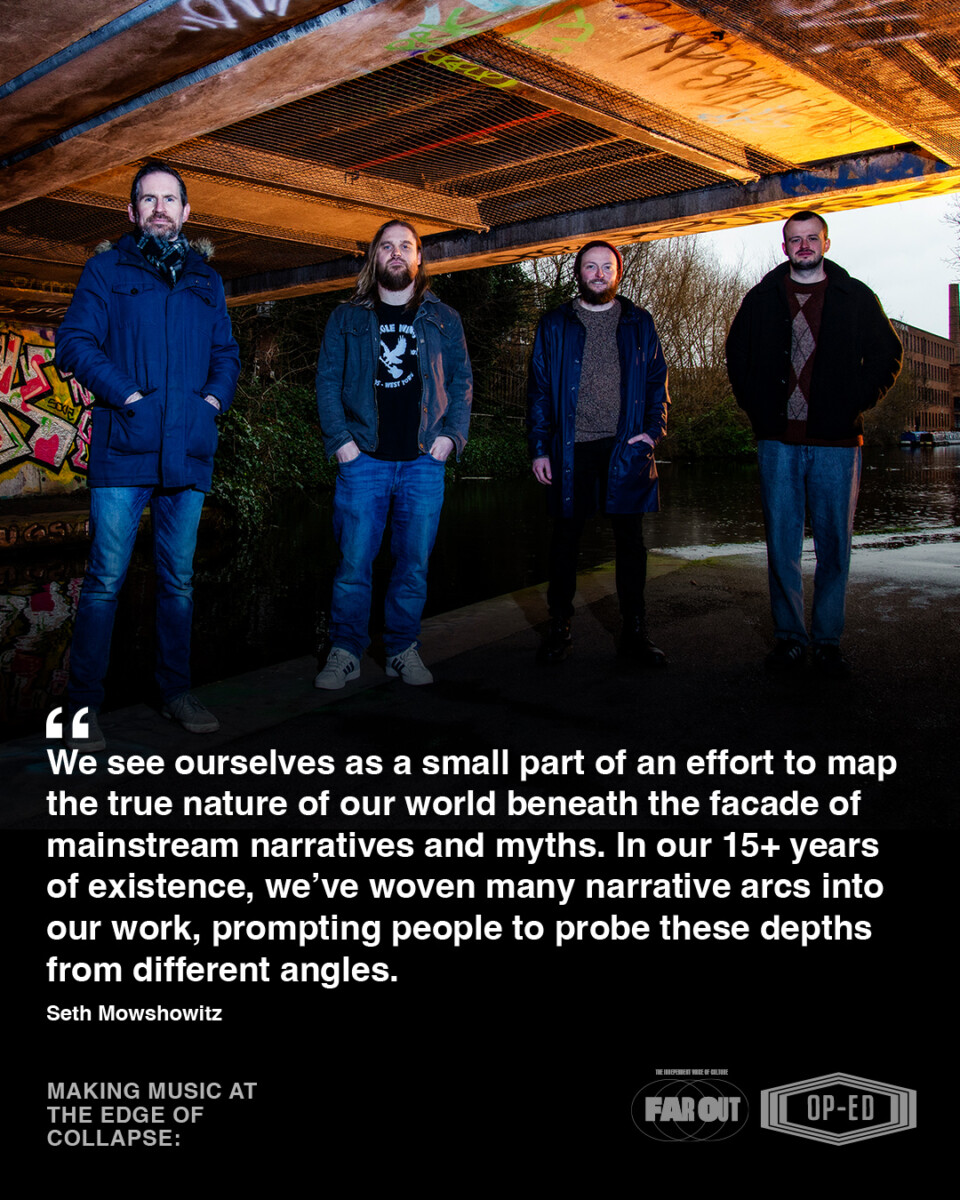
“We see ourselves as a small part of an effort to map the true nature of our world beneath the facade of mainstream narratives and myths”.
In our 15+ years of existence, we’ve woven many narrative arcs into our work, prompting people to probe these depths from different angles. One such angle is the inevitable collapse of the global financial system, due to being predicated on the assumption of infinite growth in a world of finite resources, the key finite resources being oil and natural gas. These fossil fuels presently underpin the running and expansion of global civilisation. They’re rapidly running out, and the edifice built by them cannot currently be replaced.
A key figure that I came across early on through his peerless investigation of 9/11 is the late Mike Ruppert. Having lived through the events of that day and its aftermath, I’m permanently obsessed with 9/11 as a historical turning point. Mike argued that in order to understand 9/11, you must first grasp the extent of our species’ dependency on fossil fuels and the alarming implications of the fact that we have passed the peak of production for both oil and natural gas. This understanding frames the geopolitical landscape that led to 9/11.
We first sampled Mike back in 2010 on the track ‘Oil-Powered Machine’ and again soon after on a B-side called ‘That’s the Life Experience’ in 2012. We obtained his blessing to do so via an exchange of emails. The latter amplifies Mike’s prediction that the collapse of ”human industrialised civilisation will happen when oil prices spike again, and nobody can afford to buy that oil, and everything will just shut down”. He’d already correctly predicted the financial crisis of 2007–2009.
One of Mike’s core messages was that the only way we’ll get through this collapse is by building community; we will not survive as rugged individualists. Sadly, Mike took his own life in 2014, but his observations stayed with us, and his voice made its way onto several more of our records since.
In late February 2026, the US and Israel launched an unprovoked attack on Iran. In retaliation, Iran blockaded the Strait of Hormuz, a crucial oil export choke point, in order to drive up the price of oil and hit Western economies where it hurts most. At the time of writing, the situation continues to escalate, and the potential for Ruppert’s prediction coming true seems more possible than ever before.
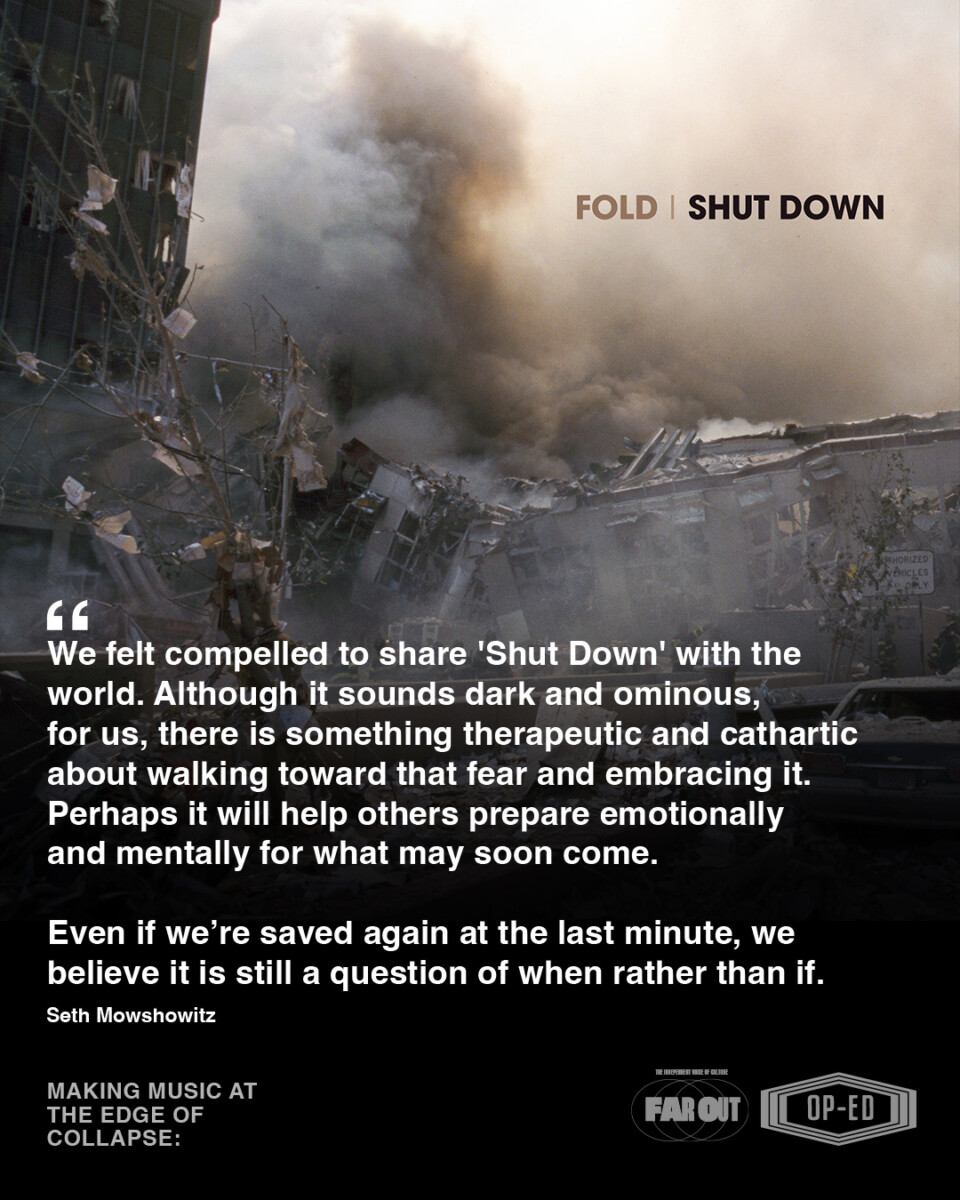
Upon hearing of this attack, a familiar sense of dread took hold in the Fold camp. Without any plan or intent, I found myself writing a piece, just a bit each day, until something emerged that reflected the ominous, dreadful feeling of being on the precipice of collapse. One morning, I played the piece back. All I could think of were Ruppert’s words. Before I knew what happened, they had placed themselves inside the music and ‘Shut Down’ was born.
We felt compelled to share ‘Shut Down’ with the world. Although it sounds dark and ominous, for us, there is something therapeutic and cathartic about walking toward that fear and embracing it. Perhaps it will help others prepare emotionally and mentally for what may soon come. Even if we’re saved again at the last minute, we believe it is still a question of when rather than if.
Despite stepping back, ‘Shut Down’ reminded us that we still have the machinery in place to respond to events with a release if we feel called upon to do so. It may not be a huge success. In fact, it could be our final release. That would be fine. If the waters recede, this tiny island we stand on may once again have enough space to move around. Hope remains.”
