


10 movies that make you question your sanity

Around 99% of the time, Hollywood wants a trip to the movies to be a journey into another world, where the Na’vi of Avatar leap out from the screen and the many superheroes of Marvel’s magical world allow you to forget, if just for a moment, about that pesky water bill, you have to pay. But this also leaves 1% of cinema to do the exact opposite, placing the audience into a state of relative insanity that makes a trip to the theatre very uncomfortable.
Surrealist filmmakers such as Alejandro Jodorowsky, Luis Buñuel and Man Ray knew this when they were in their prime, toying with the medium of cinema to take viewers on trips that were totally different from anything else being offered in the mainstream space. Such films forced viewers to reconsider what they knew about cinema and encouraged them to decode new languages of the moving image.
But there are movies that are good to watch with a cheeky space cake, and then there are films which simply provoke anxiety and question your sanity, with the following list exploring the latter. Indeed, while many of these films are spectacular visual head spinners, they also aim to pierce into the viewer’s mind and offer them a new perspective on the medium and life itself.
Starting with some more commercial surrealist picks before moving on to other films that delve deeper into the human subconscious, explore the list below.
10 movies that make you question sanity:
10. Enter the Void (Gaspar Noé, 2009)
Gaspar Noé rocked the boat with his previous feature Irréversible, and following a seven-year absence from screens, the filmmaker confirmed he’d lost none of his ability to mesmerise and traumatise viewers when the phantasmagorical was unleashed upon an unsuspecting world. Told from the perspective of Nathaniel Brown’s Oscar, his death opens the gateway to a journey that weaves through his past, present, and future, punctuated by neon-soaked visuals and ruminations on the nature of existence.
There’s nothing else like it, though, with Noé’s penchant for pushing both the boundaries and conventions of cinema to unseen extremes. Oscar isn’t just the protagonist, but the audience surrogate, and Enter the Void asks some of the biggest questions possible, manifesting the deepest fears and traumas people hold of themselves and projecting them onto the biggest possible screen to serve as more of a distorted mirror than a motion picture.
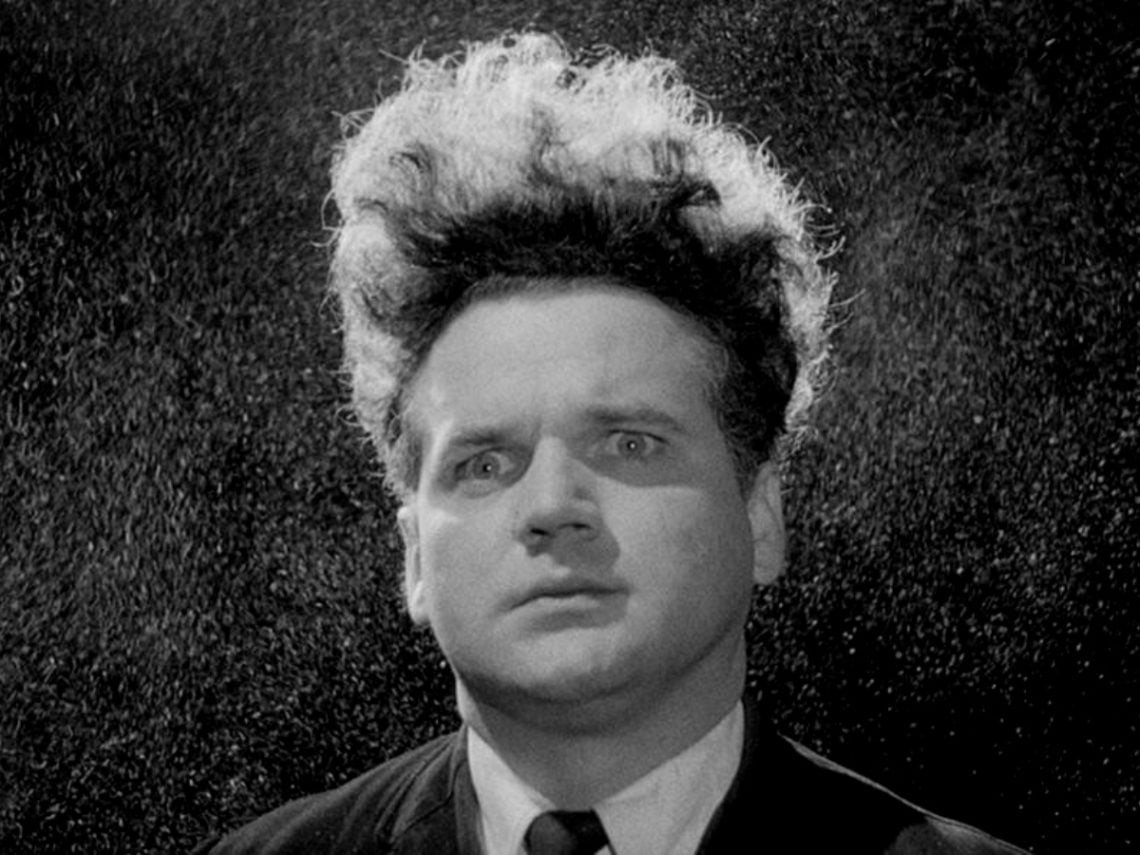
9. Eraserhead (David Lynch, 1977)
Before Lynchian was even a part of the cinematic lexicon, David Lynch displayed exactly what the term would come to mean when he wrote, directed, produced, and edited his mind-bending debut feature Eraserhead. A personal favourite of Stanley Kubrick, in Eraserhead, Jack Nance’s Henry impulsively marries the woman expecting his child, who turns out to be a perpetually crying lizard creature.
Even though he already had a child at the time, the film’s thematic ambiguities more often than not relate to the fear of fatherhood, which in this case manifests as a howling lizard baby that turns Henry’s entire world into a living nightmare. Almost every Lynch film exists in a reality of its own, but none of them have been more stark, unforgiving, and anxiety-inducing than his very first.
8. Mindgame (Masaaki Yuasa, 2004)
An experimental anime anthology that utilises different visual styles to tell its story, Masaaki Yuasa’s Mind Game tracks lovelorn Nishi as he navigates the perils of metaphysical existence after being shot in the arse and propelled into the afterlife. Stuck in limbo and forced to watch his death replayed over and over again, what follows is an eye-popping and extravagant exploration of morality, with 250 artists working to realise Yuasa’s ambitious visual of pivoting between different aesthetics in the service of doing justice to Nishi’s trip through the spiritual plane.
Evoking everything from Frank Capra to the Bible along the way, Mind Game is an enthrallingly unique examination of the near-infinite possibilities presented by every single life, digging into how the vastness of the universe has an ultimate destination for everyone regardless of how they plan on getting there.
7. Begotten (E. Elias Merhige, 1990)
Nicolas Cage is a huge fan of E. Elias Merhige’s horror film Begotten, which says everything really when the Academy Award-winning star has clearly been inhabiting a reality of his very own since the day he was born. Free from dialogue and crafted to be reminiscent of early silent films, its uniquely structured narrative begins with a figure – credited as ‘God Killing Himself’ in the credits – disembowelling himself to give rise to Mother Earth and Son of Earth, with Merhige wanting his film to look “as if it were from the time of Christ”.
Rooted deeply in biblical overtones, drenched in the occult, and representing the singular vision of a filmmaker unrestrained by the applicable rules of cinema, Begotten is a startlingly intense and endlessly intoxicating experience.
6. The Forbidden Room (Guy Maddin, Evan Johnson, 2015)
Fear is an emotion that everybody deals with differently but experiences in their own way. That’s essentially the crux of The Forbidden Room from director Guy Maddin, which dives into the origins of individual fears through the means of a submarine crew trapped underwater for months. In the movie, a mysterious woodsman appears out of nowhere, leading the gathered crew to become convinced it’s a sign their situation is nearing its end. The interlocking narrative unfolds through framing devices, segments, and stories being told on top of stories, culminating in a montage of possible endings ripped straight from ‘The Book of Climaxes’.
It sounds impenetrable, and it can be, at points, Maddin forgoes any semblance of narrative structure or adherence in favour of crafting a parable on mortality, with The Forbidden Room simultaneously meaning everything and nothing at all.
5. The Clock (Christian Marclay, 2010)
If you really want to punish yourself on a Sunday evening, why not stick to Christian Marclay’s experimental piece, The Clock, from 2010? A stunning art installation, film and genuine timepiece, The Clock is a montage of thousands of different shots from television and film, edited together to show the actual time, with Marclay using scenes from a variety of different genres and movie styles.
It also inadvertently features one of the most impressive casts ever put to film, featuring brief glimpses of the likes of Leonardo DiCaprio, Steve McQueen, Bette Davis, Marilyn Monroe, James Stewart and Sharon Stone. Even if you lose your mind while watching the film, you can take solace in the fact that you will never lose your sense of time.
4. Decasia (Bill Morrison, 2003)
From one movie that toys with the medium of cinema to another, Bill Morrison’s Decasia is a study on the natural decomposition and decay of celluloid film. An extraordinary piece of cinema that is far more engrossing than it may sound, Decasia is a haunting film that asks the viewer to look into the ephemerality of life and film’s ability to transcend time, space and mortality entirely.
There is something deeply disturbing about it all, but also something absorbing and even serene, speaking to the steady march of time that consumes everything without prejudice. Watch the non-narrative film too intently, and you might just lose yourself in the picture.
3. The 5,000 Fingers of Dr. T. (Roy Rowland, 1953)
Taking a break from straight experimental cinema to focus, instead, on something far more joyously bonkers, The 5,000 Fingers of Dr. T. by Roy Rowland is a true oddity. The only movie entirely conceived by the iconic Cat in the Hat writer Dr. Seuss, this bizarre flick tells the story of a young boy who dreams of an imaginary world where he must save a bunch of other children and genius pianists from an oppressive music teacher.
A phantasmagorical technicolour fantasy musical, Seuss’ only movie makes the cut thanks to the sheer audacity of its creation, sharing little similarity with any other Hollywood movie in its size, scale and scintillating appearance.
2. Dementia (John Parker, 1955)
In banning John Parker’s Dementia from distribution, the New York State Film Board called the film “inhuman, indecent, and the quintessence of gruesomeness,” undoubtedly only rallying hundreds of people across the city to find a copy as quickly as possible. An ingenious movie that combined elements of horror and film noir, Dementia told the story of a psychotic woman’s nightmarish night in Downtown LA with no dialogue at all.
Impressionistic and utterly psychedelic, the film is truly a nightmare brought to life that also protests against the violence towards women in a patriarchal society. So influential was the movie it was later immortalised in the much more popular 1958 movie The Blob.
1. Clean, Shaven (Lodge Kerrigan, 1993)
What better movie to make you question your sanity than the psychological drama Clean, Shaven by director Lodge Kerrigan? Pulsating with intensity, the film places the viewer inside the mind of a man with schizophrenia as he attempts to make sense of his life after being released from a mental institution. Struggling to stay sane, he desperately searches for his lost daughter, with the audience immediately understanding the struggles of the very real mental health condition.
As well as a deeply distressing film, Clean, Shaven is a well-constructed emotional drama that the director makes more difficult to digest by adding grainy visuals and constant background noise. At 80 minutes long, Clean, Shaven might be a tricky watch, but it is also hugely rewarding for anyone hardy enough to last through its turmoil.
