


10 essential films from the “non-narrative” genre

When conventional film narratives are discussed, the word “plot” gets thrown around a lot and is often considered by many to be integral to the cinematic experience. Others insist that cinema, since it is a visual medium, can eliminate such literary banalities by reimagining the very definition of what a narrative can be. By presenting unique images instead of verbal discourses, “non-narrative” films transcend the limitations of cinematic conventions and highlight the true potential of the medium.
One of the pioneers of the genre, James Benning said: “My films are an antidote to consumerism. They’re made as cheaply as possible—most of the time for less than twenty thousand dollars—and they’re not about consuming more; they’re about seeing and hearing more of what’s already around you. I don’t work to transform my films into consumer products. You can’t buy DVDs of my films, and while the films do tend to pay for themselves, they’re certainly not making me wealthy.”
Adding, “As for audience, this new strategy is asking them to work harder; you can’t experience something subtle if you don’t look more closely than we’re accustomed to looking, and looking more closely isn’t easy. At first I was worried that audiences would be bored, but the contrary seems to be true. These films have been successful with many different audiences.”
In this edition of our weekly spotlight on world cinema, we take a look at 10 examples of cinematic art from the non-narrative genre in order to get a better understanding of their unique sensibilities.
10 essential non-narrative films:
Man with a Movie Camera (Dziga Vertov – 1929)
One of the most influential documentaries ever made, Dziga Vertov’s seminal Man with a Movie Camera is a brilliant chronicle of life during the Soviet regime. The film features a range of visual narrative techniques used to this day, including freeze frames and slow motion.
“The idea for The Man with a Movie Camera had already arisen in 1924,” cinematographer Mikhail Kaufman revealed. “How did this idea take shape? Strictly speaking, we needed a Kino-theory and a Kino-program in cinematic form. I suggested such an idea to Vertov, but it could not be realised at that time.”
Dog Star Man (Stan Brakhage – 1964)
Brakhage’s acclaimed series of experimental shorts is an exercise in avant-garde filmmaking, consisting of mystical imagery and the disruption of aesthetic norms. Dog Star Man constructs a surreal experience with the help of a fairly simple premise: a man climbing a mountain with his dog.
In an interview, Brakhage reflected, “I wasn’t trying to invent new ways of being a filmmaker; that was just a by-product of my struggle to come to a sense of sight. And it seemed reasonable to me that film ought to be based on human seeing, and not just the physical eyes but the mind’s eye: that is, what happens when the eye receives images from the outside and how they interrelate with remembered images on the inside of the mind. How do we arrive at our seeing and then imagine with our sight?”
The Falls (Peter Greenaway – 1980)
Presented as a mockumentary, Greenaway’s first-ever feature film records the accounts of various people who have been affected by something known as the “Violent Unknown Event”. The bizarre consequences of this unprecedented event lend a delightfully absurdist undertone to The Falls.
“I think it’s always been a limitation of cinema, this idea that it only shows you one image at a time. When you look at the world you don’t see one image at a time, and certainly not through a frame,” Greenaway once said. “So, I think cinema should find an equivalent for that multi-variability of attitudes towards seeing and looking.”
Koyaanisqatsi (Godfrey Reggio – 1982)
The first addition to Reggio’s trilogy, Koyaanisqatsi is visual poetry at its finest. It is a striking reflection that is contextualised within the constructs of modernity, examining how the advance of our technological developments have changed the world forever.
Reggio revealed: “It was explained to me that the term qatsi means ‘life.’ In its compound form, qatsi means ‘way of life.’ In fact, the Hopi language is so rich it can really make our language limp when it comes to explanations for things. This term meant ‘crazy life, life out of balance, life in turmoil, a way of life that calls for another way of living.’ I’m sure there are many other meanings, but since I was presenting this to white people, not Hopis, I used a dictionary form.”
Blue (Derek Jarman – 1993)
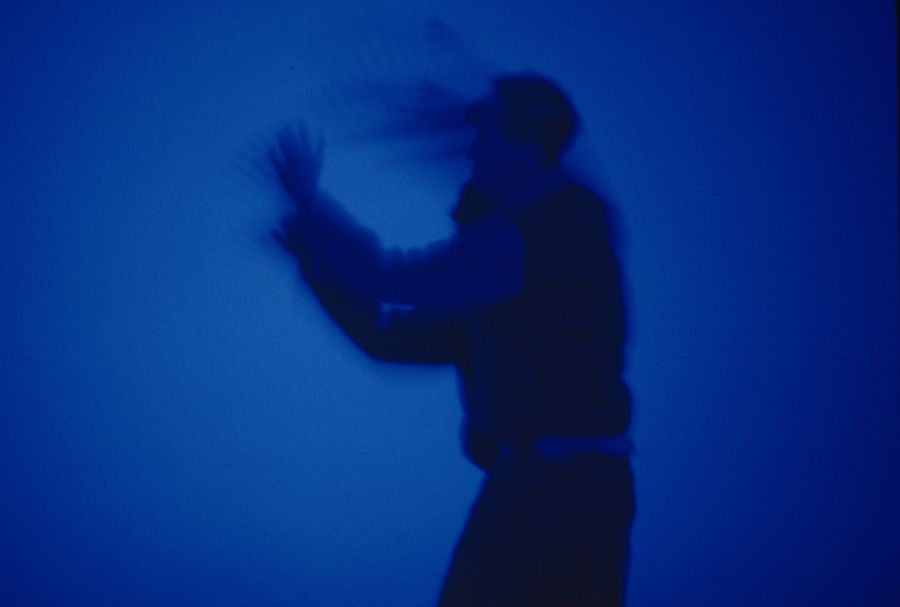
Derek Jarman‘s 1993 magnum opus was the final feature of his career before his death due to complications caused by his battle with AIDS. Through this experimental film, Jarman manages to translate his experience to the cinematic medium by framing how he saw the world when he was dying: in shades of blue.
Jarman explained, “I wanted to convey some of what I’d seen, and the disaster of which I’ve been living through of the last few years. I mean for instance, last Thursday, I was in the hospital, and there was a mom with a two-year-old child who’s got the same infection in the eyes as I have, I couldn’t…
“I sat and watched as I waited, it was just quite terrible, honestly, you know, I was thinking of this child, you know, that’s all happening and people don’t see it, and they don’t think about it very often, and I hope the film sort of makes people think about that just for a moment.”
Decasia (Bill Morrison – 2002)
Bill Morrison’s 2002 montage film is an impressive cinematic exploration of the concepts of entropy and mortality. Featuring segments from archival footage of old films, Morrison presents decaying images to us in an attempt to perforate and deconstruct the grandeur of the spectacle of cinema.
Morrison elaborated in an interview: “Throughout my career, I have made films that have told stories woven out of the bits and pieces of many films taken from many different archives… Whether you would categorise these films as documentary, narrative, or other, for these particular titles, I was in the archive hunting for certain images to get from point A to point B, to tell a story.”
Adding, “I feel I have evolved in the sense that I have more confidence that I can tell more and more complex and layered stories using archival sources—that the images are out there waiting for me, and if I listen to them they will guide me, if the story lends itself to being told that way.”
Bodysong (Simon Pummell – 2003)
Bodysong is an ambitious project which traces the trajectory of human life from the beginning to the very end, capturing the fundamental truths about the existence of our species. With haunting images of violence and death, Pummell’s examination of the human condition is an unforgettable experience.
“One dream starting point was that I wanted to make a film I could show to anyone, and they would recognise something of themselves,” the filmmaker commented. “The other dream starting point was to compose a new perspective for the audience. What has come to be about making a pretty picture was originally about moving things forward and backward in the narrative, and juxtaposing elements in ways that heightened their narrative relevance—and that is what Bodysong does.”
13 Lakes (James Benning – 2004)
One of Benning’s most simple yet challenging works, the concept of 13 Lakes is self-evident. In it, he invites the audience to surrender themselves to the images of lakes as he eliminates the usual tendencies of the voyeuristic process by achieving minimalistic sublimity.
While talking about the film, Benning said: “I wanted the frame to include the same basic information for each of the thirteen shots—that is, half sky and half water. But the real problem was to find a frame that would reveal the uniqueness of each lake.”
He added, “I find each frame in a purely visual way—considering symmetry, negative space, meaning, colour, texture, balance… By not using language, I can communicate with myself much more efficiently. It’s not intuitive but rather a kind of fast thinking based on years of experience.”
Samsara (Ron Fricke – 2011)
Shot in 25 countries over the course of five years, Fricke’s monumental work tries to recreate the entire spectrum of human existence within the framework of the film. Samsara is Fricke’s cinematic meditation on the spirituality that is embedded into the layers of the world, oscillating between the ancient and the modern.
“We’re spiritually orientated so it’s wanting to express the inner connection of things. We’ve all been invited to this planet, and life’s the host and didn’t ask anybody to approve of the guest list. Showing that. That’s what Samsara’s about – showing the flow,” Fricke stated.
Homo Sapiens (Nikolaus Geyrhalter – 2016)
A modern masterpiece, Homo Sapiens is a revelatory look at a post-human world that is marked by the crumbling decadence of a dead civilisation. With the use of dystopian imagery, Geyrhalter imagines what our planet would look like after we disappear along with our unfulfilled ambitions and leave behind only the evidence of our arrogance.
The filmmaker said: “I wouldn’t really describe Homo Sapiens as a documentary film. It’s a film. The film industry and film festivals need categorisation. In this case it only partly applies, in my view. The film may perhaps be rather closer to a documentary film than a feature film. But one reason why I consider Homo Sapiens a very fictional production is that we intervened a lot and changed a lot.
“The trees, the buildings and even the wind were almost like actors for me. It wasn’t my intention at any time to depict a documentary reality here. For me it’s a vision which is closer to fiction. The documentary aspect of the film is the fact that the buildings and landscapes can be found now, in the present day, or at least could be until they were pulled down.”
