


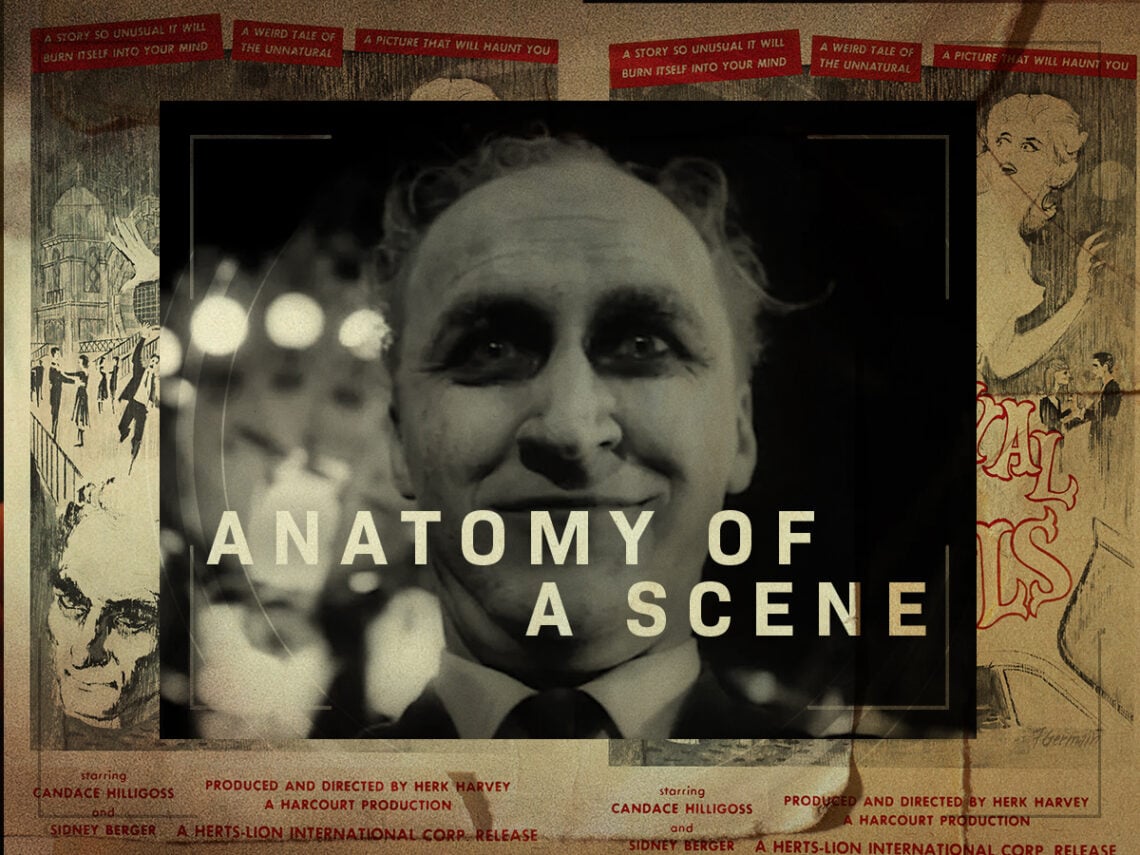
Anatomy of a Scene: the world goes silent in Herk Harvey’s ‘Carnival of Souls’

It’s a tragedy rarely discussed when, after watching a great film, you discover that the director has made no other movies. From Barbara Loden with Wanda to Charles Laughton with The Night of the Hunter, some of the greatest movies of all time have been created by someone with no prior – and no subsequent – experience as a filmmaker. Then there’s Herk Harvey, whose career was largely made up of educational and documentary films for Centron Corporation before he made his one and only fictional feature, 1962’s Carnival of Souls.
It’s an incredible film, both visually and thematically, with Harvey working on a miniscule budget of $33,000 yet creating a movie that looks timelessly beautiful. At the beginning of the film, shot in very atmospheric black-and-white, we see a group of young women challenged to a car race by a group of young men, leading the women’s car to crash into the side of a bridge and topple into the water below. Then, emerging from the water sometime later is Mary, confused and startled.
After the incident, Mary moves away and becomes a church pianist, despite her lack of religious beliefs. However, it’s not long until she begins seeing a terrifying man following her around, his face – white and emotionless – appearing at her window or at the bottom of the stairs. She is haunted by the man, whose appearance in her life is seemingly relentless, like her new neighbour, John Linden, who continuously pesters her for attention.
Mary’s condition is reflective of someone suffering from several mental illnesses – she is anxious, scared to be alone despite isolating herself from others, and paranoid. The trauma from her experience of the crash manifests in these strange ways, but really, the crash is just a stand-in for trauma as a concept. Her consistently terrifying or uncomfortable encounters with men throughout the film suggest that the car crash (caused by a group of men) could reflect sexual violence or repression, but the film lets the audience interpret Mary’s condition however it resonates most.
Perhaps the car crash represents Mary’s deteriorating mental health for reasons untold to the audience – the cause doesn’t really matter. What does matter is the film’s rather groundbreaking exploration of female mental health issues, which takes into account her struggles without merely painting her as hysterical. Whenever Mary sees the man, it is as though she is coming face to face with her fears and anxieties, looming over her without resistance. She can’t seem to trust anyone throughout the film because she is so overly cautious and scared, and the film explores just how isolating mental illness can be – especially when it feels like you just want to hide from the world.
This brings us to one of the movie’s standout scenes, one that seems to define the movie’s exploration of mental health issues most succinctly. It begins when Mary goes to a department store to try on some new outfits, then heads to the changing rooms and begins undressing. Once she’s down to her slip, a ripple effect washes over the screen, and Mary suddenly becomes incredibly alert. The panic sets in as she looks around, and a shrill piece of music plays over the scene, conveying a sense of anxiety. She quickly gets herself dressed and exits the changing room to talk to an employee about a purchase, only to realise that the world has gone silent and she is invisible.
The woman ignores her, continuing to look through the racks before going to serve another customer, much to Mary’s confusion. She stands right behind another woman and says, “What’s the matter with everyone? Why don’t they answer me?” As the unnerving music continues, it becomes clear that everything around Mary is just a silent blur, people might as well be aliens and her surroundings a foreign place. When she exits the building, even the heavy drilling outside is silent, leading Mary to walk towards a green space where her grasping of a tree brings everything back to normal.
For those familiar with derealisation – something that can occur when you feel incredibly anxious, leaving your surroundings feeling unreal and as though you’re not truly there – this scene accurately represents this hardly talked-about phenomenon. In these moments of high anxiety, everything can look a little different, and suddenly, all that you can hear are your own thoughts, drowning out the sound of everything else. You feel invisible, as though you’re an alien walking among normal people, trying to search for a sense of stability and a way out of the situation. This strange episode that Mary has is only remedied when she grounds herself in the natural world, away from people and artificial noises.
While Harvey likely didn’t intend to capture one of anxiety’s most stressful forms of manifestation in his film, for many, this scene reflects something that can be hard to articulate. Many viewers might come to relate to Mary, whose attempts to live a normal life are complicated by her inability to navigate the world without paranoia. The movie ends with a plot twist that technically negates this reading, instead revealing that Mary actually died at the beginning and has been stuck on the threshold between life and death for most of the film, with The Man representing death itself attempting to collect her.
Yet, films can take on whatever meaning the audience comes to resonate with, and for many, Carnival of Souls is a story of mental purgatory. People come and go, but Mary is stuck, mentally unable to move forward from the feelings of trauma, anxiety, and mental instability she suffers from.
