


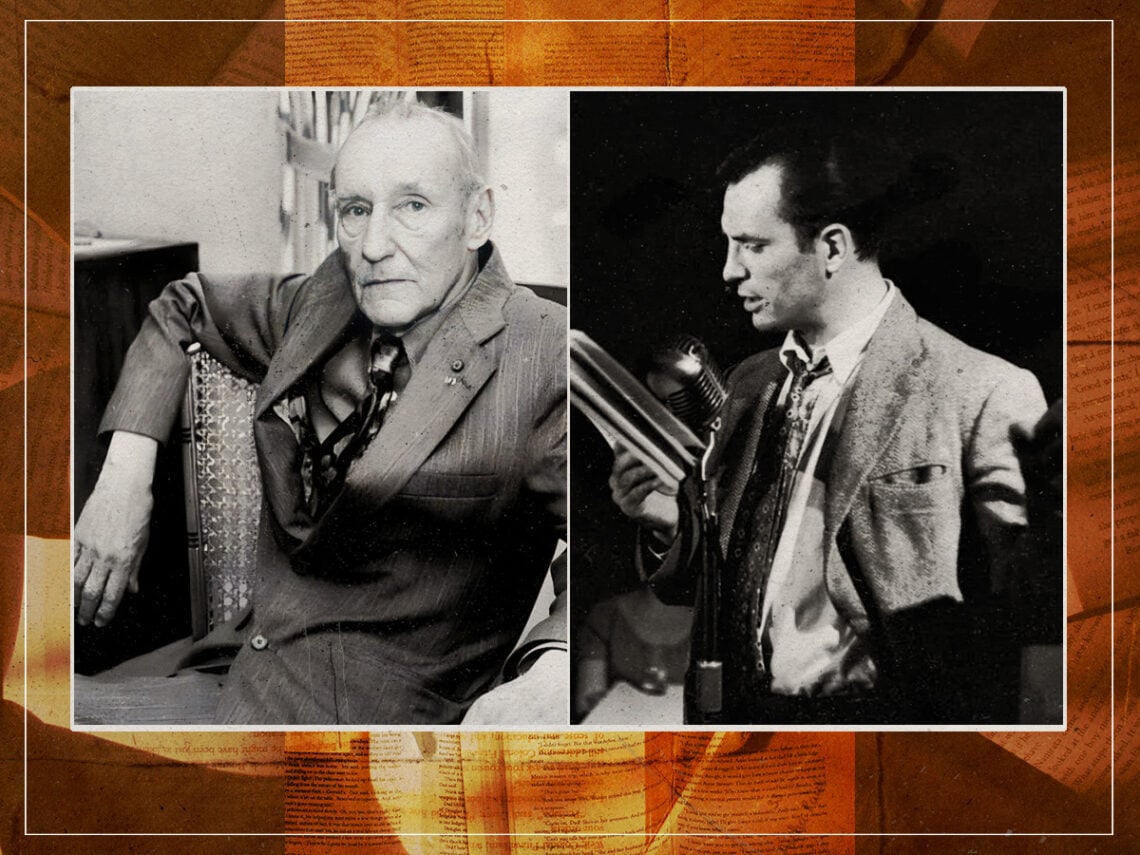
“Unprecedented”: why William S. Burroughs pins the Beat Revolution on Jack Kerouac

All scenes and movements have to start somewhere. No cultural phenomenon has ever exploded out of nowhere, but sometimes, the tiniest spark starts the whole thing up. When it comes to the Beat Generation, a crowd of writers who ripped up the rule book and changed literature forever, that spark can be traced back to a university room where Jack Kerouac sat.
The Beats were born out of a tight cast who all found themselves at Columbia University in New York. Those inclined would claim it to be fated as the writers landed in the same room through a series of kismet moments. Allen Ginsberg had joined the Merchant Navy while in New Jersey to try and fund his education, eventually getting himself there. Lucien Carr, while still just a kid, happened to meet a teacher who happened to be childhood friends with William S. Burroughs, inspiring him to become a writer. Jack Kerouac only got into the school through a football scholarship.
But when they were all there, the writers gravitated towards one another, all sharing the belief that it was time for a “New Vision”, a term they borrowed from Yeats. All were interested in casting off form and tradition, desiring to try something more daring with their work. As they attended classes and met up afterwards to share drafts and ideas, their friendship birthed the Beat Generation.
All of them would create landmark works that would not only define the movement but redefine American literature. However, according to William S. Burroughs, it was Kerouac who sat at the centre as the catalyst and king. To him, Kerouac is the only one who can be credited as the originator.
“He started a cultural revolution of unprecedented worldwide extent,” Burroughs said of the writer. It seems like an odd call, especially considering that Burroughs himself was eight years older and had already released his own major Beat work, Junkie, before Kerouac’s essential text On The Road was published.
From that debut text in 1953, Burroughs was already playing around with all the features that would become standard tropes of the movement: utilising unreliable narration and non-linear plots and starting to form the cut-up technique that would become his signature. While Junkie sees these ideas in their infancy, the seeds are certainly there.
But still, Burroughs puts the onus on Kerouac’s shoulders, whether he would have agreed or not. “He didn’t acknowledge it, but he was one of the people instrumental in starting it, the whole Beat movement, which has become a worldwide cultural revolution,” he said. “There’s never been anything like it before.”
Perhaps he credits Kerouac simply because he was one of the first in the group, with him, Ginsberg, Carr, and Hal Chase being the first to meet at Columbia before being introduced to Burroughs and beyond. Alternatively, it could be because Kerouac was the one to actually coin the term ‘Beat Generation’ in 1948 after a conversation with fellow poet Herbert Huncke.
However, it could also be due to the fact that Kerouac undeniably played a major role in elevating the movement from a localised group of friends into a global phenomenon. While texts like Ginsberg’s Howl or Burroughs’ Naked Lunch were important, they’re niche and tricky. They’re experimental to a far greater degree, demanding to be read with an active analytical mind and dedication to surrendering to the strangeness of the Beats.
They were also wrapped up in censorship issues, making them even harder to engage with as they were hard to get a hold of. On the flip side, On The Road took the very idea of the ‘Great American Novel’ and flipped it on his head. His road-tripping book has the makeup of a recognisable and respected thing, but by morphing it into something altogether different through his writing style, he welcomed hoards of readers into their world. In that way, On The Road has become the best-known Beat Generation text and perhaps the most essential entry on the reading list for the movement.
According to Burroughs, Kerouac would never have admitted to his world-changing role in literature, but the proof is in the works. “He started it,” Burroughs declared, “Jesus Christ said, ‘By their fruits you shall know them,’ not by their disclaimers.”
