


Who coined the term ‘Britpop’?

“Every TV show, every radio station, every T-shirt. It’s all anybody wanted to talk about: Britpop, Britpop, Britpop, Britpop,” Skunk Anansie’s Skin once said. In the 1990s, there was one word on everyone’s lips. It was a cultural phenomenon, turning Britishness into a new kind of cool cultural currency. But where did the word ‘Britpop’ actually come from?
Like all words, it now feels like there could be no other way to describe or label Britpop than with that term itself. It’s a perfect phrase, seeming to capture the movement sharply in two catch syllables. As a cultural moment, the era was firmly rooted in Englishness and its various codified images and aesthetics. British designer Fred Perry became the uniform as the look of the moment was all pints, old school pubs, local town sites and a take on the 1960s mod look, modernised with the energy of the decade and looming new millennia. In every way, Britpop was British, not only in the bands involved but in every level of the aesthetic.
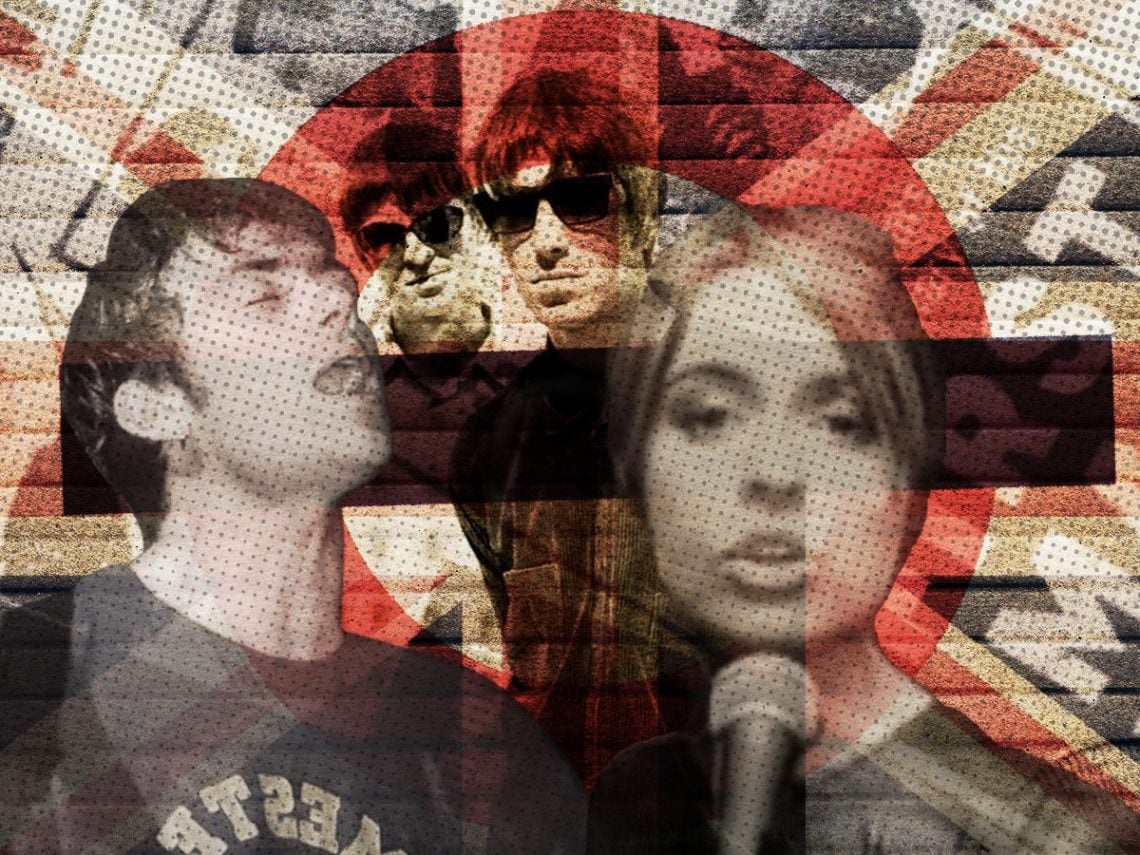
But it was also pop. Even though Britpop bands like Blur, Oasis, Suede, Pulp and others would more likely be levelled as rock acts, there was a distinct poppiness to all their output and the imagery surrounding them. The songs were catchy and crafted for big singalong moments like all good pop songs are. They were on repeat across the radio stations as the UK adopted the bands and their songs as new national anthems in a way that is mostly seen with pop art forms. The Union Jack became an image in pop culture again as figures like Suede’s Brett Anderson were plastered on magazine covers with the flag behind them. It was a fashion statement that perfectly suited the deeply British sound of their musical outputs, putting the Brit right there in pop culture.
The question of what Britpop actually meant and who started it, in terms of the era and its energy, is a rabbit hole of a question. Some argue it began with Blur’s 1992 single ‘Popscene’, while others assign its origin to Suede’s emergence with ‘The Drowners’.
However, in the years that have passed, Anderson has distanced himself from that label and the movement as a whole as he told the BBC, “I disassociated myself from that very early on, as soon as I saw what I saw as becoming this kind of laddish, jingoistic, cartoon happening, which became Britpop, I very quickly distanced Suede from that.” But whether he likes it or not, Suede are a vital part of the era’s soundtrack, being just as vital to its output as Oasis and Blur were during their 1995 Battle of Britpop, where the term was headline news.
Who coined the term ‘Britpop’?
The question of where the word ‘Britpop’ came from is a contested one, too. It’s said that BBC radio DJ Stuart Maconie was the first to spark the term’s broad use in media. It had been brewing as people attempted to pin down a neat word for the new musical sound, throwing around phrases like “lion pop” in reference to the coat of arms. But Maconie first used “Britpop” in 1993, and it stuck.
However, he claims it was actually used back in the 1960s to describe the original British invasion with bands like The Beatles and The Rolling Stones. Bringing the phrase back seemed, to him, to be the perfect way of describing this fresh wave of British acts storming to success or even British artists like Damien Hirst rising to the top of the culture sphere.
But John Robb, who was a member of the 1980s punk back The Membranes as well as a music journalist, claims he used the term in the late ‘80s to describe that era of groups like The Stone Roses or The La’s. Now, they’d all fall under the Madchester scene, so maybe that’s why it didn’t stick then.
Either way, no matter what the etymology of the term is, ‘Britpop’ is the perfect phrase for the hard-to-define era.
