


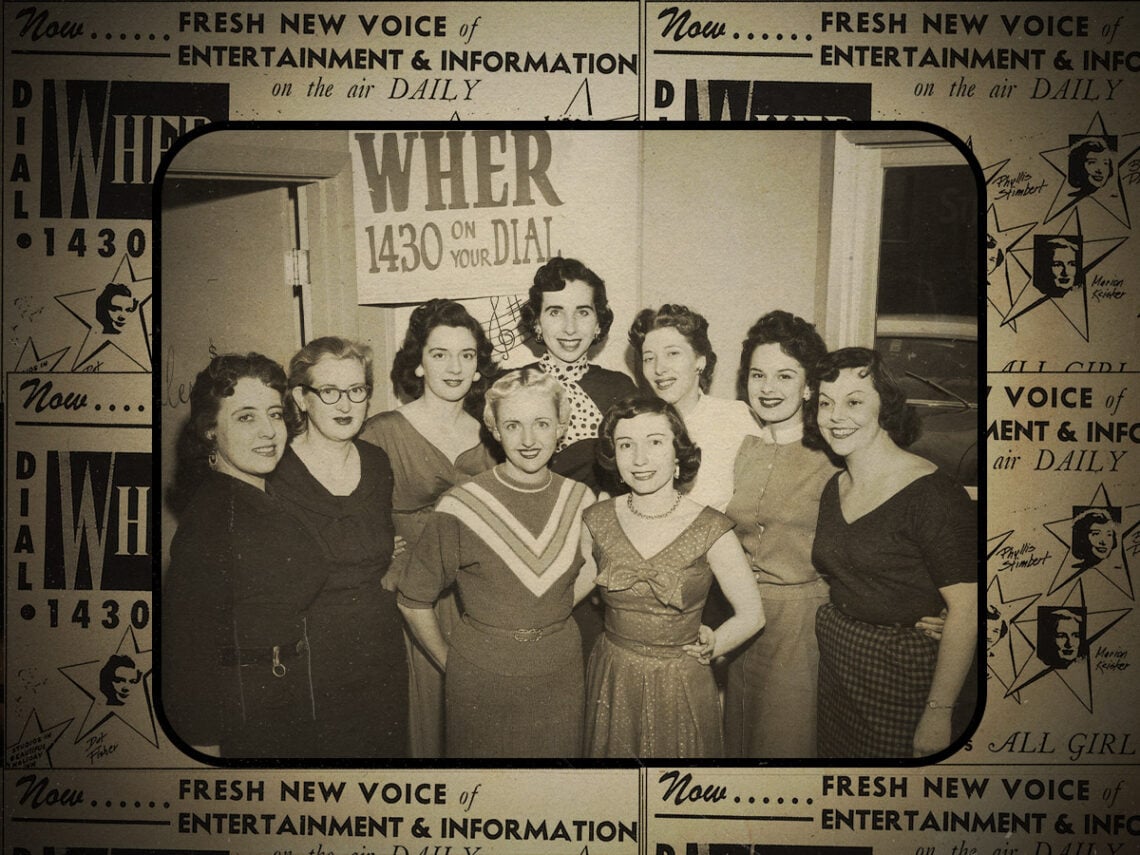
WHER: The all-female radio station from 1955

When you think of women in the 1950s, it’s probably not the most powerful and progressive image that comes to mind.
The tropes of housewives and sexism are what we all know, and indeed, have been conditioned to believe in an arc of female history that makes it look like the past is the past and the landscape we have now is night and day in comparison. That argument can be left for another day, but it’s the ‘50s that are the real area of interest here.
Think about it: all of the stories we’re told about women in the era confine them only to the kitchen, the home, and looking after the children. And while this wouldn’t be wrong in many cases, it also does a disservice to the female fraternity out there, who were genuinely making bold and revolutionary changes.
Just one of those examples was WHER, the first-ever American all-female radio station. Do you want to know the even better part? It was all funded thanks to Elvis Presley. Yes, the ‘King of Rock and Roll’, who was also known as the king of treating women like absolute dirt, was ironically the one to inadvertently start a liberation movement.
Well, more accurately, it was Sam Phillips, the founder of the Sun Records label, who helped to catapult his career, along with the likes of a litany of others, including Johnny Cash, Roy Orbison, and Carl Perkins. But as the label’s success with Presley soared and the wads of cash rolled in for Phillips by proxy, he knew he had to do something.
As such, WHER was his brainchild as he had a fascination with the radio, and what it would be like to pass women the microphone. His wife, Becky, was one of the first DJs to present live on the station, and everything was a female-led affair, from working in the studio to going behind the scenes as a sound engineer.
It sounds like a forward-thinking feminist utopia, doesn’t it? Well, not so fast. The studio that WHER broadcast from was dubbed ‘The Doll Bin’, painted pink and purple with bras and underwear hanging from a clothesline on the wall. The station’s slogan catchphrase was “1000 Beautiful Watts”. Yikes.


It may not be the most politically correct thing in the context of this day and age, but the fact remained that WHER went further for women than most other outlets did at the time, particularly in music. The fact that it was all brought to life using funds generated by the ‘King of Rock and Roll’ made it sweeter, as if it were somehow discreetly resetting the patriarchy.
For his passion on that front, Phillips deserved to be celebrated. He took a chance where no one else would, and gave women the opportunity for their voices to be heard. The true sense of revolution in that cannot be understated. But let’s leave the last thought to the real masterminds themselves. To Becky and all the rest of the WHER women, you paved the way forward.
