


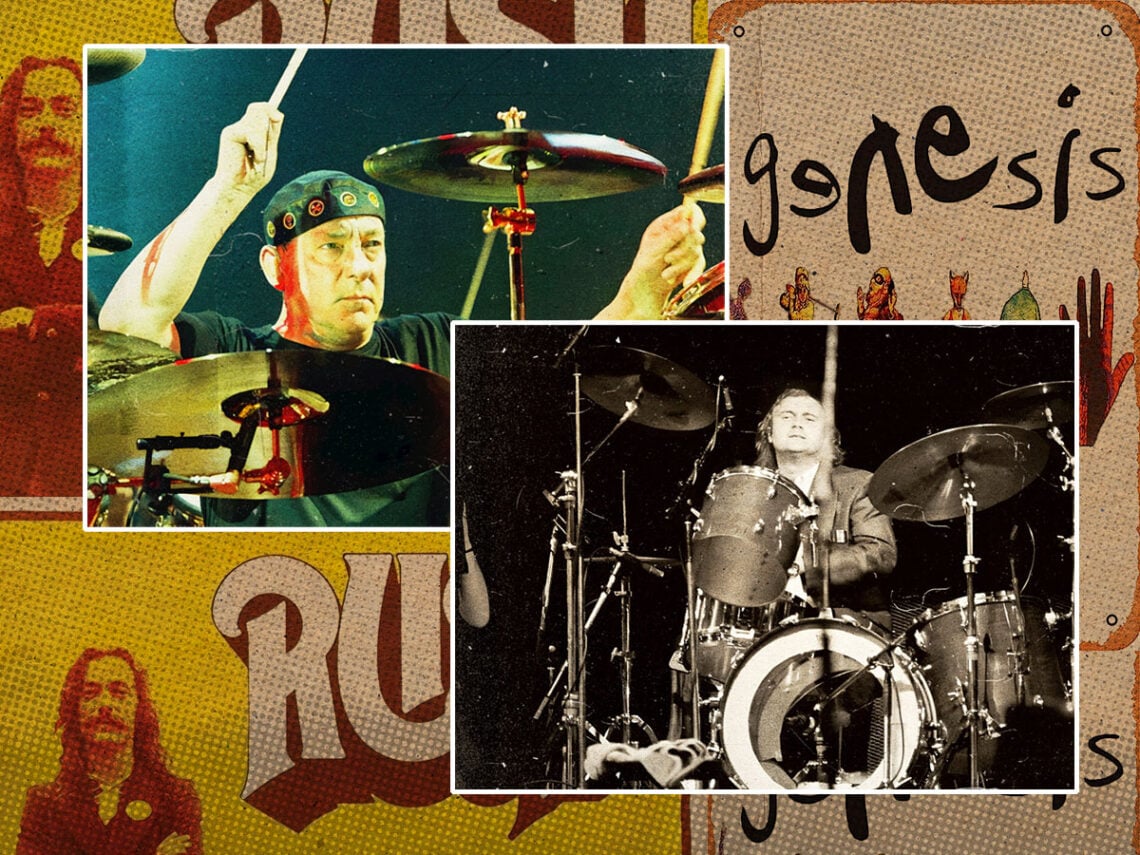
When Neil Peart met Phil Collins: “a murmur went through the room”

The playing style of Rush drummer Neil Peart is so distinctive that it’s sometimes hard to think of anyone informing his approach. Peart’s sound was instantly recognisable and unique to him, incorporating elements of his personality, including his humour and studiousness. But just like every other musician, Peart was picking up tricks and tips from his heroes and contemporaries along the way.
One of the most unexpected drummers to have a massive impact on Peart was Genesis drummer Phil Collins. “Phil Collins was an enormous influence on my drumming in the 1970s. Thus remains a part of my playing even today,” Peart told Rhythm Magazine in 2011. “His recorded drum parts with Genesis and Brand X in those years were technically accomplished, yet so musical – even lyrical. (Also) his rhythmic patterns were woven into the intricacy of the music. While lending a smooth, fluid pulse to the songs and extended instrumentals.”
“His fills were imaginative and exciting, alive with energy and variety, while the refined technique was always in the service of the music,” Peart gushed about Collins. “Even within those fills, Phil applied a jazz drummer’s sense of dynamics. Which also guided his ensemble playing and inspired me to try to incorporate that sensibility into my own triple-f approach.”
“Plus, his drums sounded so good. Good-sounding drums are always the result of a good-sounding drummer and speak of the player’s touch,” Peart explained. “Phil’s combination of that quality and the natural drive of his playing produced truly melodic-sounding drum parts – flowing and musical. One outstanding piece of work that reflected all of those qualities was the Genesis album Selling England By The Pound, from ’73.”
Peart was notoriously shy and took great pains not to be perturbed outside the safe confines of Rush’s live shows. It makes sense, then, that Peart had only briefly met Collins in person. Both times, Peart never actually talked to the Genesis frontman but rather allowed Collins some undisturbed privacy.
“I find it amusing that despite not meeting ‘formally’, Phil and I have actually encountered each other face-to-face, unknown to him, on two occasions, almost 20 years apart,” Peart writes. “In the late ’70s, I was recording with Rush in London. One day (I) popped into a science-fiction bookstore in Soho called Dark They Were And Golden Eyed. At the door, I stood back to hold it for another patron, a bearded little guy in a flat cap and overcoat, on his way out.”
“Our eyes met for a moment, we nodded courteously,” Peart adds. “I recognised Phil in his hirsute ‘Artful Dodger’ period, just before he was thrust into the frontman position with Genesis that would so change his life. From modestly successful drummer to immense international popstar.”
Two decades later, Peart and Collins crossed paths again. “In the mid-90s, I was in Geneva, Switzerland, with my friend Brutus, at the end of a motorcycle journey that had taken us from Munich down through Italy to Tunisia and into the Sahara. Brutus and I had survived some harrowing adventures before finally arriving at the Hotel du Rhone in Geneva, so we were feeling extremely fortunate just to be there – and to be revelling in an incredible dinner of European haute cuisine.”
“A murmur went through the room, and Brutus and I turned to see Phil Collins being seated just behind us. I believe he was performing at the nearby Montreux Jazz Festival,” Peart said. “I felt no need to impose upon his evening, and my own evening was already full; Brutus and me sharing a journey’s end combination of exaltation and relief. But I smiled to myself at the coincidence.”
“In any case, it seems to me that when someone you have long admired becomes so enormously popular that his arrival sends a murmur through a high-class restaurant, you can’t help but feel a kind of personal pride,” Peart beamed with amusement. “‘Why, I remember Phil Collins when he was just a drummer.'”
