


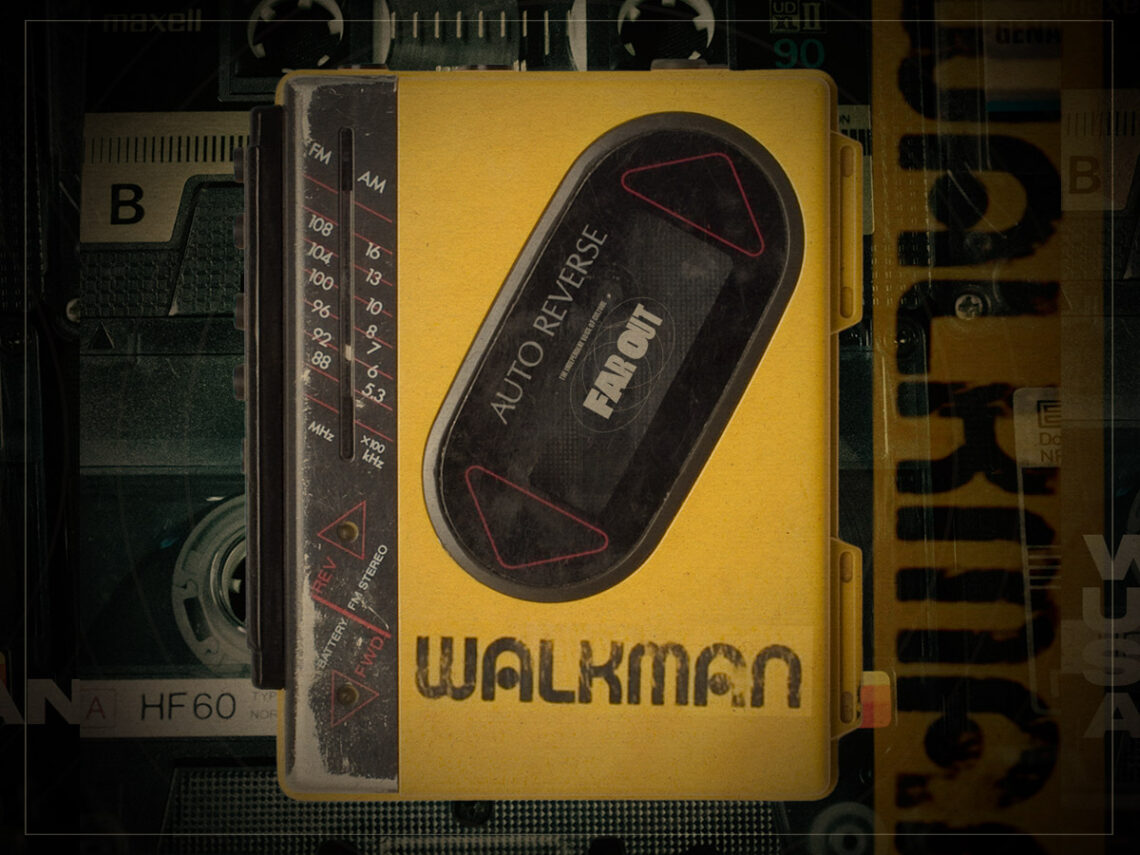
What is the ultimate Sony Walkman album?

First debuted in 1974, the Walkman rose to popularity in the synthesised wave of the 1980s.
The audio player’s compact design proved perfect for listening on the go, revolutionising the way consumers listened to music forever. Before, music listening was largely a solitary act, confined to one’s home radio and vinyl turntables. The Walkman was an assertion of independence, particularly for young music fans. The invention opened the doors to an entirely new consumer market, one that thrived on the interests of young people and redefined the means of mass music consumption.
Further, both cassettes and the Walkman introduced a smaller form of physical media and liberated recorded music. Just the sheer thought of being able to walk outside, headphones on, and listen to something other than one’s own inner monologue was thrilling. Whether you were on a plane, walking to school or wandering around the mall, the Walkman could transport you elsewhere; a form of travel, without having to go very far.
In the 1980s, over 100million Walkmans were sold worldwide; by 1995, 150m units were produced, and, at the end of the decade, a total of 186m cassette Walkmans were sold. An unfathomable phenomenon, it saw, for the first time, people ubiquitously wearing headphones in public, adding a layer to the personalised listening experience. By no means was the Walkman “perfect”: compared to today’s technologies, a Walkman’s quality was lacklustre. A cassette tape was always at risk of unravelling, and the device’s headphones were miniature in size, producing an audio quality that somewhat minimised a song’s true sound. But, for a time, the Walkman was handheld perfection, beauty in the eyes (and ears) of the beholder.
While the 1980s were dominated by pop music, the highest-selling album being Michael Jackson’s Thriller, the Walkman was the perfect music listening format for a slower subgenre of music: lo-fi. “Low fidelity” music was not necessarily intentional; rather, it sprang from a DIY ethos that produced a more mellowed sound. Like the Walkman, lo-fi embraced the qualities that most regarded as “unfavourable,” like the sound of tape whirring or the beat skipping once or twice. While its roots can be traced to 1950s rock ‘n’ roll, lo-fi became closely tied with cassette culture in the 1980s, as though the subgenre and its listening experience were a match made in heaven.
So, what was the perfect Walkman album?
Lo-fi music was pioneered by one man who recorded full-length albums on reel-to-reel tape in his parents’ basement in Tennessee. Starting his musical career in 1968, R Stevie Moore would not see his music published on a proper record label until 1976’s Phonography. The album made its rounds among New York’s punk and new wave circles and became a pivotal predecessor to the Walkman’s boom.
Lo-fi held to its roots, and when the Walkman’s cousin, the compact disc player, was introduced in 1984, the genre continued to lean on the cassette tape. In the early 1990s, “indie” music circulated, growing from its literal meaning of being produced outside of a major record label and instead, defining a new style that existed somewhere between pop and rock.
Welsh post-punk rockers released their sole studio album, Colossal Youth, on a self-recorded cassette tape in 1970, before its release on Rough Trade Records the year after. Later indie darlings Pavement achieved damn-near cult-like status with their debut album Slanted and Enchanted. Initially, the California natives spread their recordings themselves via cassette tape before receiving a commercial release in 1992. Known for its imperfect recording quality, the collection remains a fan favourite.
The defining album of the Sony Walkman era, however, would soundtrack American lo-fi forever. REM’s Murmur, released in 1983, was produced with a strict emphasis on raw, natural sound. As producer Don Dixon stated in Peter Hogan’s The Complete Guide to the Music of REM: “We felt like our job was to, as cheaply as possible, reproduce what appeared to be just them playing live.” Murmur was the product of years of playing live around their native Georgia and across the Southern United States.
Their previous releases favoured a pop-rock sensibility. Their debut, on the other hand, was more grounded and stripped back. It sounds like REM could have recorded it themselves, in their own goddamn bedroom, with Michael Stipe’s mumbled vocals and guitarist Peter Buck’s atmospheric instrumentation working in tandem with the simplicity of a cassette tape’s output.
Going on to receive critical acclaim and catapult REM to stardom, even beating Thriller as Rolling Stone’s Best Album of 1983, the cassette tape editions of Murmur were worn out on Walkmans around the world. The sound harnessed across the album amplified the unrefined allure of the Walkman and represents some of the most defining music from the era.
