


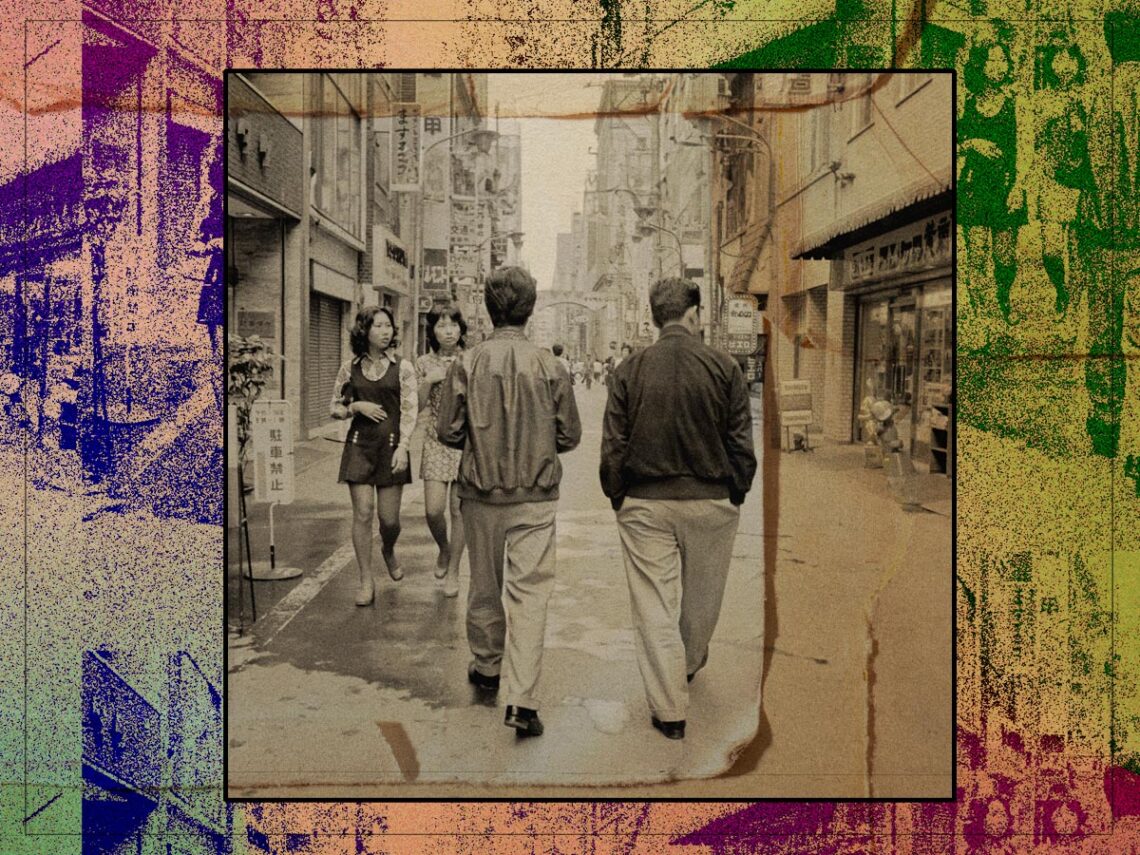
URC: The label that launched acid folk and changed Japan

1960s Japan was a confused and dizzying place. Still reeling from the after-effects of a catastrophic war with the West, the country was occupied by American forces and in the midst of a huge rebuilding job—both physically and psychologically. Now more than ever, the question of what it meant to be Japanese was on everyone’s lips. It was going through an identity crisis like no other.
Japan’s superiority complex had been shattered, and the country’s psyche was being reshaped by the world’s new major superpower: the USA. However, the presence of American soldiers in the country had a knock-on effect on Japan’s culture. American forces stationed there would blast out the most popular jazz and rock ‘n’ roll tunes that were in the charts back home, which had a profound effect on the young generation.
“I grew up with American culture,” Japanese acid folk musician Haruomi Hosono told Red Bull Music Academy in 2014. “I even regretted that I wasn’t American.” Japan’s population listened to the likes of The Beatles, The Rolling Stones, and Bob Dylan with great interest, and they slowly began to copy them. However, they impersonated them in their own unique way.
In the 1960s, bands started to form in Japan that aped the most popular Western music of the decade. But with lyrics in English set to Western music, this was no more than a tweaked pastiche of those ’60s giants. To really progress, Japan needed a scene of its own. That would arrive in the form of Nippon acid folk—a movement that stretched that ‘tweak’ to a new extreme.
Springing from the college campuses of Tokyo, Kyoto and Osaka, acid folk was Japan’s youthful response to the folk music movement in the West. Kenji Endo, one of the movement’s main proponents, told the New York Times in 2017 of how Bob Dylan’s ‘Like A Rolling Stone’ had a profound effect on him. “This guy is creating something that has never been created before,” he said, “[Although] I had no idea what the hell he was singing about!” Though the music itself was still heavily influenced by Western folk, crucially, the lyrics were delivered in Japanese. It allowed the artists involved in the nascent scene to capture the hopes, dreams, worries and despairs of the emerging post-war generation in Japan.
Yet, with strict censorship rules still in place in the Japanese music industry, it was near-impossible to find an outlet for this outpouring of youthful anxiety. Help would arrive in the form of URC, the independent, underground record label that overcame those restrictions through mail-order records. Fittingly, the label’s first release came in 1970, marking a neat counterpoint between the death of the 1960s and the hopes of a bright new era for Japan. The releases immediately proved popular on college campuses, passed around counter-cultural circles and built a sizeable underground following over the 1970s.
Happy End were one of the label’s biggest draws, leaning on a sound that drew unashamedly from Buffalo Springfield. They even went on to achieve international recognition with ‘Kaze Wo Atsumete’, a song that was included on the soundtrack for the 2003 film Lost in Translation. Nobuyasu Okabayashi was behind the second-ever release on URC and later came to be known as ‘the God of folk’ in his native Japan.
Meanwhile, Hiroki Tamaki was a classically-trained violinist who was heavily influenced by both prog-rock and the teachings of controversial religious leader Bhagwan Shree Rajneesh (whose liberal attitudes towards sex led him to be christened ‘the sex guru’) – a pairing which he combined with mind-bending effect on the tracks ‘River’ and ‘Beautiful Song.’
Though the tracks released on URC in the 1970s achieved a fair amount of underground success in their time, their influence on future generations of Japanese musicians marks them out as vital. They pointed a new way forward for Japan: one which took the prevailing Western influences present in the culture at the time but also allowed a new generation to express themselves in their native language. With URC and acid folk, Japan finally had an avenue to show how it was really feeling.
Now, that vitality is kissed with nostalgia, creating a renaissance of interest in URC’s output as we increasingly delve into the past and prize its riches.
