


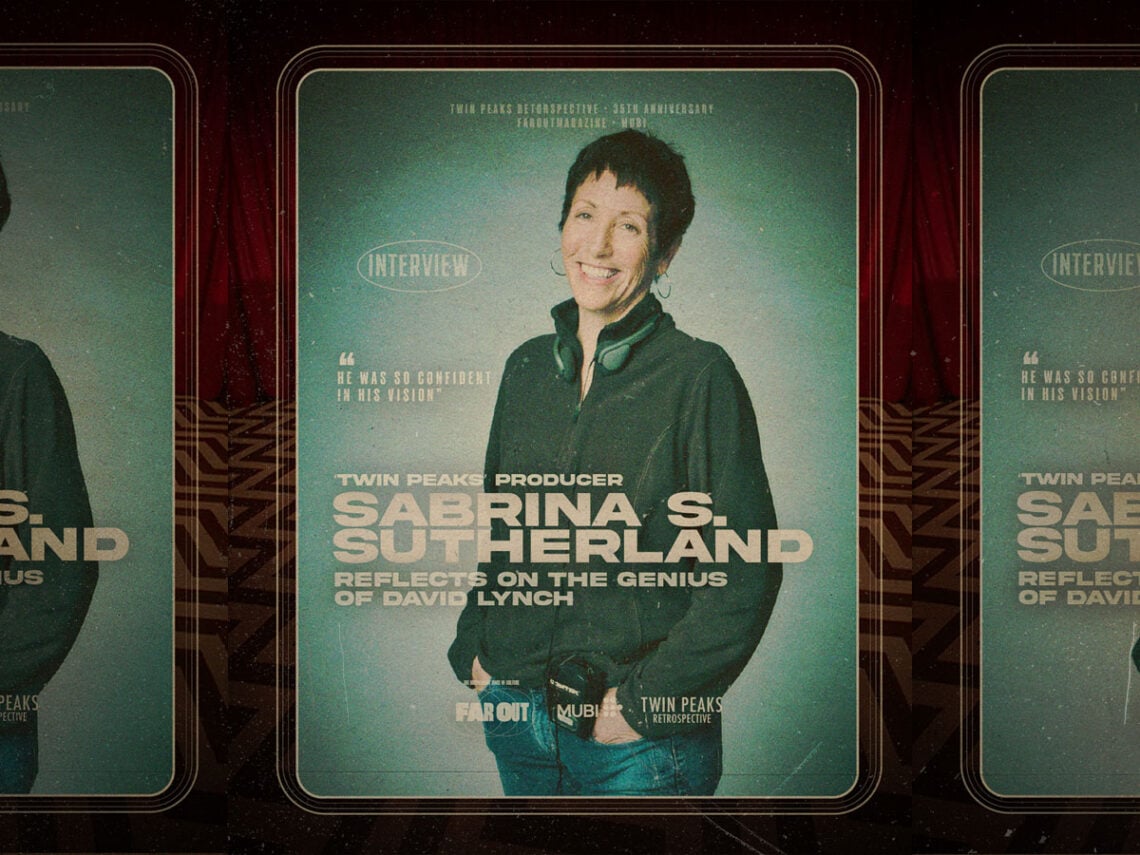
‘Twin Peaks’ producer Sabrina S. Sutherland reflects on the genius of David Lynch: “He was so confident in his vision”

When Sabrina S. Sutherland joined our Zoom call, it immediately became clear how much the producer adored her time working on Twin Peaks. “I’m a huge fan of the show,” I told her, and she instantly matched my enthusiasm: “I’m excited because I, too, am a Twin Peaks fan,” she beamed. The iconic mystery drama – a rich blend of soap opera, comedy, and horror – debuted 35 years ago, and Sutherland was among many viewers who eagerly tuned in each week.
The producer was particularly captivated by the pilot episode, which “took me to another world,” so she tried her hand at landing a job on the show. “I liked it so much that I called and asked if I could work on it. So I was lucky. I got in and I met David [Lynch] through that show originally.” From there, Sutherland became wrapped up in a project that was truly a labour of love, authenticity, and artistry.
Created by David Lynch and Mark Frost, Twin Peaks has resonated with viewers for years because of its bold and boundary-pushing approach to peeling back the layers of American society, revealing both the darkness and the humour that can be found in everyday life. While the show tackled topics like sexual abuse, incest, and murder, it seems that the process of creating it was a true celebration of art and humanity, with Lynch’s uncompromising vision making Twin Peaks a real force to be reckoned with.
“He was just such a decent human being. He was just so very kind to people. He was so very comfortable in his skin and comfortable with people, and I think he just genuinely loved people. He was just a very kind person. And I think he is the best example to me as the best human being,” Sutherland explained. “He was so confident in his vision. He’d have an idea, and that was it. He knew that that was the idea he wanted to do no matter what.”
Sutherland admired Lynch’s drive and authenticity, even if it often resulted in some logistical challenges. “The hardest thing is really to get what David wanted. He’s got a very specific view of what he wants, and just delivering that is probably the hardest thing, to make sure that he’s happy.” The crew had to adapt to any challenges that came their way, like when a visual effect proved to be much harder to create than expected. “It wasn’t working the way David wanted it, and so we ended up having to shoot that live and having some other thing happen, and the visual effects.”

There were other issues that Sutherland and her team had to work with, too, like reassembling the cast for season three, almost 25 years on. “The way we were shooting it was centred on locations because we wanted to shoot the locations out. So if you think about all the hours and however many times we go back to a certain place, we tried to shoot that all at one time. But if we had that location only for a period of time, and an actor who was in there wasn’t available, we’d have to figure out what to do – either arrange that location around that actor, or bring the actor back at some point.”
Reuniting with the cast was a rewarding experience, especially with those Sutherland hadn’t seen for many years. “Having everybody there was great, to see them all again, because there were some that I hadn’t seen since, gosh, I guess 1991. Everybody seemed the same, and there was a lot of love. Everybody was just so happy to be there and working on the set.”
There was no doubt in Sutherland’s mind that the third season would actually come to fruition, telling me, “Once David and Mark started writing, I knew it would happen. No matter what, no matter where it went, it was going to happen because who wouldn’t want to see Twin Peaks again?” The filming of season two and season three was quite different, though, with the approach to writing and shooting taking a more cinematic approach.
“In the original series, each episode was shot by itself, so you’d shoot episode one and then maybe the next week, you shot episode two and then episode three. So you’re constantly editing, prepping and working, shooting on different shows as they go on, so they’re all separate. In season three, we shot it like a big movie, so there wasn’t any differentiation about the episodes.”
When it came to shooting The Return, Lynch directed every part, which Sutherland found to be a strikingly different experience from her work on the show several decades prior. “In season two, there were different directors each time, although David recurred, there were a couple of others also recurred. But for the most part, there are different directors, and that’s always different. You’re working with a different sense of a lot of things. And also, the writers were different.”

“Season two, you had more staff writing, and they were writing while we were shooting, so they didn’t know what was going to happen. Like at the very end, they were constantly writing. Versus season three, we had the script before we started shooting for the most part, and although David still wrote as we went along, the majority of it was already done.”
Sutherland walked away from season three with a deep sense of achievement. It had taken several years for season three to reach a stage of completion, and she was relieved that “we fulfilled all the requests that Showtime had, and I was able to fulfil all the requests that David and Mark had for the show.”
While all projects are undoubtedly rewarding after a hard graft is put in, Sutherland is particularly proud of her work on Twin Peaks, which was a “more gruelling” experience compared to other shows. It’s one that was certainly worth the long hours and often challenging work, not least because she got to work with someone as magnificent as David Lynch.
“I think it’s such a brilliant show. And I just miss David terribly, so it’s so nice just to celebrate him,” Sutherland told me, and she is eternally grateful that fans are still watching, discussing, and honouring such a special and unique show all these years later.
All episodes of Twin Peaks launch on MUBI on 13 June in the US, UK, Latin America, Germany, Turkey, Italy, Netherlands and India.
