


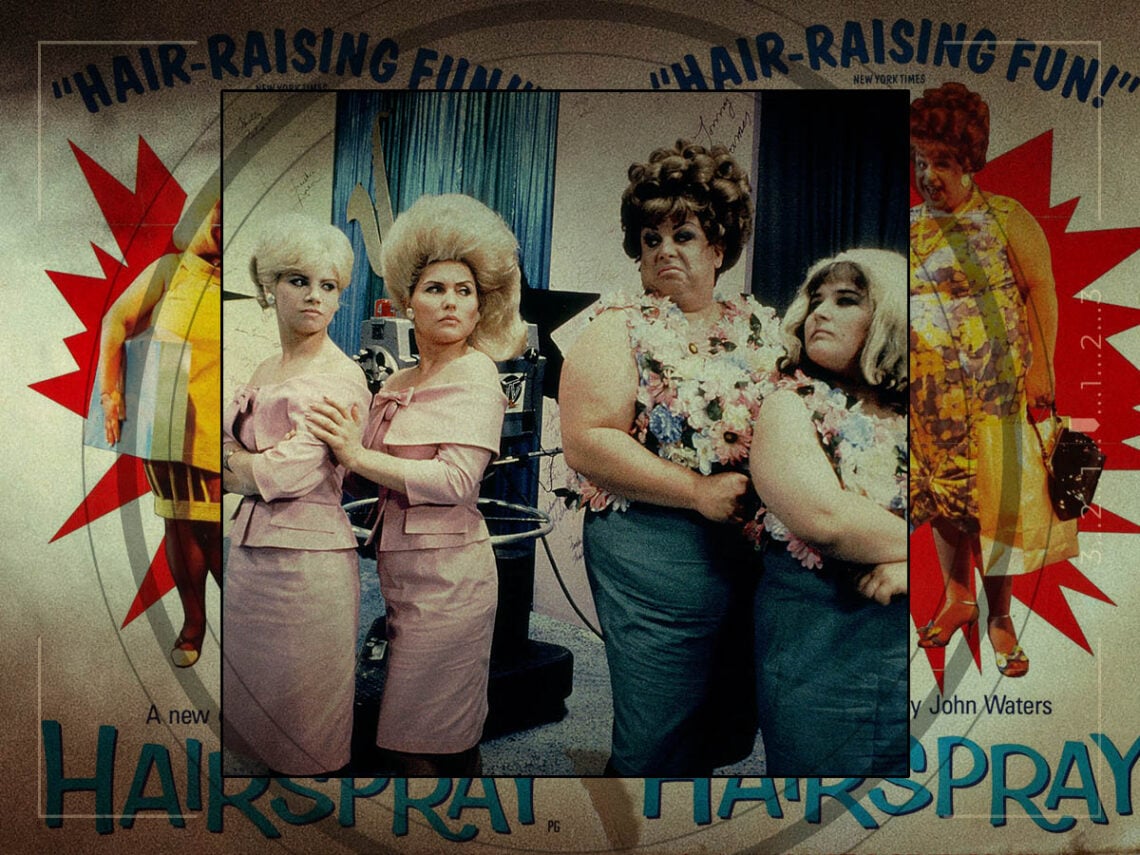
The true story behind John Waters’ ‘Hairspray’

During the 1970s, John Waters’ reputation as a filmmaker was rather polarising, to say the least. While he found a dedicated cult following of midnight movie lovers and experimental cinema enjoyers with a taste for the perverse, several countries banned his movies, most notoriously Pink Flamingos. The film shocked even the most radical audience members with its images of everything from eating shit to prolapsed anuses – Waters officially became known as one of cinema’s most controversial enfant terribles.
Yet, by the 1980s, Waters’ career had progressed to the point of unexpected commercial success. While 1974’s Female Trouble and 1977’s Desperate Living followed in a similar vein to Pink Flamingos – starring predominantly non-professional actors from Waters’ Dreamlanders friendship group – 1981’s Polyester saw the filmmaker working with a larger budget for the first time, with ‘50s Tab Hunter starring in a main role. Waters wasn’t going to strictly forgo his taste for the bizarre and transgressive as he moved towards more commercially viable productions, but he began to make his narratives much more palatable for a wider audience, resulting in Hairspray.
Released in 1988, the film earned acclaim, but it was over the next few years that it truly became popular due to the home video market. The movie has an unusual premise, and in the wrong hands, it could’ve easily fallen incredibly flat, but with Waters at the helm, it worked, balancing humour with real consideration for the issue at hand: segregation.
Hairspray went on to spawn a musical of the same name, which was subsequently adapted into the hit 2007 movie, proving its enduring popularity; yet, many people are unfamiliar with the narrative’s roots in real life. Of course, everyone is well aware of the fact that segregation was a massive issue in America, but Waters was actually inspired by a real show that was segregated like The Corny Collins Show called The Buddy Deane Show, which ran between 1957 and 1964 in the filmmaker’s native Baltimore. In an article for Baltimore Magazine, Waters explained that “every rock ‘n’ roll star of the day (except Elvis) came to town to lip-synch and plug their records on the show.”
The young Waters was a fan of the show, but the series only allowed African-American kids to dance on a Monday, known as ‘Black Monday’. When it came to making Hairspray, Waters tackled this issue with ‘Negro Day’, pointing out the absurdity of this racist idea. In the film, protagonist Tracy Turnblad learns how to dance from the local African American kids, and as she is exposed to the extreme racial prejudices her new friends face, she becomes committed to the cause of ending the Corny Collins Show’s segregation.
Speaking for a crowd of fans at the IFC Center in New York in 2018, Waters explained, “This movie is the only radical movie I ever made because it snuck in mid-America. Even racists like it.” The filmmaker revealed some of the parallels between his own experience of growing up in Baltimore and watching The Buddy Deane Show and the events of the movie, stating that “I was Tracy.”
He continued: “We hung around with Black and whites together, which you couldn’t do. The Black cops would stop us and say: ‘This isn’t Greenwich Village, you know. You’re in Baltimore. You can’t do this.’ I remember once we all got arrested at the drive-in for underage drinking, and the Black kids didn’t get out, and the white kids did. The white kids’ parents came and got them. That really hit home then.”
The Buddy Deane Show was cancelled in 1964 due to an ongoing battle between local segregationists and integrationists, with the racist attitudes from many residents preventing the show from integrating.
Waters wrote in his Baltimore Magazine article: “At frantic meetings of the Committee [the regular white dancers on the show], many said, ‘My parents simply won’t let me come if it’s integrated,’ and WJZ [the television station] realised it just couldn’t be done. ‘It was the times,’ most remember. ‘This town just wasn’t ready for that.’ There were threats and bomb scares; integrationists smuggled whites into the all-Black shows to dance cheek to cheek on camera with Blacks, and that was it. The Buddy Deane Show was over. Buddy wanted it to end happily, but WJZ angered Deaners when it tried to blame the ratings.”
Thus, the complicated end to The Buddy Deane Show inspired Waters to turn this story into a movie—albeit one with an integrated ending and lots of humorous characters, from the overweight and agoraphobic Edna Turnblad, played by Divine in drag, to Tracy’s charming love interest, Link.
