


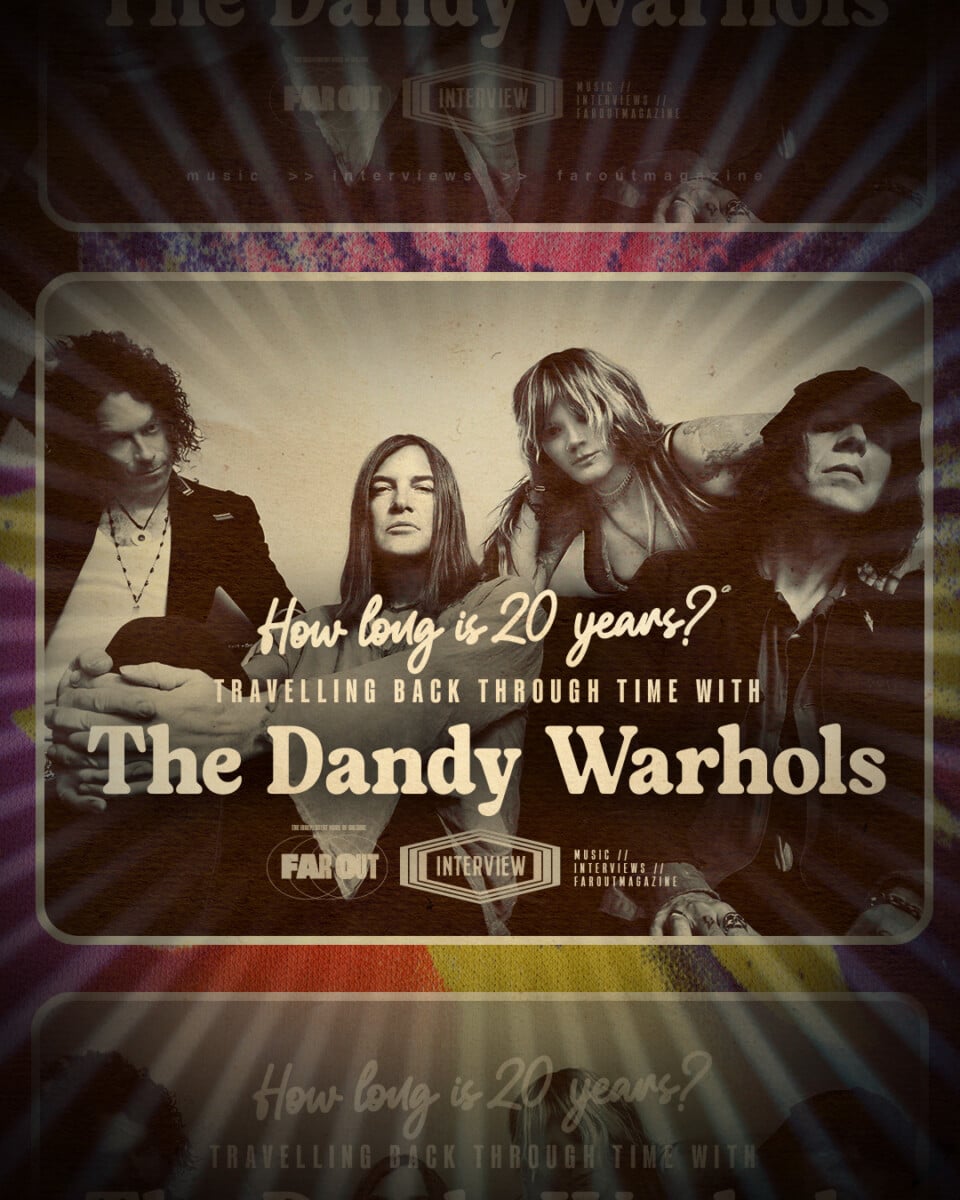
How long is 20 years? Travelling back through time with The Dandy Warhols

“Just move it a little upwards,” I tell Courtney Taylor-Taylor of The Dandy Warhols, as he adjusts his phone on the counter, activating our video call.
Like transatlantic colleagues, we run through the usual niceties of checking we can be heard or seen before flippantly lamenting the new digital age. “It’s not like it used to be, eh?” I awkwardly hang in the conversation, knowing that I never really existed in whatever it actually used to be.
But that doesn’t mean I’m not interested in said time gone by. In fact, I harbour a deep-rooted jealousy of Taylor-Taylor, as I always do whenever I talk to a musician who lived through what many of us would consider the golden years of culture. In my mid 20s, I was doing exactly what we did at the start of this call, fumbling my way through family Zoom calls, doing mind-numbing pub quizzes in a bid to feel normal. In his mid 20s, Taylor-Taylor was in the midst of a booming American grunge scene.
“God, 2020 was the beginning of Covid?” he asks, adding, “That just seems like 20 years ago. I mean, it seems like a long time ago to me”. Sadly, it doesn’t for me, still cobbling together the pieces of my mid-20s in whatever this dystopic afterlife that we’ve been left in.
At that time, The Dandy Warhols were working on their wildly experimental album Tafelmuzik Means More When You’re Alone. An aptly titled album that burrowed deep into the immersion of ambient sounds, it was suitably escapist for a world in flux, while creatively challenging for a band that had been on the scene for three decades at that point.
Soundtracking a pandemic wasn’t intentional, however. “I mean, it took us ten years to make Tafelmuzik, that was just completely and utterly undisciplined,” Taylor-Taylor explained, adding, “We really weren’t applying any discipline to anything and shaping it at the end. We were only applying paint and clay or whatever you want to call it.”
It was rather an exercise afforded to them, built on the legacy of their band. Their 11th studio album, at the time, they had rightly earned a position that let go of the commercial structures expected of fans, and instead were given free rein to painstakingly work on ideas that had no logic, no cultural relevancy but crucially, no expectation.
No one could begrudge the band of this either. Ever since forming in Portland, Oregon, in 1994, they’ve constantly sought to evolve. Psychedelia, shoegaze and even a tinge of Britpop were splashed into their sound, which never made them the heroes of one specific scene, nor the relics when it inevitably moved on. Taylor-Taylor’s clear disinterest in ruminating on timeframes in the same way as my anxious post-Covid mind has meant the band are immune to such cultural dependency.
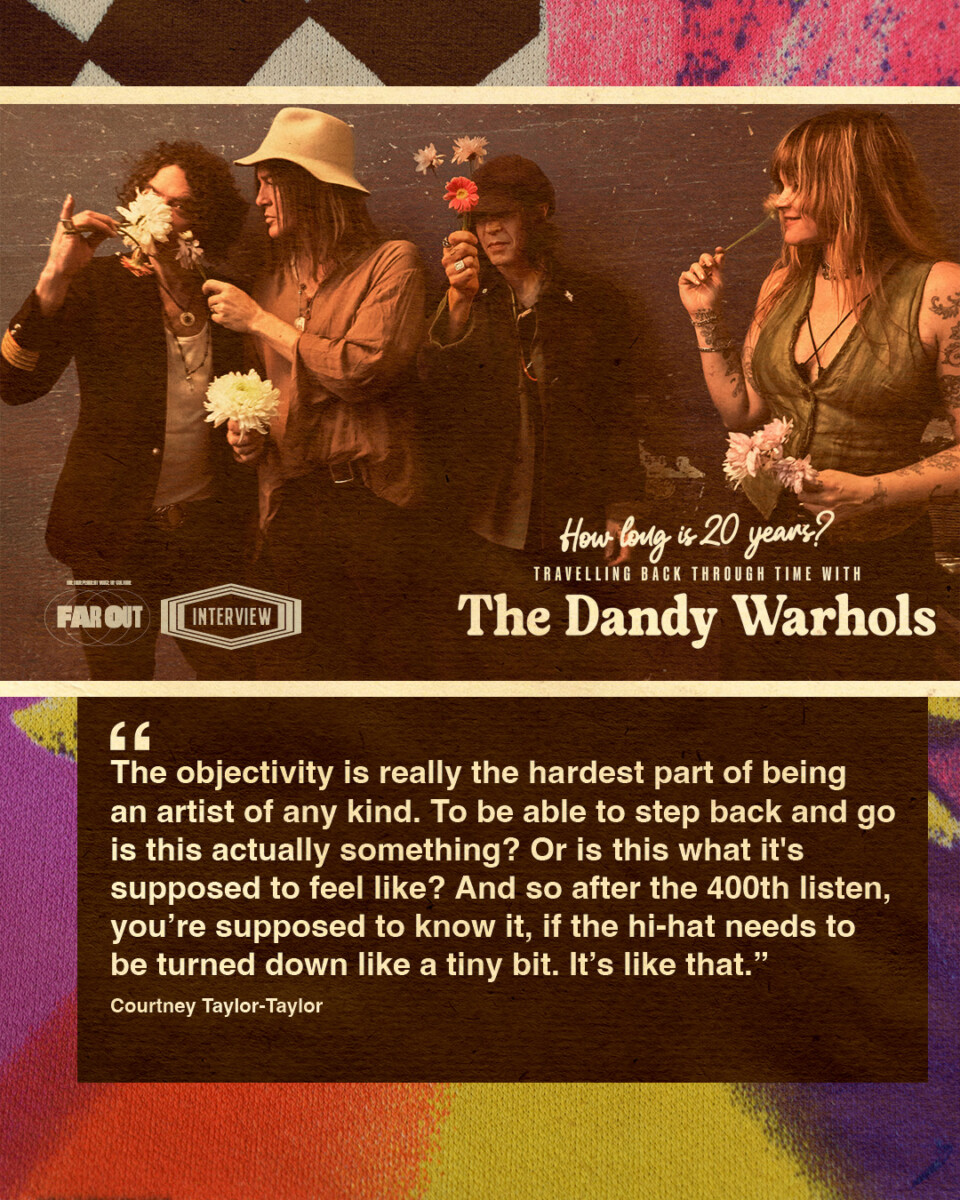
Nevertheless, a three and a half hour experimental album is likely to exhaust any band. “The objectivity is really the hardest part of being an artist of any kind. To be able to step back and go is this actually something? Or is this what it’s supposed to feel like? And so after the 400th listen, you’re supposed to know it, if the hi-hat needs to be turned down a tiny bit. It’s like that. So comparing it to Tafelmuzik, the covers record, you don’t have to approach it like that until the very end, and it’s just a lot easier to make that than a real record.”
The covers record in question is The Dandy Warhols’ latest release, Pin Ups. Three sides made up of three different historic approaches to classic rock, performed by the Portland band who are reversing the clock and remembering what it was like to be a wide-eyed garage band, ripping into covers of their favourite artists. The Cure, Gang of Four, The Clash, Bob Dylan, The Beatles, The Cramps, The Runaways, Violent Femmes and The Byrds all feature on this record that has influenced a band whose sound has evolved frequently over the years.
Nostalgia is an exhausted creative tool as of late, but this project feels more inward-facing if anything. Because after all, this mercurial outfit who have slipped through the ever-changing tides of history feels inherently disconnected from any supposed era of supremacy and, in turn, have no reason to reduce themselves to repetition at the request of their fans.
Instead, they were the fans, worshipping bands who existed a very real 20 years before their seminal album Thirteen Tales From Bohemia. But this is where our conversation starts to come alive. Moving further back in time, way beyond the trauma of modernity, we both find common ground with a love for the bands that appear on Pin Ups tracklisting. While for most of his career, it’s me looking back, wondering what those days were really like, now we begin to mythologise together.
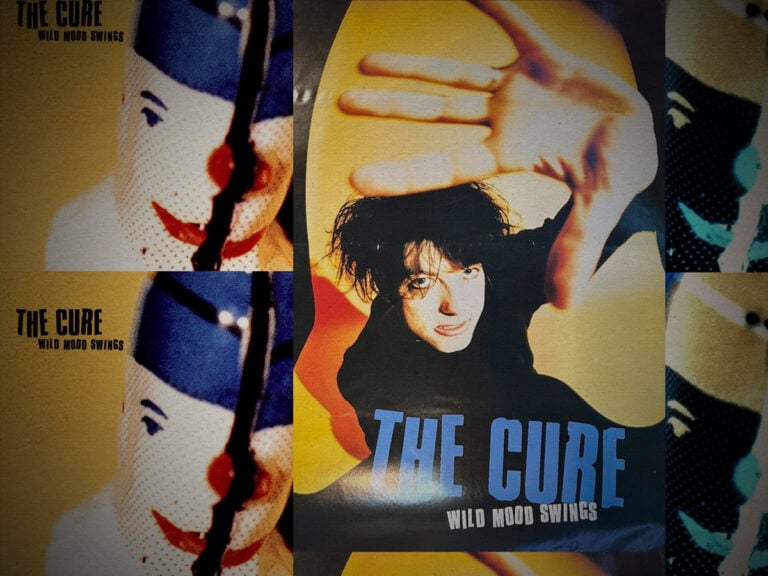
The first side feels like a very obvious nod to brutalist Britain in the 1980s. A time when Taylor-Taylor said birthed songs that had “very pivotal cultural moments in all of our youths, like ‘Primary’ by The Cure or the two songs by The Cult, ‘Rain’ and ‘She Sells Sanctuary’; The Cult really was the biggest band for other bands in ‘89.”
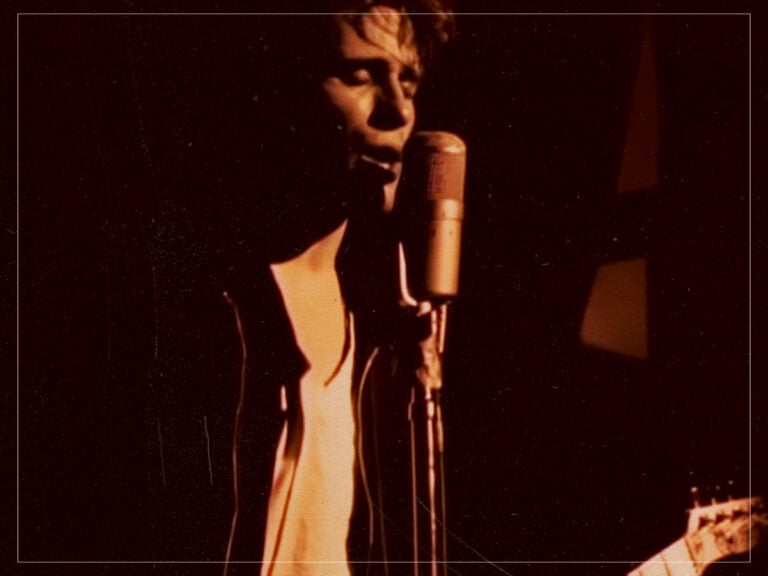
The record also goes further back, a decade into the late punk era of the 1970s. The decade that Taylor-Taylor was born, but more importantly, gave way to a wave of punk bands who would ultimately shape the edgier tingings of The Dandy Warhols’ music. Something about stepping into their shoes, for a brief moment on this record, gave Taylor-Taylor a sense of liberation that his own music hadn’t achieved in a while. Desensitised by his own process, the sheer rudimentary and DIY enjoyment of laying down vocals for someone else’s music, revitalised that early punk spirit in him.
The Damned, who The Dandy Warhols have forever cited as a major influence, was unsurprisingly on the record with their track ‘Love Song’. Taylor-Taylor simply described covering that song as “the greatest vocal experience I’ve ever had”, continuing, “I enjoyed that more, for pure, ‘fuck yeah!’ I enjoyed that I think as much as I enjoy the favourites of my own songs. But somehow the irresponsibility of it not being my original feelings definitely makes it more fun.”
Through the tracklisting, Taylor-Taylor and I embark on a whistle-stop tour of industrial Britain. With all that’s gone on in music recently, I had become conditioned to view nostalgia as a vehicle for taking us back to a more blissful time gone by, but maybe setting the tone of our conversations with our varying perceptions of a recent pandemic cast a cloud that never retreated.
Rather than talk about the band’s renditions of ‘Blackbird’ by The Beatles or ‘Lay Lady Lay’ by Bob Dylan, we talked about Britain and the sharp edges of its punk movement that happened decades ago. Suddenly, Taylor-Taylor was no longer a bohemian rock wizard, staring at me through a computer screen from his wonderfully arranged home studio, but a music fan, opposite me with a pint in hand, talking about yesterday.
On Joe Strummer’s lyrics, he said, “They were impressionist political poetry, impressionist defiance songs that in a lot of ways, I don’t do. He was so well-travelled and only in the shittiest parts of the empire, and so it’s rust and poverty and starvation and abuse, it’s a lot of harsh visual poetry in that song and that impressionist as fuck.”
What is the point of a covers record like this, if not to unite us music fans from varying parts of the globe and culture? The bridge between us had been beautifully built by the musicians who existed on The Dandy Warhols’ tracklisting. Of course, that was the primary reason for this album, but as we got drunker on our hypothetical pubroom chat, a more profound why rose to the surface. Seriously, Courtney, if we’re going to go back in time and think about music of old, why is it the likes of The Clash and The Damned?
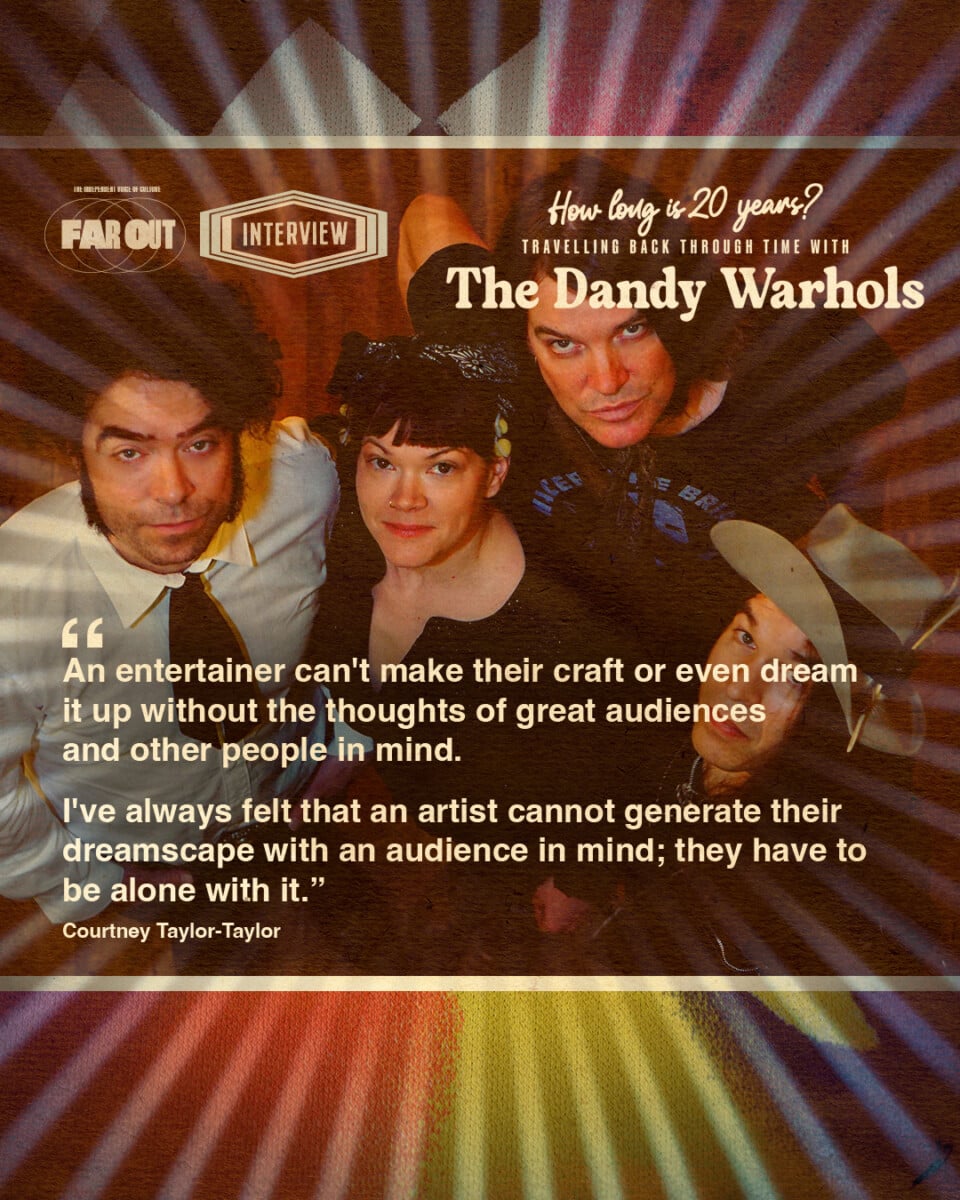
“There used to be such a great distinction between art and entertainment,” he said, “Our artists historically have been better off not being a part of the real world. They just live in the life of the mind and very singular perspectives. An entertainer can’t make their craft or even dream it up without the thoughts of great audiences and other people in mind. I’ve always felt that an artist cannot generate their dreamscape with an audience in mind; they have to be alone with it.”
There was no doubt by that metric; all of the musicians honoured on this record were artists. But what he next said to me jolted me back to life. Suddenly, the whistle-stop tour through history had ground to a halt, and suddenly, we were back in the confused modern day.
“Now it seems very weird, more like an Andy Warhol situation where, what is the difference between commerce and an expression?”
This record then is very much an escape, like most music harnessing the power of nostalgia should be, but the difference is, there’s no falsity in what it is serving. Some musicians are desperate to return to former glory by rehashing an old product that flew off the shelves all those years ago, while The Dandy Warhols are simply celebrating the past through the lens of other artists. It is as fun as simple nostalgia is meant to be.
With just a few minutes left on the allotted time, we got to where I was in the world. Maybe this digital landscape that no longer puts us music journalists in the lion’s den can offer a window into our world, oddly connecting us to our subjects. Nodding towards the grey British sky, I told him I was in Bristol.
His eyes lit up, clearly flicking through anecdotes of his own experiences there. “Great music scene,” he suggests, to which I confirm, rattling off some of the artists who make this little cultural hot-pot such an exciting place to live. But of course, today wasn’t so much about the present as it was the past, and so I was left with one last memory of Taylor-Taylor’s rich history.
“We became friends with Massive Attack,” he recalled, “They invited us to come stay in Bristol and work in their studio for a few days, and that was really cool. The song ‘And Then I Dreamt of Yes’, that’s the only song that we actually completed. We were introduced to a cider bar and had Scrumpy Jack or some shit like that. Wow, that’s a drug.”
This interview came just days before I watched a pretty life-affirming gig of my own in Bristol, sharing a handful of Guinnesses, not ciders, with a collection of creative friends who give me that same feeling of excitement Taylor-Taylor had in those days with Massive Attack. Yet somehow, drunker with nostalgia and with the winds of the past still whistling in my ears from our conversation, I envied those salad days that Taylor-Taylor was a part of, and a life lived through the very greatest years of music.
