


How the Covid-19 pandemic became the second undoing of Eric Clapton, and perhaps the last

It’s all very well being one of the greatest musicians of a generation, but if you allow the manner in which you present yourself to spiral out of control and end up portraying yourself as a myopic egomaniac, then does your talent as an artist really matter?
Eric Clapton had the world at his fingertips throughout the 1960s and early ‘70s, making a name for himself through various projects such as The Yardbirds, John Mayall and the Bluesbreakers, Cream, Blind Faith and Derek and the Dominos – this alone is a rather remarkable resumé to have accrued in such a short space of time, but the fact that many of these projects were short-lived, or that he ended up departing after a brief stint, ought to have been a warning about his difficult nature.
This would begin to rear its head in a very public fashion at the start of the 1970s, with an increasing addiction to heroin and alcohol causing many of his relationships to suffer, all while his career was entering a transitional period as he made the move from being in bands to establishing himself as a solo artist. The ugliest side of the real Clapton would make itself known in 1976, when he managed to place himself under huge scrutiny after choosing to derail a live performance in Birmingham with a virulent racist tirade.
Without wishing to repeat some of the more abhorrent turns of phrase that slurred from his inebriated lips, the gist of his message was clear: “Stop Britain from becoming a black colony. Get the foreigners out,” he ranted, echoing the sentiments of Enoch Powell’s infamous ‘Rivers of Blood’ speech in 1968. Peppered with a number of slurs and hostile requests for people of colour to not just get out of the concert hall, but the country entirely, Clapton had seemingly dropped a bomb on his entire career by expressing his most unsavoury views in a place where everyone could witness it.

Suddenly, a man who seemed untouchable was scrambling to keep his career afloat as a result of him not wanting to hold his tongue and pandering to xenophobic ideologies and using rhetoric reflective of the most intolerant members of society. There was simply no place for this attitude in rock music, and the immediate aftermath of the incident proved that virtually nobody was on Clapton’s side, with many actively distancing themselves from his toxic opinions.
One of the largest responses to Clapton’s regrettable outburst was the formation of Rock Against Racism, a charitable organisation that put on a series of concerts that aimed to showcase a variety of acts who were firmly opposed to any form of racial discrimination existing within British society, with Clapton’s remarks having also coincided with a rise in racially-motivated acts of violence across the country.
However, when Clapton recognised that his career was taking a nosedive as a result of his heinous actions, he chose to issue a grovelling apology, not too dissimilar to the sort you’d receive in the form of a notes app essay from any modern artist trying to mitigate their downfall after becoming embroiled in controversy. “I was so ashamed of who I was, a kind of semi-racist, which didn’t make sense,” he whimpered, semi-convincingly, before going on to make a number of weak justifications for how he can’t be racist on the grounds of him having Black friends and a Black ex-partner.
Yet, despite his pathetic attempts to exonerate himself from any culpability, the world seemed to move past this unpleasant episode just as quickly as he sought to gloss over it, and all his dickish behaviour seemed to be forgiven on the grounds that his musical ability hadn’t bombed in the interim. Clapton’s career returned to its former glory; he gained relevance again, and because people were paying attention to him, he was tactfully maintaining a sense of propriety in the public eye.
The ‘80s saw him reach his previous levels once again, and even during the ‘90s, he was able to keep his profile despite the tragic loss of his son. And then all began to go quiet again in the 21st century, and when the entire world entered a lockdown, Clapton’s old self began to emerge along with new misguided beliefs and values.

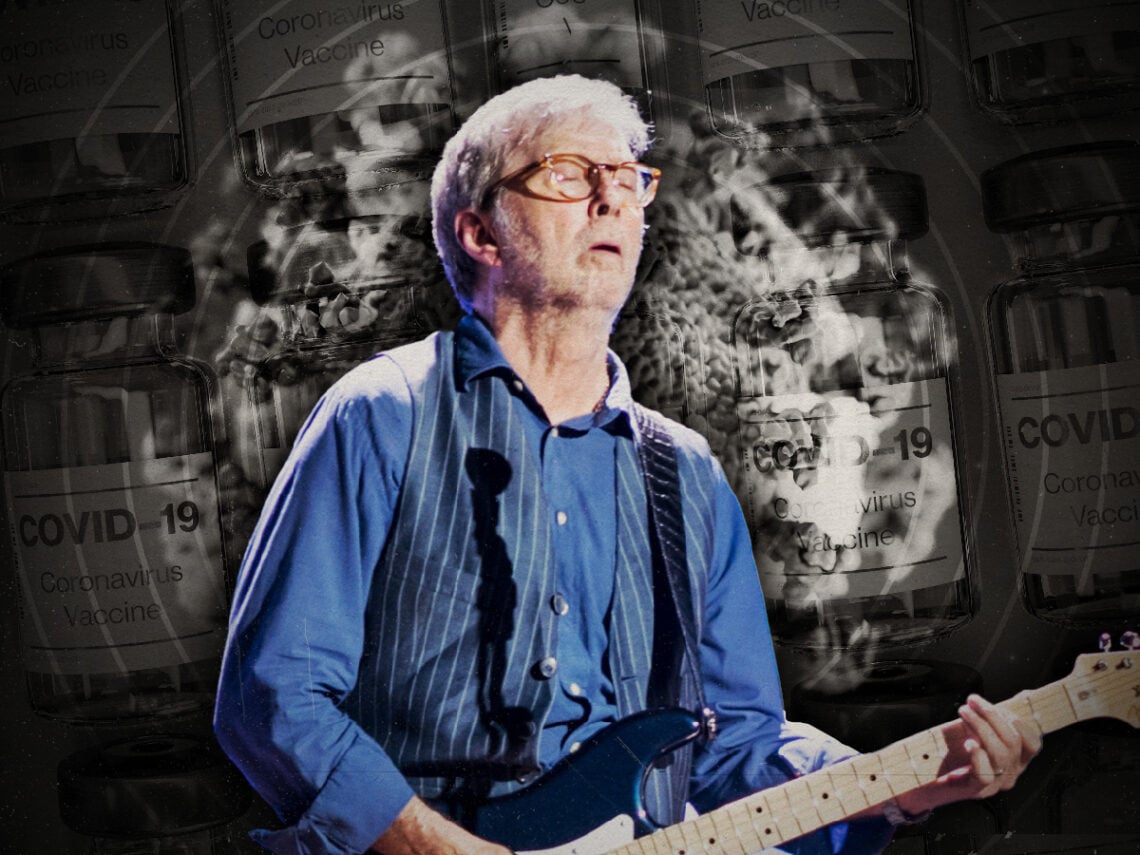
With a pandemic to contend with and no audience for him to entertain, fringe theories about the coronavirus and vaccine safety began to trickle through the filter he’d put in place for his unsanitary opinions. Given his track record for spewing alternative beliefs when attention isn’t coming his way, this shouldn’t have come as a surprise to anyone, but having seemingly worked hard to regain the trust of his audience, he found himself tanking his career a second time.
Rowing back on his admittedly casual effort to become less of a polarising figure, only to start spouting anti-vax nonsense at the height of a global pandemic, and even going to the extreme of refusing to play venues with vaccine mandates, was practically the last straw for many fans whose patience had been previously tested by Clapton’s belligerence. He’d been given a second chance at having a career, and it was only ever really possible for that to be undone by his own idiocy.
As if his scientific scepticism wasn’t enough of a red flag, Clapton chose to release two songs to try and reinforce his daft point of view, one with the equally notoriously anti-woke curmudgeon, Van Morrison. However, his claims that he was against discrimination being shown towards those who opted not to receive vaccines were perhaps the ultimate display of hypocrisy, as if to say that he was overthinking the fact that he’d previously been criticised for racially-motivated outbursts in the past.
Yes, Clapton has gone on record for supposedly supporting Gaza and the freedom of Palestine, but are we to even believe that he holds these beliefs, given how fickle he has proven himself to be, or is the man just unable to think for himself, instead opting to blindly float towards where he believes his audience will be?
Clapton may be a great guitarist, but a great mind he is not, and while the casual attempts to brush his racism under the carpet shouldn’t have been ignored in the first place, the fact that he has failed to regain any of his relevance following his confused anti-vax statements suggests that the world may finally have had enough of trying to defend a man whose principles simply don’t align with those of his fans.
