


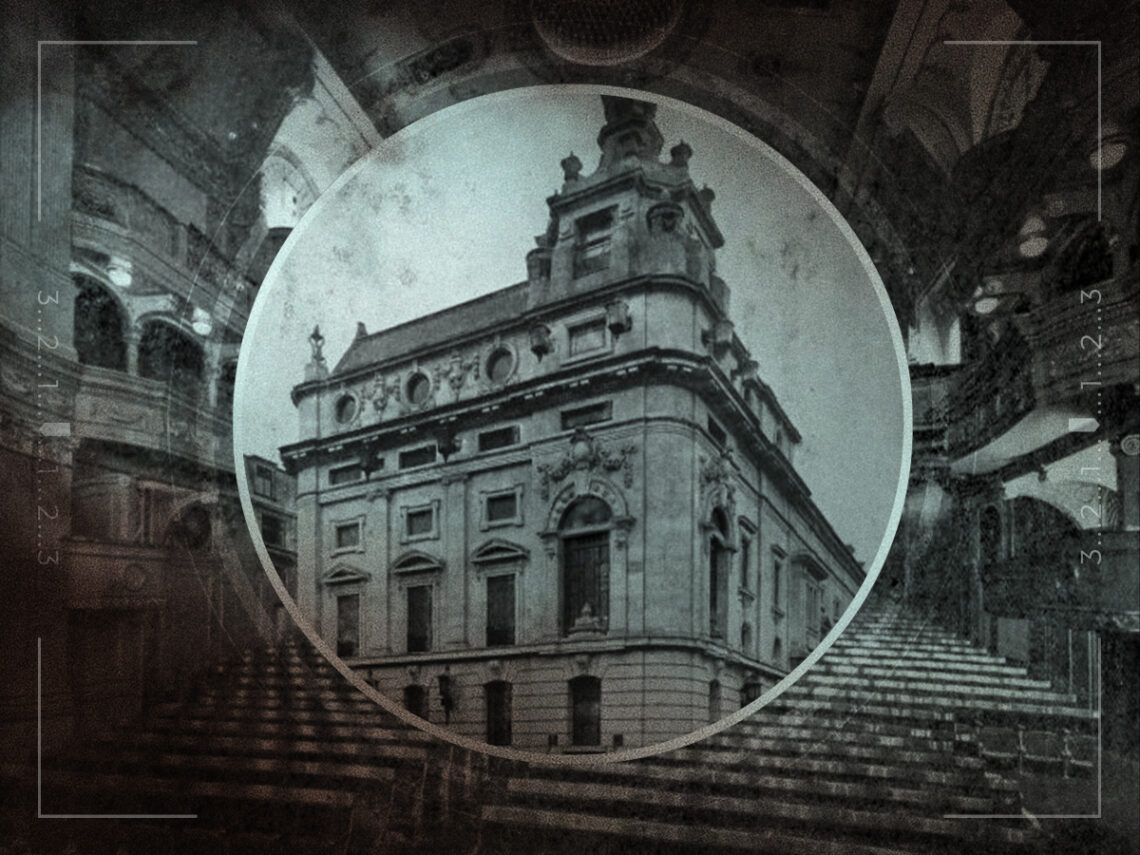
“Beaten to a frazzle”: the West End cinema that laid down the gauntlet to America

When it comes to movies, let’s be honest, there aren’t too many things we can claim to have one-upped our friends over the Atlantic with. Hollywood is, without doubt, the centre of the film-making universe, and no amount of Downton Abbey or the occasional Guy Ritchie gangster flick is going to change that.
But that doesn’t mean that now and then we haven’t laid a particularly polite glove on our American cousins, perhaps while raising a little finger at the same time. Because for several decades we had a very potent, very rotund weapon in our celluloid arsenal in the form of Sir Alfred Hitchcock, and he might well be the finest to ever stand (or more likely sit) behind a camera.
Hitchcock, lest we forget, made films for a long, long time, spanning silent films as early as the mid-1920s, having his first hit in 1927 with the dialogue-less thriller The Lodger: A Story of the London Fog, which was a huge success and also featured the British director’s first ever cameo appearance in a movie. Then, two years later, he was ready to enter the world of talkies, and his first film to feature actors speaking was also England’s first: 1929’s Blackmail.
He chose to stage the thriller at The Capitol Theatre, a spectacular venue that had opened just four years previously on the Haymarket in London. It was a 1,500-seat auditorium that combined a cinema, a huge dance club and a restaurant, and the neo-classical style building had already played host to several Hollywood movies that featured speaking as part of the entertainment.
But Hitchcock’s newest movie was a game-changer, prompting genuine pride on Fleet Street, with British reviewers proclaiming, “Blackmail has the best of America’s talkies beaten to a frazzle” and “I defy anyone to produce to me one American talkie now in this country which is in any way the equal of Alfred Hitchcock’s”.
With a dark subject matter concerning a woman being blackmailed after killing a man who attempted to rape her, Blackmail starred the Czech actor Anny Ondra in the lead role, and her heavy Eastern European accent proved an issue for Hitchcock while he made his first talkie, a problem he solved by having British actress Joan Barry stand off camera delivering lines while Ondra mimed on camera.
The film includes several elements that would become almost Hitchcockian trademarks over the decades, and was in fact also filmed in a silent version with a musical soundtrack, because the vast majority of cinemas at the time weren’t equipped with the means to properly show versions with sound. Some of the content proved too much for some cinema-goers to handle, and due to a scene involving stabbing, the film was banned in Australia until several cuts were made.

Although Hitchcock’s film was a big success and ran at the cinema for several months, the relative popularity of the Capitol was fairly short-lived, and by 1936, it was already being completely redesigned and renamed as The Gaumont Theatre. It continued to show movies but was upgraded with fewer seats and the latest air conditioning, lighting and heating systems, plus a revolutionary ‘DuoSonic’ sound system.
That iteration lasted until 1959, when it was bought by Odeon Cinemas and refurbished again.
