


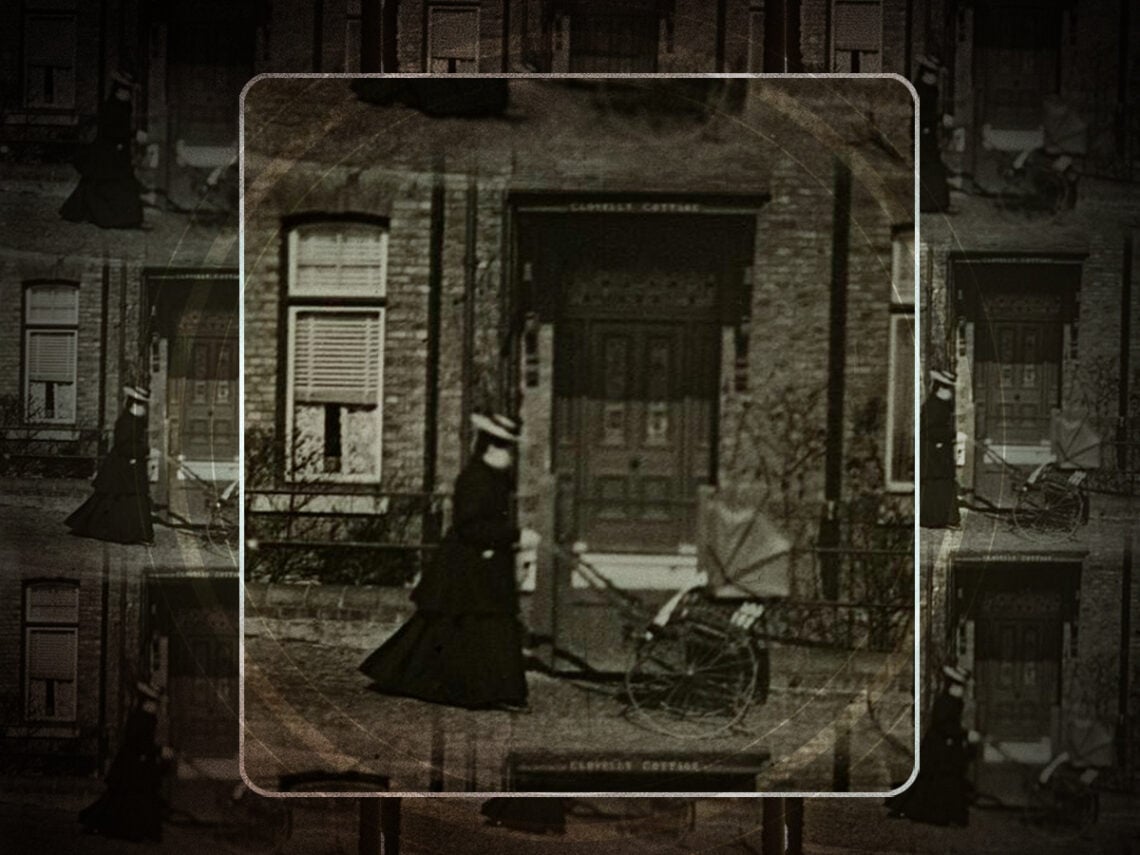
The unassuming house in London that birthed the entire British film industry

Most people, that is, people who don’t live in Barnet, north London, would probably struggle to point it out on a map, let alone tell you any facts about the place.
They might well shrug if you told them Barnet is the capital city’s second most populous borough, or that it’s one of London’s highest points at a whopping 130metres above sea level. ‘Who cares?’ they’ll say, possibly, quite rightly, which is when you can hit them with the fact that without the place there would be no cinemas in Britain and watch their faces change.
Now admittedly once you’d delivered that soupçon of information you’d have to qualify it somewhat by admitting that probably, at some point, someone else would have come over to the UK and gone ‘here, look at this moving pictures thing’, but the truth is that 120 years ago, in 1895 to be exact, a chap called Birt Acres who lived at 19, Park Road (also known as Clovelly Cottage) in Barnet did something fairly extraordinary that led directly to the multiplexes and overpriced bags of Maltesers we now know so well.
Acres had an electrical engineering friend who had managed to somehow pirate Edison’s Kinetoscope, the rudimentary motion picture device developed in New Jersey that allowed people to view films through a peephole, but he didn’t have any films made for it. Acres ran a business manufacturing ‘dry plates’ for photography and used his friend’s camera to film a short piece outside his house called Incident at Clovelly Cottage, which, given it was just his wife and baby walking past their front door, doesn’t sound all that exciting, but Acres had just made the first movie ever made in Britain.
Somewhat cheekily, he then decided to patent his mate’s camera himself, causing a permanent rift in the friendship, but he did at least make something of the technology. Acres founded the Northern Photographic Works, the UK’s first moving picture production company, at a different address in Barnet, and just a few months later, on January 10th, 1896, he gave Londoners the first projected movie performance in the country, predating the Lumiere brothers’ far more lauded performances by five weeks.
He didn’t stop there, however, and although he hadn’t yet had the idea of selling enormous boxes of popcorn for £11, he did begin to understand the possibilities this burgeoning technology could have, patenting a projector called Kineopticon later that year and even an early iteration of a home movie camera two years later called the ‘Birtac’ (because his name was Birt; clever).
What he put in place has turned into big business, to say the least. The UK film industry is now a massive deal, a powerhouse that had a record $2.8billion in production spend last year, with almost 90,000 people working to make movies over here and playing host to countless Hollywood productions.
Studios, like Shepperton and the home of Harry Potter, the Warner Bros lot at Leavesden, just north of Watford, have doubled their spaces in recent years as film companies plough money into British filmmaking, and in terms of cinema-going, it seems heading out to catch a film has also picked up again after the low points of the Covid-19 pandemic, with millions wanting to experience blockbusters like Wicked, Project Hail Mary and various Marvel movies in person.
This December’s Avengers: Doomsday is expected to not only be the most expensive film ever made, but also quite possibly the highest-grossing in history at the box office, and for Britain, this trajectory began because one man decided to be a little proactive with technology.
