


The unsung importance of electronic music pioneer Clara Rockmore

Synthesisers are one of the most popular instruments, possessing the versatility to find a home across genres, from electronica to alternative rock. The instrument was made accessible when Robert Moog released his portable Moog synthesiser in the 1960s, allowing musicians worldwide to experiment with new electronic sounds.
However, before the Moog synthesiser, electronic music was developed by various female musicians, including Daphne Oram and Delia Derbyshire, who pioneered the genre through their innovative work, particularly at the BBC Radiophonic Workshop.
According to acclaimed electronic artist Suzanne Ciani, “I think for women, [electronic music] gave us independence,” she told NME. “I studied classical composition, conducting, the whole thing, and it was a man’s world – and still is today, really, annoying as it is. But in electronic music, you could do the whole thing yourself. That’s what attracted women. This is a story of intimacy, in a way, with these machines.”
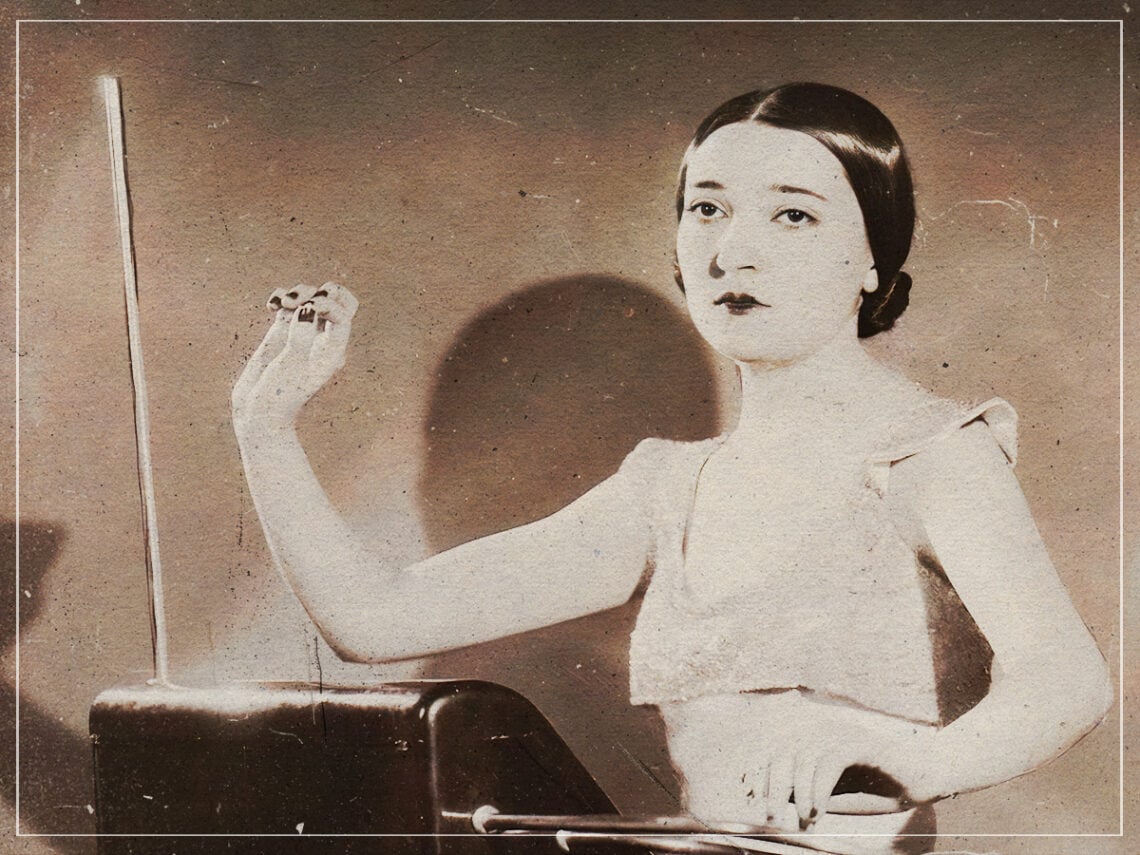
Thus, it’s no surprise that in the 1920s, the theremin, an early precursor to the synthesiser, was significantly developed by a woman – Clara Rockmore. The instrument was invented by Leon Theremin, a Russian physicist and amateur musician who accidentally created the theremin while creating a device to measure gas density. Everyone was so impressed by the instrument that he swiftly toured the world to demonstrate its unique ability to produce high-pitched sounds.
This led him to meet Clara Rockmore, a prodigious violinist from Lithuania, who attended the St. Petersburg Conservatory when she was just five years old. Incredibly gifted, Rockmore even toured with her sister, a piano prodigy, as a child. When she was 17, she witnessed Theremin demonstrate his new invention at a party, subsequently trying her hand at it. By this point, muscular injuries prevented Rockmore from playing the violin, much to her devastation. Thus, she was delighted to discover the theremin, which she seemed to control better than anyone else due to her absolute pitch and precise classical training.
Due to Theremin’s lack of musical knowledge, Rockmore soon became a vital component in the refinement of the instrument, giving him advice on how to develop its capabilities. She suggested that the pitch antenna and volume controls be made more sensitive, allowing the performer to play with greater ease and pace. Since then, the theremin has been widely used in music, particularly movie soundtracks, due to the creepy sound it can omit.
Not only did Rockmore help to develop the instrument, but her tours and performances, often playing classical pieces, helped give electronic music artistic credibility. According to Tara Rodgers, Rockmore helped to establish “electronic and experimental music as a viable art form in the public imagination”.
Talking to Moog in 1977, she explained: “Ninety-nine per cent of people think of electronic instruments as something for new, eerie, strange, ugly, strident sounds. Now, that is completely the opposite of my approach. I am a violinist and a musician. I wanted to see if it were possible to use the theremin to make real music. Bach couldn’t write for the theremin when he was alive, but there is no reason why I can’t play Bach on the theremin today.”
Rockmore’s influence on the development of electronic music, now one of the most championed genres in the world, remains unknown or underappreciated by many. Yet, thanks to her musical genius, she was able to take an invention and turn it into something capable of producing art, imbuing Theremin’s instrument with a sense of humanity that was otherwise absent. Moreover, Moog credits the theremin with inspiring his synthesiser, meaning that without Rockmore’s popularisation of the invention, modern music would look very, very different.
