


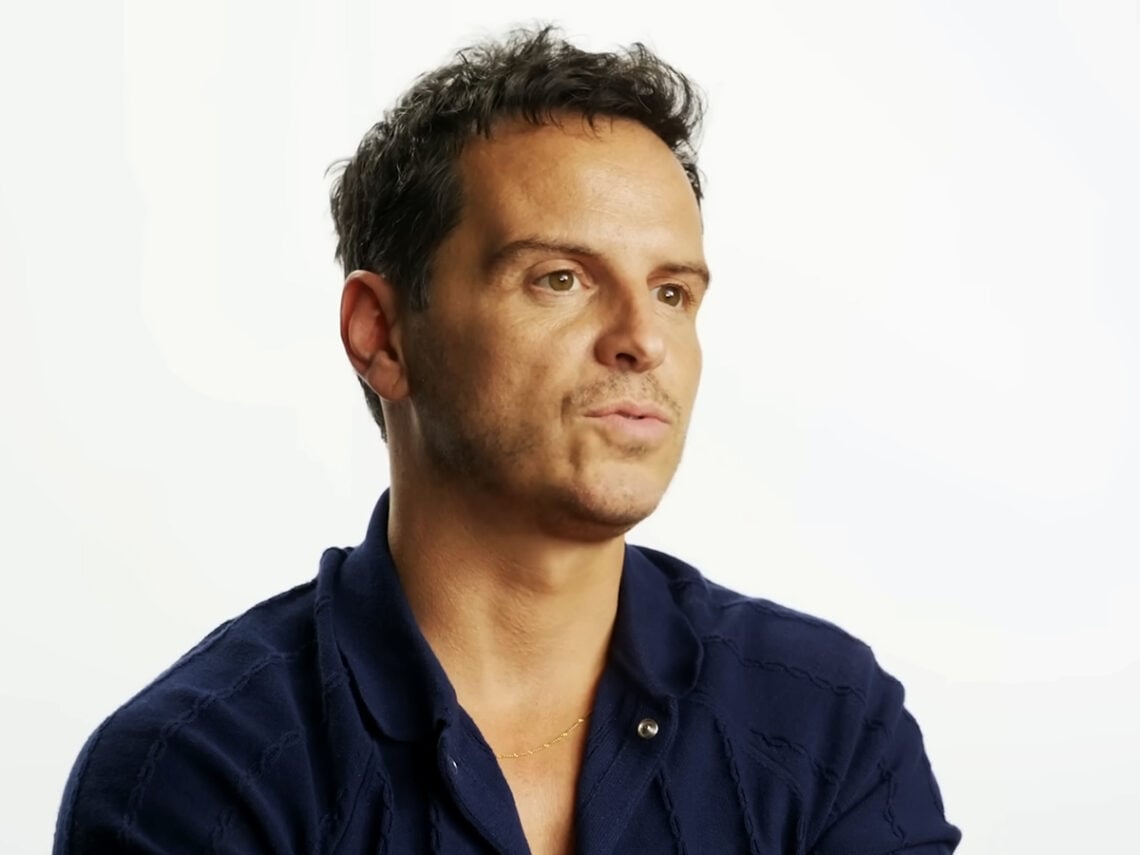
The one thing Andrew Scott hates about the modern film industry: “It’s horrific”

Andrew Scott seemed to suddenly explode to global stardom after his now infamous role as the hot priest in Phoebe Waller-Bridge’s Fleabag, taking catholic guilt to a whole new level after hoards of audience members began fantasising about unspeakable acts with a man of the cloth. However, the actor didn’t just appear out of nowhere; he had, in fact, been hustling for many years and earning a reputation for his work as a villain.
Scott found success through his portrayal of Moriarty, Sherlock Holmes’s arch-nemesis, in the Benedict Cumberbatch adaptation of the classic novel. He gained notoriety for his stark characterisation of the twisted figure, embodying someone who is disturbed and manically unpredictable in his quest to outsmart the detective.
After the recent success of All of Us Strangers, it seems as though the sky has no limits for Scott, with the actor experiencing a renaissance after years of hard work in such a cutthroat business, describing his complex relationship with the industry.
Many actors have described their mixed experiences in Hollywood, including awful auditions, strange industry parties, predictably creepy men, and dangerous contracts. It is not a business for the faint-hearted, and the process of breaking in becomes a warning against any attempt to try. Hundreds of people have taken a stab at success and abandoned this brutal quest after enough bad experiences to fill a premature memoir.
But for those that manage to survive this harrowing initiation period, they are apparently met with enough rewards to make it all worth it, suddenly escalating towards the top and being given money and fame to compensate for this struggle and the subsequent loss of privacy and corruption of their ego.
However, while some actors love every aspect of their job, there are some who criticise the business as openly as they can, sharing their experiences of trying to make it and the struggle to break in. This is something that Scott has been very candid about, with the actor recently reflecting on this period with fellow performer Olivia Colman.
The industry has evolved in many ways since the dawn of the internet, with Scott highlighting one particular aspect of the business that this so-called development has negatively impacted. When discussing this, Scott described a practice of the past that he preferred to modern methods, saying, “All this self-taping now is so hard. Because when we had an audition, at least you got to go in and talk to the casting director, but putting yourself on self-tape where they ask you to learn 11 pages, and you don’t get any feedback”.
Colman also shared her dislike of this practice, saying, “It’s really rude. I can see how it’s easier for them not to have to do things in the flesh, but I wouldn’t have gotten where I am if I’d had to do self-tapes, because I used to go to auditions knowing that they didn’t want me, but it was so much fun to win them over”.
This has understandably made the already difficult process of booking a role even more tricky, with no opportunity to make an impression in-person and show the casting directors who you really are. In a business that revolves around the internal chemistry and charisma of an actor, it is bizarre that this practice is slowly fading away entirely, which will no doubt have a negative impact on filmmaking as a whole.
