


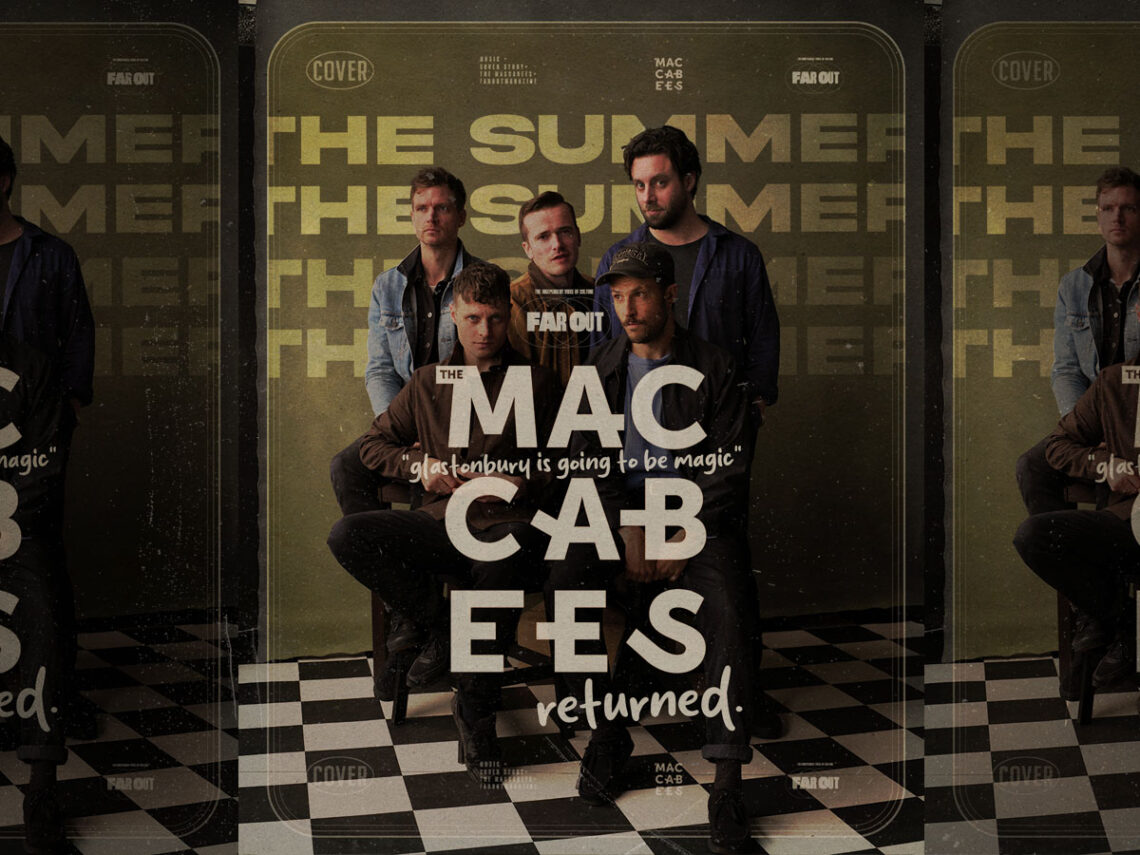
The summer The Maccabees returned: “Glastonbury is going to be magic”

Reunion can be a bit of a dirty word these days. A one-word gateway to a quick buck, fuelled by the internet’s insatiable appetite for nostalgia. I mean, there are countless bands we all want to reunite, but who do we actually need? It turns out, in the foggy October dampness, the band unknowingly perfect to fill that void were The Maccabees.
A decade is an interesting period of time to look back on. In some respects, it feels as though it has passed within the blink of an eye, out of nowhere, your face is a little wearier, your knees a little creakier, and, in my case, hair is a little thinner. But underneath it all remains the same adolescent spirit that fuelled what are arguably your life’s greatest days.
But in other respects, it feels like a historic time gone by. Through art and culture, the lens with which we view the world has changed, and the music of a decade gone by can flirt with the antiquated. And it’s safe to say, in 2025, we find ourselves in murkier waters than we did ten years prior. So naturally, a yearning for nostalgia slowly blossomed underneath the current of societal anger. But there was no way of knowing how that looked, sounded and felt. We couldn’t just dimly embrace parka jackets in the hopes that it would take us back to Cool Britannia. We needed a feeling.
“It’s been incredibly heartening,” the band’s pair Felix White and Orlando Weeks tell me, both with a wry smile and deliberate tongue-in-cheek way as they try to diffuse what was a seismic response to their comeback. A phrase continually used throughout my chat with the pair, that borders on the giddy, silly and lighthearted. A feeling that the pair hold is the one we fans didn’t realise we needed.
But moreover, it’s an important atmosphere to note, for it’s now been eight years since their last show. A time when the emotional air was heavy, the self-placed burden of fulfilling the band’s identity chipped away at the dynamics that made them so compelling in the first place. So to be sat in the sun with one of Britain’s most quietly treasured bands, sharing a laugh at my expense is undoubtedly a good sign.
“We were speaking again, and it was feeling much lighter. And yeah, you know, it was kind of like, ‘what?’ ‘Who wouldn’t do that?’” Felix said, when recalling the glimmer of opportunity that arose for the band last year. “That” was, of course, All Points East, the mammoth headline show they booked for themselves. Because there was something about walking in Victoria Park those late summer evenings that provided context to the individual members of the band, to remember that The Maccabees was more than just a project that eventually weighed heavily on their shoulders.

“All Points East was always that one,” White explained, “Where it like almost stung a bit sharper when I’d been gone to see Nick Cave or LCD or, whoever it is, Yeah Yeah Yeahs, The Strokes, you know, in that chunk of time that the Maccabees had been away, you’d always be there and you’d be like playing in your head like, ‘Oh my God, we would have been… Would we have been top of this bill? Second top of this bill?’ It punctuated the loss of it a little bit more for some reason, particularly there. So the idea that they were like, you could put your own festival together, Maccabees at the top of the bill.”
A follow-up isn’t needed, for the opportunity spoke for itself. This was a chance to do it right, on their own terms and in a place that felt natural to the atmosphere of a reunion. But in the eight years since their last show, it hasn’t been complete creative exile, and that’s arguably what’s made the prospect more palatable. Of course, The Maccabees knew a reunion simply couldn’t initially take place on the grand stage of All Points East. To reignite that innocent spark that fuelled the embers of their first album Colour It In, the five London lads did what could have quite easily hammered the final nail in the coffin: become a wedding band.
When White’s brother and fellow guitarist Hugo got married in 2020, he seized the opportunity all wedding parties should. In the spirit of leveraging all of your friends’ love and loyalty, Hugo loosely floated the idea of getting the band back together for an intimate reunion at his own wedding. Blindsided by love, the remaining members agreed and played a show that, despite following on from Adele, Florence & The Machine, and Jamie T, proved to the boys that an exciting reality, without the overbearing expectations of the music industry, existed.
But now, in 2025, having spoken to the band about the infamous secret show, on the eve of a global lockdown, I can now confidently say something I haven’t for five years: thank god for Covid-19. Because in that time of reflection, the most recent memory of normal life these five band of disbanded brothers could ruminate on was playing together.
“I do think it changed everyone a little bit, and I definitely think it gives you a bit of a sense of like, there’s every chance that you don’t ever get to do this again. And there’s every chance that, if you don’t take the opportunities, then you’ll regret them,” frontman Orlando Weeks told me.
So here the band are, eight months on from the announcement of their reunion and a further eight years on from their last tour. The damp fog of an October evening in which they announced their comeback has lifted, and the reality of the return feels palpable.
“When I think of the Maccabees, it does feel like it wasn’t me that did it right? It does feel like another person because so much has happened in that ten years between the Glastonbury or whatever is, you know, like so much life, away from each other.”
Felix White
As I sit with the band in a sun-trapped beer garden, battling hayfever and keeping a bottle of suncream within arm’s length, I can’t help but think of festivals and more specifically, one that awaits the band in just one week.
“I haven’t been to Glastonbury since we did it ten years ago,” White revealed. “Not even as a punter?” I ask, to which he swiftly replies, “Nope”.
For the band, it’s one step at a time. Because when I speak to them, they are just days out from their first official show, a charity gig for The MS Society at The Dome. “I just feel like I want to get to that and play it,” Orlando explained, continuing, “I think because it’s the first gig on Friday, I in a way can’t see beyond that. I just feel like that’s the thing. Do that and then it will answer a lot of questions and free up a lot of space in here [points to head] to, like, to see what the rest of it’s going to feel like.”
“But Glastonbury is going to be magic, I hope,” White touches wood and says, as he indulges my request to steer our conversation back to the festival, buoyed by the warm weather. Because while we may not fully divulge, we all know Glastonbury is always going to be a seminal moment, even without the added twist of Felix making his grand return to Somerset’s big party as the Sunday headliner for The Park Stage.
Because he hasn’t had the chance to figure out exactly who he is at that festival in the meantime. Footage of their last appearance there in 2015 proudly showcases the sort of carefree fanbase we’ve come to associate with the festival, but there was undoubtedly a particular glint in the eye of the band, one that knew their horizon was inching ever closer.
Despite all of the indie mountains they conquered, renewed context has made it clearer that the band were somewhat playing the part of what they thought an Other Stage act should look like. They perhaps didn’t know they, right there, onstage, were creating a legacy that in ten years’ time would have fans shaking with excitement at the prospect of their summer headlining. Without knowing that, how do you fully embrace your sense of self?
“You know, when you’re like getting older and you think of yourself when you’re 19, and you almost embarrass yourself because you can see the person you wanted other people to see you as and you’re like performing as it,” White explained.

Isn’t that what made The Maccabees so compelling for a generation? Because you don’t have to be a musician or public figure to fall into the trap of crafting a persona to fit your own expectations of self. That’s an adolescent rite of passage. But the band and fans alike needed time.
“When I think of the Maccabees, it does feel like it wasn’t me that did it right,” White elaborates. “It does feel like another person because so much has happened in those ten years between the Glastonbury or whatever is, you know, like so much life, away from each other.”
As I bob between the different areas of this South London rehearsal space, sharing hallways, drinks and laughs with various members of the band at different times, that individual growth has shifted the wider dynamic. There’s a giddiness to the atmosphere that reminds me of a band ramping up to their debut album, encouraged by nothing more than the simple prospect of sharing their music with mass audiences.
As White simply put, “The whole point of doing this was to, for the first time, do it, because it would be really, like, just a really good time and no one has to be obligated to something we decided as teenagers.”
And so for now, in keeping with all of the grander questions that have come with this seismic reunion for indie quarters, that doesn’t necessarily mean a new record. But, it doesn’t necessarily rule it out either. White continued, “We’re just going to see here and, now without thinking like, ‘oh, this record or whatever’. It’s like an overview of The Maccabees and just try and do what we used to do, you know, have those really sort of an emotive, high energy and high dynamic guitar band type shows, and just see if that feels good and right. If it has the goosebump thing to it and it feels magical, then let’s see how we feel about it. But I like the idea of looking back on the whole thing without, like, alluding to, like, oh, this is where we’re heading, you know?”
It feels like a natural continuation to the final lyric they left us with in 2015. On ‘Dawn Chorus’, the closing track from their 2015 album Marks to Prove It, they conclude with the lines, “And break it up to make it better / It’s not for us to say”. Ten years on, with the fate of their destiny firmly back in their hands, it is in fact for the band to say, who collectively agree when Orlando claims, “it was the right thing to have done”.
Partly because of what it prevented if they hadn’t, partly because of what it afforded them all when they did; but, more importantly, what it now provides us all as a collective, band and fans alike, trudging through the thick mud of a heavy society, is the chance to be uplifted by the lightness of a Maccabees reunion.
