


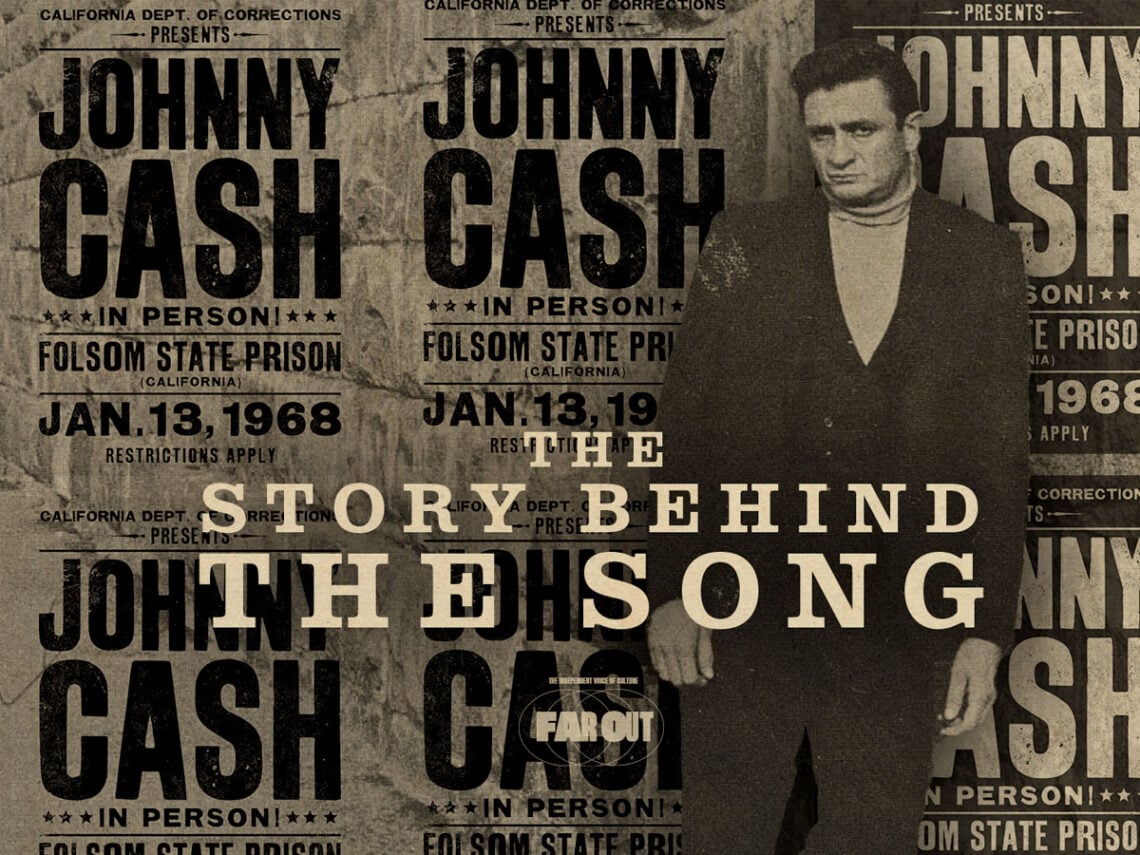
The Story Behind The Song: Johnny Cash and the two lives of ‘Folsom Prison Blues’

It’s been nearly a quarter-century now since Johnny Cash’s death, and while his legend has carried on without interruption, the line between the facts and myths of his life is getting increasingly hazy.
Maybe it’s fitting that a folklorist like Cash would become a folk hero himself, but in some cases, leaning into the big myths of the ‘Man in Black’ actually diminishes some of the real, meaningful contributions he made to modern music.
Walk into any novelty shop selling rock T-shirts and incense, and you’ll inevitably encounter the mythical version of Cash not far from the stoner posters of Bob Marley and Jim Morrison. One of the images most often repurposed for bootleg magnets and keychains these days is a mugshot photo of a 34-year-old Cash with a bandage on the side of his head, taken at Folsom State Prison in Folsom, California, in 1966.
It’s a very real photograph from the very real Folsom Prison, but it doesn’t actually depict an ‘outlaw’ Cash getting booked into the joint. The shot was choreographed as a gag of sorts for promotional purposes ahead of Cash’s first concert at the state pen in November of that year. The plaster was a prop, too, intentionally added to make it seem like Johnny had just been in a scrape with a fellow inmate.
Because he famously did have some run-ins with the law, including a pair of drug related arrests in 1965, and sang about criminals, rebels, and scoundrels throughout his career, many people are inclined to imagine that Cash’s songs were gleaned from personal experience; that he wasn’t just one of the faces of ‘outlaw country’ music, but a living embodiment of it. In truth, he never spent more than one night in a county jail for his various offences and certainly wasn’t locked up in any cells of a federal institution like Folsom or San Quentin. Suffice it to say, he also never shot a man in Reno just to watch him die.
Rather than these facts somehow making his songs less authentic, though, they actually help reveal Cash’s abilities as a writer of character studies, and his unique level of empathy for people who’d wound up on the wrong side of the law, including some of the most serious offenders.
“The torment that prisoners go through can’t possibly do them any good,” Cash told a reporter in 1969, “You sit on your cold steel mattress-less bunk and watch a cockroach crawl out from under the filthy commode, and you don’t kill it. You envy the roach as you watch it crawl out under the cell door.”
When he returned to Folsom Prison to record a live album in 1968, the inmates in the audience welcomed him with enthusiasm, not because they thought Cash was one of them, necessarily, but because they knew he respected them as human beings and wasn’t just there to preach or to collect some good publicity. If anything, Cash saw himself in them.
When he’d posed for that convict photo at Folsom in 1966, he was still in the throes of drug addiction and in the middle of a prolonged career slump. With the fork in the road clearly approaching, he knew that he could easily find himself behind bars for real if he got busted again. Fortunately, with the help of June Carter, he navigated his way down the better path.
“I straightened out, I had to,” Cash says in the 1970 biography The Johnny Cash Story, “I was ready for the gutter, you know?”
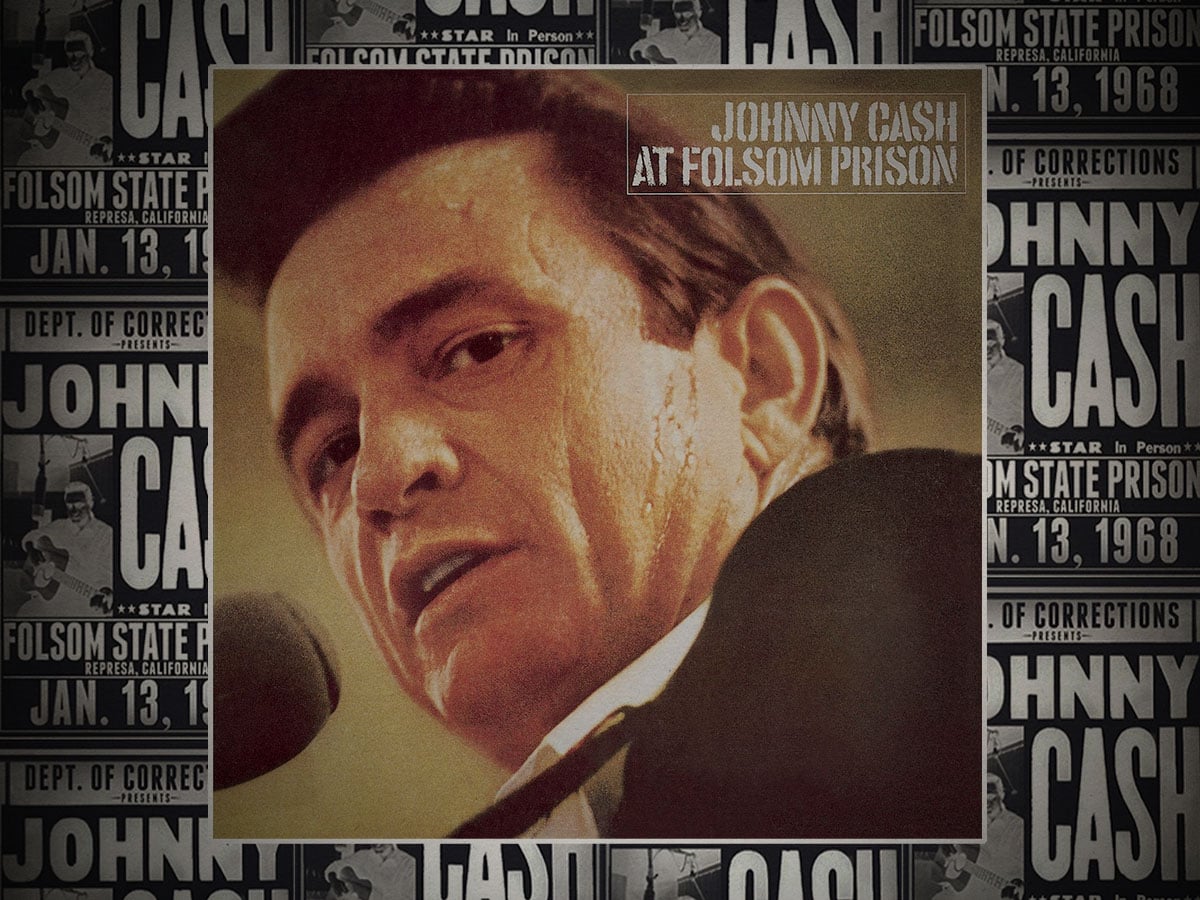
Despite escaping his own dark chapter, though, Cash became no less passionate about the cause of the people who weren’t so fortunate. His live 1968 recording At Folsom Prison, which lined up with his pill detox, completely changed his career, framing him as a cause-based performer in a turbulent time when younger audiences were looking for voices speaking in support of the common man. The album was a commercial and critical hit, and its opening track, ‘Folsom Prison Blues’, went to number one on the US country charts and number 32 on the Billboard Hot 100.
The subtle irony, of course, was that he had written that song long before he’d ever set foot in Folsom itself, with the original studio recording dating all the way back to Cash’s days on Sun Records in 1955. It was inspired not by any personal jail time, but by a film Johnny had seen while serving in the Air Force in West Germany. That movie, directed by Crane Wilbur, was called Inside the Walls of Folsom Prison, and was released in 1951 as a crime noir with a strong element of social commentary, shining a light on the inhumane state of the California prison system prior to the reforms that were ushered in during World War II.
After watching the film, a 21-year-old Cash returned to his bunk and started jotting down some lyrics on a yellow notepad. He would later downplay the moment, which was depicted in predictably cinematic “Eureka!” style in the 2005 film Walk the Line.
“There wasn’t much romance to the writing of ‘Folsom Prison’,” Cash said in The Johnny Cash Story, “I saw the movie, liked it, and wrote the song. That’s all there was to it.” In his 1997 autobiography Cash, Johnny does offer a little more insight into the song’s most famous lyric.

“That line in ‘Folsom Prison Blues,’ the one that still gets the biggest rise out of my audiences, ‘I shot a man in Reno just watch him die’, is imaginative, not autobiographical,” he wrote, somewhat needlessly setting the record straight on whether he was a murderer or not. “I sat with my pen in my hand, trying to think up the worst reason a person could have for killing another person, and that’s what came to mind. It did come to mind quite easily, though.”
The 1955 recording of ‘Folsom Prison Blues’ became an immediate breakout hit for Cash, largely because it was affecting listeners in the same way the film had affected him. At a young age, he’d tapped into the core of something that would remain a signature part of his art for the next 50 years; the ability to sing about pain, loneliness, and “hurt” not in the performative way of the old cowboy singers, but in a visceral, direct, and intimate way, more like the new generation of folk singers.
The Nashville establishment wasn’t always keen on Cash’s unusual concept albums in the 1960s, or his twisting of the cowboy song into the Native American’s perspective, but the success of At Folsom Prison forced them to reckon with the full Cash experience once and for all.
“Country music’s been building,” he told the Associated Press in 1969, “I’m still doing it the way I’ve always done it the past 14 years, but more people are buying. I think people were looking for something, and I think they’ve found it now. It’s realism and truth; I think that’s why they’re buying.”
If Cash represented the new face of gritty realism, though, it’s worth noting that, even back in the ‘60s, there was already a mythical aspect to his celebrity, and nothing was ever entirely as it seemed. One of the big reasons the live recording of ‘Folsom Prison Blues’ struck such a chord with listeners in 1968 was the inclusion of the responses coming directly from the inmates in attendance at the concert; the tension of a room full of convicts listening to a song about murder in front of their own guards and warden, cheering and whooping at the mention of that dead man in Reno.
While doing research for his 2004 book Johnny Cash At Folsom Prison: The Making of a Masterpiece, author Michael Streissguth listened to the original master tapes from the Folsom gig, and discovered that the reactions of the inmates during the concert were actually much more subdued than what ended up on the record, as the crowd that day, it turned out, was reluctant to sound too rebellious, likely for fear of suffering the consequences later. This apparently led producer Bob Johnston to either enhance or splice in crowd reactions in post-production, including the famously huge response after the line “just to watch him die”.
Those initial inmate reactions are a massive tone-setter for the entire At Folsom Prison record, and the rest of Cash’s career in many respects, but they were only as real as the Cash mugshot photo from a couple of years earlier: cheeky rebellion in a highly controlled state. Part of the legend, and part of the myth.
