


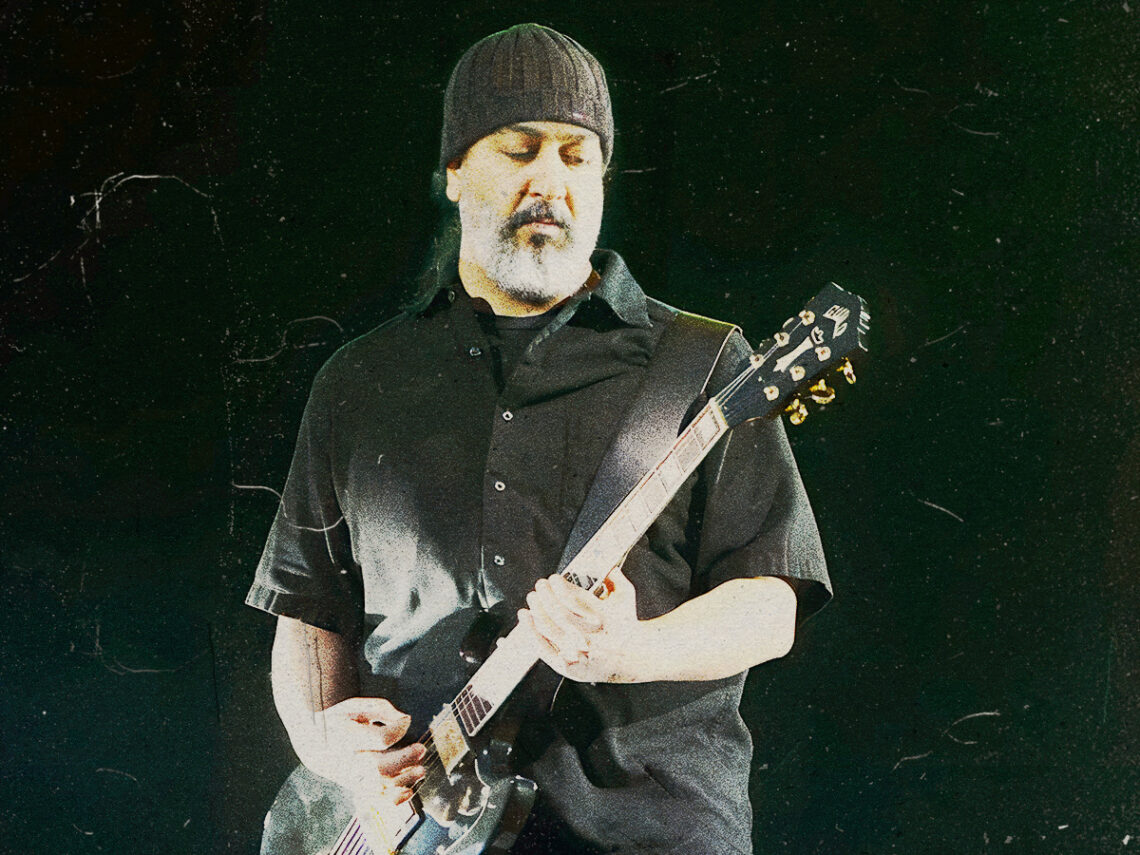
The Soundgarden song Kim Thayil struggled to play: “This is not me”

“It was this combination of bright and dark, this sense of hope and underlying moodiness.” – Chris Cornell, Soundgarden
One day, while driving home from Seattle, Chris Cornell got an idea that would unknowingly become the band’s biggest song of their career. It was a juxtaposing idea – the idea of a black hole and a sun – but delivered the kind of dissonance perfect for a song combining themes of light and dark, with a sound that was as timeless as it was atmospheric.
The third single from Superunkown, ‘Black Hole Sun’ came together from this place of somehow crafting a “surreal dreamscape”, sparked by some garbled nonsense Cornell heard in passing while listening to the radio in the car. In between other nondescript verbal flourishes, the words “black hole sun” stood out to him, sparking a creative flow that felt inherently like “Syd Barrett-era Pink Floyd, where there’s a happy veneer over something dark”.
A familiar, 1960s-esque toy with psychedelic realms and contemporary poeticism, the song is undoubtedly Soundgarden’s best, despite the argument from some loyalists that it’s not a gateway at all – merely a commercial ploy far from the distinctive abyss of their “real” discography. Nonetheless, Cornell’s pride in the track says a lot about that particular discussion, not to mention his capabilities as a songwriter in putting together a hit from a casual encounter with a random radio transmission.
But that’s not the only reason the track drew people in. The other, arguably more obvious reason – its arrangements – was something of a point of contention for the band members. Kim Thayil, in particular, felt like it was fundamentally not them. Or more specifically, not him. “On ‘Black Hole Sun’, I played the solos, the colour parts, and the chorus, but I didn’t play on the verse,” Thayil recalled to Guitar Player.
Continuing, “What I remember is the arpeggios. Now, I love playing arpeggios when you have delay or chorus on them, maybe some sustain or distortion. We would double them with high stringing from a 12-string guitar. [Producer] Terry Date introduced us to that on ‘Louder Than Love’. But the ‘Black Hole Sun’ arpeggios were stylistically unusual for me. I’ve described it as sounding like the right side of a piano, or little fairies dancing on the head of a pin like ballerinas.”
He added, “It was very delicate, and I thought, ‘This is not me.’ Chris said, ‘You’re good at arpeggios. Go ahead and do it.’”
That said, what was particularly jarring for Thayil wasn’t that it was sonically complicated, but that pulling it off as one person was technically complex (and a little impossible, despite Cornell’s vote of confidence). For instance, he recalled struggling to “punch in” because of the rotating speaker, which meant it was always in a different position. And every time he tried, he’d mess it up. So, in his desperation, he relinquished and asked Cornell to “track it” because he “thought he would do it better”.
But this disjointed improvisation didn’t distract from the broader appeal of the track, and in fact, everything flattened out smoothly, making it seem like there was never any broader issue to begin with. But this likely contributes to the argument that it’s also their best song – because, no matter the turmoil, it was always about getting it right. And from that first moment in the car, Cornell wouldn’t have settled for anything less.
