


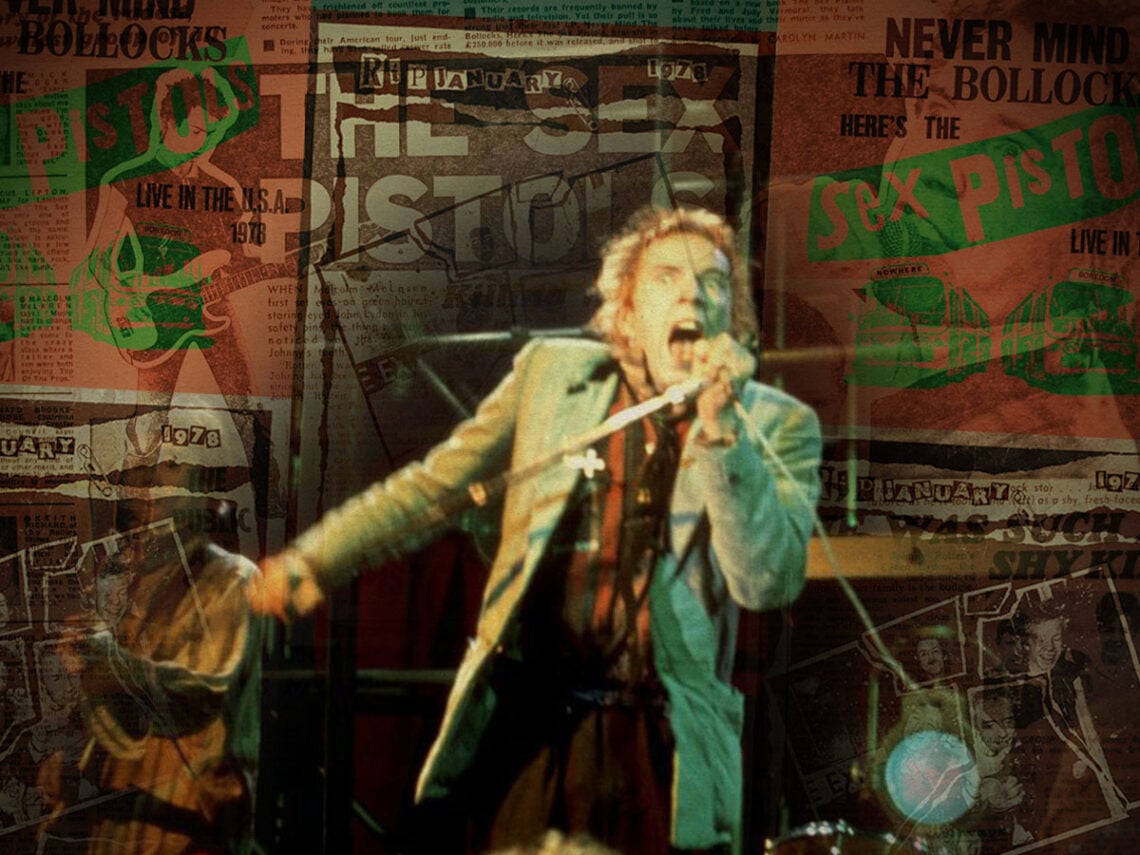
The Sex Pistols in San Francisco: A “punk Woodstock” and Altamont rolled into one

“It’s a shame,” John Lydon declared in 1994, “That most of the modern bands that say they’re influenced by punk and the Sex Pistols seem to only be attached to the mythology end of it; the glorious death of Sid [Vicious], the swindling manager. It’s a shame they don’t go much further than that.”
Lydon, as has been the case through much of his career, was talking somewhat out of both sides of his mouth. While admonishing his own admirers for not digging further under the surface, he simultaneously described the Sex Pistols, in the same interview, as “evil burlesque” and “just football hooligans with guitars. Nothing more”. This begs the question of, if the flagship band of the punk movement was just a pantomime crew, then what exactly were younger artists failing to see by not “going further”?
The answer might be easiest to find by simply looking at the seven legendarily chaotic gigs the Pistols played in America in January 1978, when four skinny, shit-talking English boys in their early 20s were dropped into the Deep South, their manager Malcolm McLaren’s idea of an amusing artistic juxtaposition. What it actually was, in retrospect, was borderline abuse, intentionally putting Lydon and his bandmates in harm’s way, hopelessly trying to get through their sets while angry bikers and cowboys tossed bottles at the stage and crunched their knuckles in anticipation of a beatdown out in the parking lot.
Yes, danger and upheaval were always necessary parts of the Pistols’ brand, and it’s what made them so fascinating and exciting in 1976, but unfortunately, it’s also what made them completely unsustainable less than two years later. If Sid could kick his drug habit or actually play the bass, or if Lydon and McLaren were ever on the same page creatively, maybe the band could have prevented its seams from bursting for a few extra years, but instead, the whole thing came crashing down in spectacular fashion in a night that effectively solidified the very mythology Lydon came to outwardly disdain.

The band that could have been the rebellious voice of the people wound up asking their own audience one of the most amusingly open-ended questions in rock history: “Ever get the feeling you’ve been cheated?”
The scene was the Winterland Ballroom in San Francisco, California, on the night of January 14th, 1978, in most respects, the friendliest setting of the band’s tour up to that point, as their ill-advised gauntlet had already taken them through consistently hostile territory in Atlanta, Memphis, San Antonio, Baton Rouge, Dallas, and Tulsa. The liberal-minded rock and roll city of San Francisco was added on as a final tour stop at the request of Winterland’s owner, Bill Graham, who was better known as the promoter who helped launch the careers of the Grateful Dead, Jefferson Airplane, and Janis Joplin.
Graham appreciated the Sex Pistols phenomenon and felt like there was an audience in his city eager to see them. This was, perhaps, too true, as somewhere between 5,000 and 6,000 people shuffled into the Winterland that night, much to Johnny Rotten’s discomfort.
“I hated that gig,” Lydon told the San Francisco Chronicle four years later.
“I really thought that was too many people. Do you know what it’s like to yell to 5,000 people and not be able to hear yourself? Bad!”
John Lydon
The giant crowd was about five times what the band had been seeing at their dates through the South, and it added some extra nerves to an already fraught situation. Sid Vicious was deep in the throes of heroin addiction, often barely able to stand, let alone play, and his performances were erratic at best, self-destructive at worst. At several shows, his bass was effectively turned down or unplugged, and in other cases, it had become a weapon, supposedly swung in the direction of trash-talking rednecks trying to charge the stage.
Lydon, Steve Jones, and Paul Cook were somewhat gallantly trying to keep things together when they arrived in California, but luck didn’t appear to be on their side from the outset. “The Winterland gig was torture,” Jones later recalled, “My guitar kept going out of tune, breaking strings. I used another guitar, and it sounded horrible.”
He also told Rolling Stone that he’d been dealing with the flu during the tour, and that Cook was “depressed”, Sid Vicious was “drunk out of his mind”, and Rotten was increasingly annoyed about all things related to Sid, including the level of attention he was getting, adding, “We were really bored with one another”.
Contrary to popular belief, however, the Winterland gig didn’t come across as a disaster to everyone in the crowd that night. Unlike some of the other cities on the tour, most of the San Francisco crowd were either true believers, industry types, or genuinely curious locals, all aware that they were seeing something of potentially historic significance. One attendee, a young San Francisco writer named Michael Snyder, found the band’s miserable attitude and sloppiness an almost welcome part of the experience. It was “an affirmation for the hardcore fans,” Snyder told Rolling Stone a decade later, “the kids who were at the source, who were hoping to start bands but didn’t have the talent to go beyond the minimalist approach of punk.”

Snyder and his friends considered themselves witnesses to a sort of “punk Woodstock”, but they were also unwittingly experiencing the ugly final chapter in a very short story, as well, the proverbial Altamont side of the coin. The physical and emotional exhaustion, the technical problems on stage, the anger and resentment toward each other and the situation they found themselves in, it all started boiling to the surface as the Pistols blasted through their 45-minute set.
At fleeting moments, Lydon’s famous contention that “anger is an energy” was proven true, as the band did reveal hints of the raw, visceral electricity they were capable of when operating as a semi-functional quartet. With the finish line of the tour in sight, though, the race to the end felt a lot more like a leap off a cliff. Everyone seemed aware that there weren’t going to be any more dates after this, nor more records. It was better, at least for this band, to burn out than fade away.
In defiance of the idea that the crowd wasn’t enjoying themselves, there was an encore and a final song, a cover of The Stooges’ ‘No Fun’, a choice that felt almost too on-the-nose. Rotten, as if imagining McLaren’s face in his mind, repeated the refrain, “No fun”, with increasing bitterness. And then, as the song ground to a halt, he stepped forward and delivered one of the great seemingly impromptu F-U sign-offs in the history of live entertainment: “Ever get the feeling you’ve been cheated?”
It was a question aimed in multiple directions at once: at the audience, who had bought into the myth of the Sex Pistols, at McLaren, whose manipulations had turned the group into a travelling circus, at the music industry, which had eagerly commodified their rebellion, and perhaps most of all, at himself, for believing, at least for a while, that any of it could amount to something of real substance.
With that, Rotten dropped the mic (he did say a quick “good night” as well) and walked offstage. It wasn’t a dramatic exit in the usual punk sense; no smashed instruments, no final crescendo, just a weary, almost resigned departure. Within days, he would leave the band entirely, effectively bringing the Sex Pistols to an end, and a year later, Sid Vicious would be dead.
Despite the disillusionment he had experienced, the guilt he felt about Sid’s demise, and the pain and frustration that he’d endured on that final tour as a 22-year-old kid, Lydon could never completely divorce himself from Johnny Rotten and what that character, and his band, represented.
“There was no punk movement,” Lydon would write in his 1994 memoir, “just the Sex Pistols and a bunch of imitators”.

Never Miss A Beat
The Far Out Punk Newsletter
All the latest Punk content from the independent voice of culture.
Straight to your inbox.