


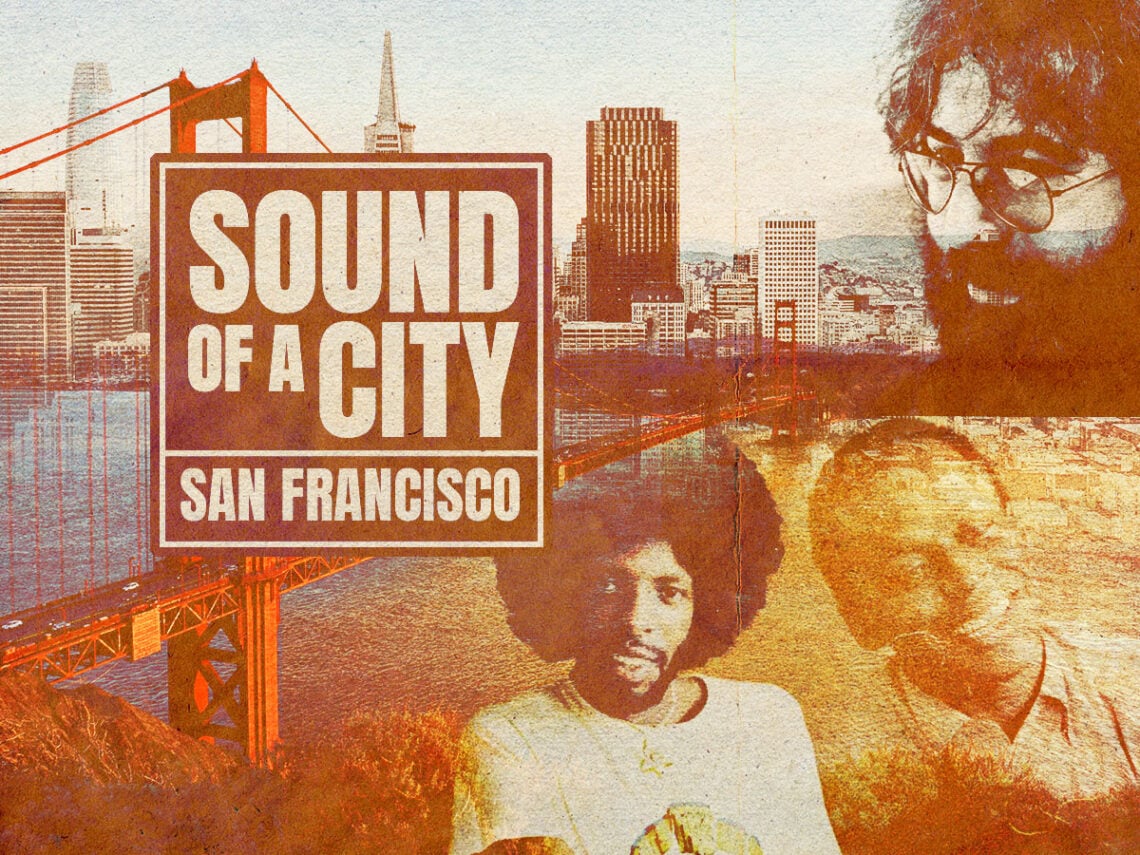
Sound of a City: A journey through San Francisco in 20 songs

There are many ways to explore a city. Anyone who has been forced to lump around after an overly-enthusiastic tourist will tell you that a city’s character cannot be captured by mere sight-seeing. Cities quite literally fill up our senses (John Denver reference not intended). We hear cities as much as we see them, so why not join us as we explore San Francisco through its music?
The first sound you’ll hear on entering San Francisco is the noise of the traffic on the golden gate bridge. Unveiled in 1937, this iconic art deco-inspired suspension bridge spans the mile-long gulf between San Francisco Bay and the Pacific Ocean. The day it opened, some 50,000 people walked across it in celebration, their footsteps pounding along the sun-scorched tarmac. There was certainly reason to celebrate. Almost from the moment it was first settled, the residents of San Francisco started conceiving ways to cross the oceanic gulf that divides it.
Even when engineers started to consider the possibility of a bridge, many were left scratching their heads and claimed that crafting something of such magnitude would only end in failure. But, then, impossibility is second nature to the golden gate bridge. According to maintenance workers, several microclimates exist along its stretch, with temperatures varying up to 20 degrees between either end, leading to stories of workers’ paintbrushes freezing in their pots in the middle of July.
In the city itself, the traffic doesn’t die down. The hum of the streets enters your bloodstream from the moment you arrive. Close your eyes, and you can hear the hard-edged slide of countless skateboarders, whose percussive slams bleed into the rattle of tramcars and the holla of prospective street-side diners waiting in line to receive something deep-fried and mouth-watering. In summer, you might even find yourself amidst the joyous roar of the city’s legendary pride parade, the first of which took place in June 1970 and saw 20 to 30 people walk from Aquatic Park to Civic Center on Polk Street.
As you continue, you’ll soon find the clamour of the city has melted away – replaced by the relative calm of one of the many tranquil parks speckled throughout San Francisco. Take the golden gate park, with its Japanese tea garden and neat hills, which offers stunning views of the surrounding city. Or, perhaps, Tenderloin National Forest – a verdant garden space in a district once filled with the sound modal jazz. Though known for its high crime and poverty rates, Tenderloin has long been home to the city’s outcasts, making it a hotbed of cultural fusion over the years. The many music venues that once lined the streets here attracted the likes of Thelonious Monk, John Coltrane, and Miles Davis – all of whom recorded live albums in Tenderloin.
Floating down to the docks, we find the echoes of another legendary artist gently reverberating along the waterfront. It was here, across from the famous Fisherman’s Wharf district, that Otis Redding rented the boathouse in which he wrote ‘(Sittin’ On) The Dock Of The Bay’. The neighbourhood still rings with the sound of fishing boats slowly churning the water as they make their into port, ready to unload their dead-eyed haul onto the wooden pontoons.
The city’s location on the shores of the Pacific has come to define the paradoxical legacy of San Francisco: a city known for both Bay Area liberality and the incarceration of dangerous criminals. The looming shadow of Alcatraz, the maximum-security prison famed for its impenetrability, cannot be ignored. The cavernous cells within this fortress prison were constructed between 1909 and 1912. After being deactivated as a military prison in 1933, it reopened as a federal one and became famous for holding the most infamous criminals of the day, such as Al Capone, Bumpy Johnson, George ‘Machine Gun’ Kelly, and Robert Franklin Stroud, otherwise known as the ‘Birdman of Alcatraz’. Despite their attempts, none of the prisoners incarcerated on Alcatraz island ever successfully escaped – or so we are told.
In 1963, struggling under the financial strain of keeping the operation running, the penitentiary was closed. Shortly after, in 1968, the island was occupied by Native American protesters led by Richard Oakes and LaNada Means. The protest group, known as Indians of All Tribes (IOAT), argued that, under the historic Fort Laramie Treaty, all abandoned or out-of-use federal land was to be returned to the Native population who had once occupied it. Seeing as Alcatraz had been abandoned, the IOAT claimed that the island qualified for reclamation and set about doing just that.
Back on the mainland, there was another protest underway, a protest of the mind. By 1968 the countercultural ‘hippie’ movement had reached its peak, and San Francisco was at the centre of it all. Having grown up looking out onto the endless expanse of San Francisco Bay, young San Franciscans were primed for utopian thinking. Surrounded by the wide expanse of the Pacific, they imagined a new world defined by individualism, pacifism, and eco-centrism. And soundtracking this utopian ideology was the cerebral pulse of bands like Jefferson Airplane and The Grateful Dead – groups who came to formulate what was coined ‘The San Francisco Sound’.
If you’re planning a trip to this beautiful city make sure you check out our San Francisco playlist below. To read about Far Out writer Thomas Leatham’s travels in San Francisco, check out his Far Out Experiences article on the Folsom Street Fair BDSM festival. Yes, you read that correctly.
