


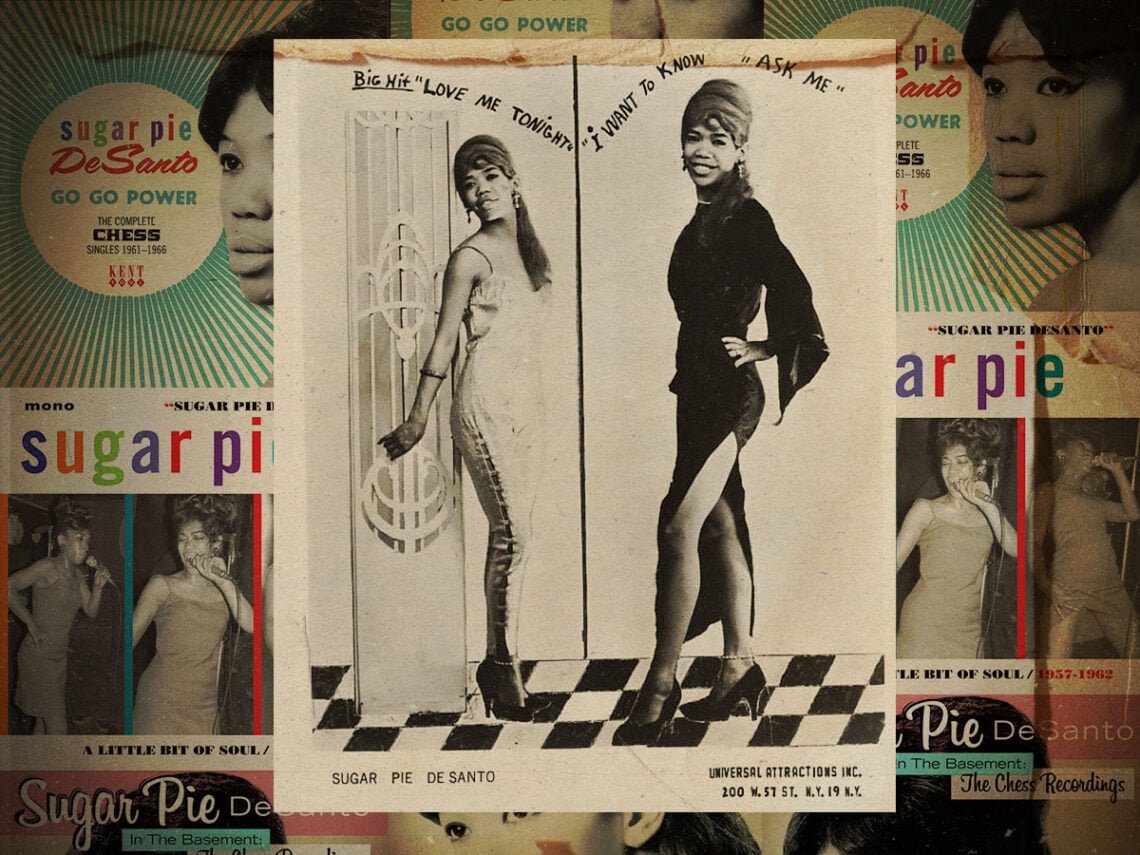
The life and times of Sugar Pie DeSanto: “Leave the stage smokin'”

Umpeylia Marsema Balinton, better known as Sugar Pie DeSanto, was a R&B singer best known for her soulful vocals. Discovered in 1955 by the pioneer Johnny Otis, she was also renowned for her acrobatic stage performances and dancing, rendering her an all-around performer. Otis was even responsible for her stage name, as she recalled, “While we were in the studio, he named me Sugar Pie because I was so little. I wore a size three shoe, and I weighed about 85 pounds. I was very tiny”.
DeSanto’s career flourished in the 1950s and ’60s after funk man James Brown spotted one of her performances at the Apollo Theatre, and he picked her to open for him. The Harlem theatre was a frequent venue where Brown would perform himself, even going on to film a live album there in 1962. Because DeSanto’s stage presence while opening for Brown was so powerful, she became known as ‘The Lady James Brown’, a nickname that, in truth, undersells and distracts from her individual brilliance. Her energetic live performance left the audience mouth-openly captivated, and she subsequently toured with him for close to two years from 1959.
By 1960, Sugar Pie DeSanto wasn’t just hanging around waiting for a lucky break. She was already scrapping her way to the front. ‘I Want to Know’, recorded with her other half Pee Wee Kingsley, punched its way onto the R&B charts and climbed up to number four, bold as brass. What made her stand out wasn’t some made-up heartache or watered-down love songs.
She was singing about real life, the rough bits most others would rather pretend didn’t happen. Sugar Pie didn’t just write songs, she told it like it was. Chess Records clocked on fast and made her their highest-paid songwriter because she was the best at it.
The fearless rise of Sugar Pie DeSanto
When the hit song ‘Soulful Dress’ landed, it was pure attitude. The groove caught listeners straight off, but it was her no-nonsense delivery that made them properly sit up. While plenty of women in music were still expected to bat their eyelashes and play nice, Sugar Pie was having none of it. She walked in like she owned the place, full of confidence and sharp as a tack. It was a proper turning point, putting female swagger right at the heart of soul music, where it belonged.
From then on, she started to write songs for popular artists like Jesse James and Minnie Riperton, a clear example of her unique writing abilities. She offered so much to R&B and soul, enjoying the art behind music as well as its performative aspects. It’s safe to say she paved the way for many female artists to come, being the only woman on the American Folk-Blues Festival tour in 1964. Without DeSanto, other female artists wouldn’t have the confidence to walk through the doors she so powerfully pushed open.
Of course, during this time, her resilience was not just tested throughout the span of her iconic career in a male-dominated field, but also in her personal life. In 2006, DeSanto tragically lost her husband, Jesse Earle Davis, to a house fire. Yet this did not dampen her thirst for performing; she continued her career, perhaps using her art as an outlet to express her unfathomable pain.
Throughout her life, Sugar Pie was constantly surrounded by blooming talent, being childhood friends with the great Etta James, with whom she went on to collaborate and sing on multiple occasions. Together, they recorded two prominent duets, ‘In the Basement’ and ‘Do I Make Myself Clear’. However, despite writing over 100 songs, success akin to James’ still eluded her. This is not to say it wasn’t deserved, but her name had slipped under the radar until rather recently.
In 1999, DeSanto received the Bay Area Music Award for ‘Best Female Blues Singer’, and, then again, in 2008, she was given the ‘Pioneer Award’ from the Rhythm and Blues Foundation. But it doesn’t stop there, as recently as last year, she was inducted into the Blues Hall of Fame, alongside other greats like Bessie Smith and Ruth Brown.
Later, after her time with Chess Records, DeSanto moved back to the Bay Area, where she proceeded to record and perform for the coming decades. She continued to record for other labels and even founded a recording home, under Jim Moore’s label, Jasman. They started producing music out of this recording home in 1972. Sadly, DeSanto passed away in 2024 at the age of 89, but her musical talents are still felt starkly, because, as she liked to say, “I like to leave the stage smokin'”, and the embers burn bright. With a fierce approach to changing the R&B sound, her personality and passion are a bedrock of the genre now. Her eclectic stage performances and overall commitment to the craft have left a legacy that continues to outlive her.
