


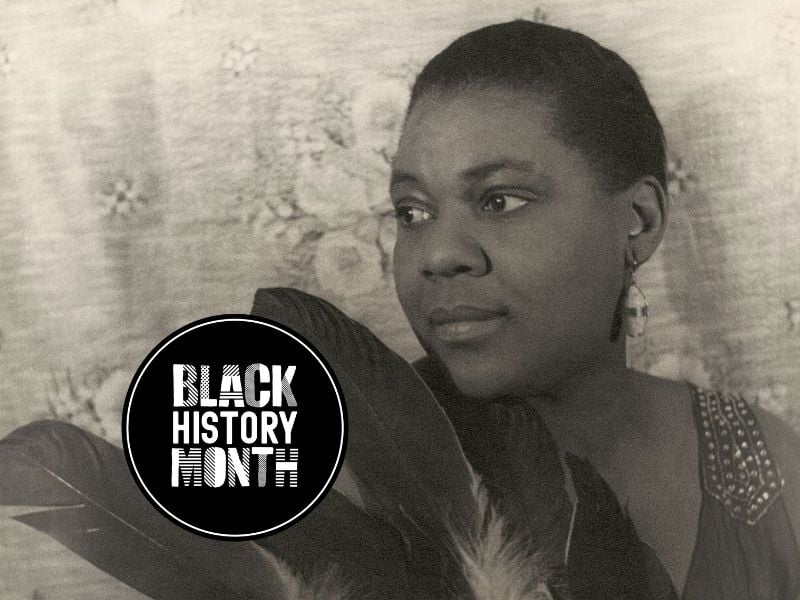
The life and times of Bessie Smith: Music’s first diva

Bessie Smith was one of the most influential singers of all time. Hitting her creative zenith during the Jazz Age, she became known as the ‘Empress of the Blues’, which says it all about her status. The most popular female blues singer of the 1920s and ’30s, Smith helped to drag music into the future by challenging social attitudes.
Possessing an immense vocal talent, she was a considerable influence on the development of blues and jazz, setting the stage for figures such as Billie Holiday and Louis Armstrong in the not too distant future.
Smith was born into abject poverty in Chattanooga, Tennessee, in 1894. She was only a child when both of her parents died, so she and her six siblings survived by performing on the streets. After her parents had passed on, her older sister, Viola, took it upon herself to care for the siblings. However, because they were without parents, Smith didn’t have an education. This reflects just how bleak her childhood was.
Mainly, it was Bessie and her brother Andrew who earned money by performing on the streets, and it was here where she gained her true education. She sang and danced, and Andrew played the guitar, and they would regularly perform in front of the White Elephant Saloon, which was at the centre of the city’s African-American neighbourhood. She cut her teeth at a young age, and this stood her in good stead for the not too distant future.
Bessie’s rise to fame would be set in motion by her eldest brother, Clarence, who left home to join a travelling troupe of musicians in 1904. “If Bessie had been old enough, she would have gone with him,” remembered Clarence’s widow, Maud. “That’s why he left without telling her, but Clarence told me she was ready, even then. Of course, she was only a child.”
However, her day would come. Some eight years later, in 1912, Clarence returned home with the troupe. He arranged for Bessie to audition with the managers of the band, Lonnie and Cora Fisher. Initially, Bessie was hired only as a dancer because the company already had their money-maker, in blues legend Ma Rainey. However, to be in the presence of such a lauded vocalist helped Smith tremendously, and it is credited with her developing her artistry.
In 1913, Smith started branching out and forming her act, centred at The 81 Theater in Atlanta, Georgia, and things then moved quickly. By 1920, Smith had cultivated great respect in the South and on the East Coast, and she was all primed for the major leagues. Around this same time, the track ‘Crazy Blues’ by Mamie Smith (no relation), was released by Okeh Records and pointed to the fact that there was a new market for record companies to explore.
The song sold over 100,000 units, and prior to this moment, the music industry hadn’t thought about marketing to black people for racist reasons. However, now that Mamie Smith had opened up the floodgates, everyone wanted to get in on the action. The hunt was on for female blues vocalists.
In 1923, Bessie Smith was snapped up amid this newfound gold rush. Soon enough, she was signed to Columbia Records by the legendary talent scout Frank Walker, the man who later discovered iconic country figure Hank Williams. Walker had seen her perform years earlier to this new boom and knew she was perfect.

Smith started her career on the label’s A-series, but when the company established their incredibly cynical ‘race records’ series, her September 1923 track ‘Cemetary Blues’ was the first to be issued under that banner.
During the mid-1920s as her popularity reached wondrous heights, Smith became a headliner of the Theatre Owners Booking Association (T.O.B.A.)
and became its hottest attraction. This combination of popular records and a hectic touring schedule made Smith the highest-paid African-American entertainer of the day. She was so famous that she travelled the country in a 72-foot railroad car. Prior, such heights were thought impossible for a woman from such a lowly background.
Columbia’s media wing gave her the moniker of ‘Queen of the Blues’, but the media thought this wasn’t enough for a performer travelling in their own rail carriage. Before long, she was awarded the title ‘Empress of the Blues’, and afterwards, her legacy was cemented in history.
The themes of Smith’s works were also groundbreaking. She described female independence, fearlessness in the face of adversity and sexual freedom, arguing that working-class women shouldn’t have to change their behaviour to be respected. She challenged longstanding norms by encouraging women of her class to drink, party and have sex as a means of alleviating the burden of everyday life. For the 1920s, this was precocious in every sense of the word.
The way she flipped the Conservative idea of African-American womanhood beyond the realms of conformity and domesticity was also groundbreaking. In many ways, Smith was the first iconoclastic woman in music history. Showing this, the themes she sang about wouldn’t be accepted until the ’60s. However, this also made her controversial, as many things she sang about were thought heinous by many in society, black or white.
Ironically, this iconoclasm would open doors and, subsequently, close them for Smith. She once auditioned for Black Swan Records, which included eminent intellectual W. E. B. Du Bois on its board but was dismissed because of her perceived roughness, a damning indictment of the misogyny of the era. Black Swan would regret their decision, though, as they watched Columbia reap all the monetary awards from music’s original diva.
In total, Smith made 160 records for Columbia and was ballasted by some of the most lauded musicians of the day, including Louis Armstrong, Fletcher Henderson and Charlie Green. Smith would also start to move from jazz and blues into swing. In 1933, John Henry Hammond, Billie Holiday‘s mentor, asked Smith to record for Okeh, a subsidiary of Columbia.
However, this transition was cut short when Smith was killed in a tragic car accident in September 1937. She was only 43, but in her short time had managed to enact a change in music that would carry it through until the rock and roll revolution of the ’50s. One of the first African-American pioneers in music, Bessie Smith’s legacy lives on today. Without her, there’d be no Beyoncé, Kanye West, Amy Winehouse or any other significant artists of contemporary culture.
