


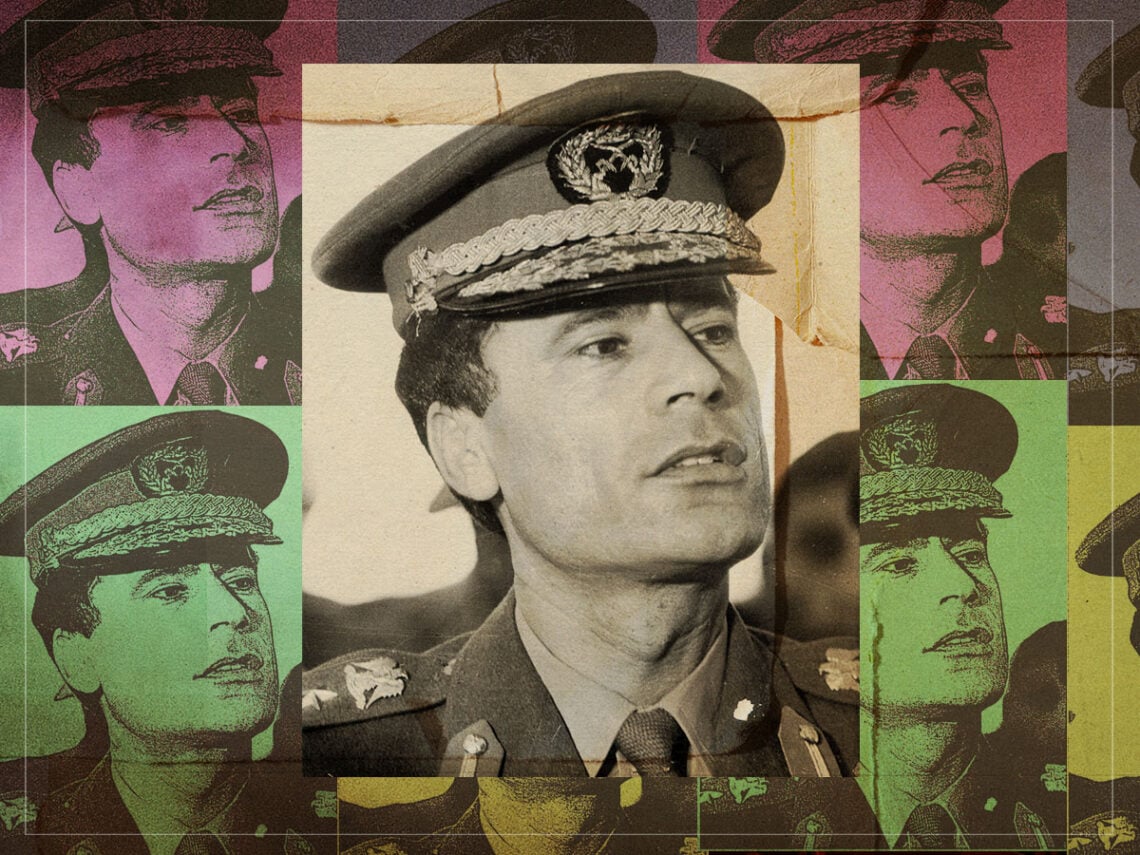
The funk albums funded by Colonel Gaddafi

A legacy that still casts a complicated shadow across the North African republic, Colonel Muammar Gaddafi’s 1969 coup established an over four-decade authoritarian rule over Libya. Carried out by the Free Officers Movement, a collective of Arab Nationalists and Nasser-aligned high-ranking members of the Libyan Army who wanted to oust the head of state, King Idris I, initial revolutionary ambitions of Arab Unity gave way to a cult of personality that ulcerated among the Libyan population up until the upheaval of 2011’s Arab Spring.
Born to a peasant bedouin family in the rural desert region of Tripolitania, the young Gaddafi was swept up in the anti-imperialist rhetoric of Egypt’s charismatic leader Gamal Abdel Nasser, a chief figure of the pan-Arabic wave that swept across the Islamic world. Pursuing a career in the Libyan Army, Gaddafi rose through its ranks as the Senussi monarchy was losing popular support. Amid a climate of nationalist protest and growing tribal alienation due to the government’s increasing centralisation, Gaddafi and his cadre of coup plotters seized the opportunity to strike. Blocking all political offices, airports, and police depots, Crown Prince Hasan was forced to relinquish his claim to the throne, and the bloodless coup’s victory was announced by Gaddafi himself via a radio address to the Libyan people.
After consolidating power in the early 1970s, Gadafi established a new ideological foundation for the Libyan state. Inspired by Chairman Mao’s Cultural Revolution, the country adopted the official title ‘Socialist People’s Libyan Arab Jamahiriya’, ostensibly a direct democracy between the people and the executive and claiming to reject both capitalist and Marxist-Leninist economic models. Ushering major administrative and social reforms, the revamped regime swapped local authorities for ‘revolutionary committees’ and implemented radical restrictions on private ownership, liberating half the country and sowing discontent for the other.
Keen to spread his new ‘Third International Theory’ philosophy beyond Libya, Gaddafi sought novel ways for his good word to travel worldwide. In addition to issuing The Green Book and proving a reliable exporter of global terror activity, including culpability in the Lockerbie massacre and IRA funding, popular music was embraced as a suitable vehicle for his regime’s rhetoric. Funded by the Overseas Broadcasting Department of the Socialist Jamahiriya, an extended organ of the Libyan Jamahiriya Broadcasting Corporation, several funk and disco records were recorded propagandising Gaddafi’s cult of personality.
The OBDSJ based in Malta, its The Voice Of Friendship And Solidarity record label recruited several local artists to cut contemporary pop songs, allegedly managing a string of records with only a handful archived in any fashion. The most prominent is the Jamahiriya LP, featuring Bayzo, Joe Cutajar (Malta’s answer to Frank Sinatra), and Mary Rose Mallia, and the majority of songwriting credited to Alfred Sant and Raymond Agius.
A conductor from Mosta primarily known for penning three of Malta’s Eurovision Song Contest entries in the 1970s and ’90s, Agius was largely attracted to the project due to the offer of working in a state-of-the-art studio. Revealing to Bas Tukker in 2018: “The idea behind it being to promote to a wider audience the ideology of Gaddafi’s ‘Green Book’ through popular music. It had to be a professional production and the managing director promised we could record our songs with a live orchestra if needed. Alfred and I made it clear to him that such a project could not be done in Malta. ‘No problem’, he said, ‘You will get your fifty-piece-orchestra and we will record it in a professional studio in Rome’. It was a golden opportunity for us. For years, we had dreamt about going to a professional studio to record our material. This obviously was an opportunity which we couldn’t pass up.”
Recording Jamahiriya in Rome’s Mammoth Studios, Agius remarked on the impression he had left on the team there: “The resident conductor of the studio was impressed by the arrangements. ‘This sounds like New York!’ he said. He was astonished when being explained these were the first-ever arrangements I had written.” Sant and Agius were comissioned further albums across the mid-1990s, even a conceptual musical with liberationary themes called The Struggle, Agius expressing fondness for his Libyan opus: “It is regrettable the rock opera was never performed in public, but I am proud of the album which was released. I would describe the music as pop rock, slightly theatrical and occasionally with a jazzy feeling.”
As the decades passed, and Gaddafi’s favour with the West wavered back and forth across the ‘War on Terror’, his eventual overthrow and violent death forged a stark, defining image of the Arab Spring to the eyes of the world. Agius continued to thrive in the Maltese music industry, composing for film and TV and influencing his son on a creative path, DJing under the moniker Jupiter Jax.
