


The Cover Uncovered: The story behind ‘The Dreaming’ by Kate Bush

1982’s The Dreaming marked a fiercely pivotal moment of Kate Bush’s creative journey.
A seismic sonic leap was detected on Never for Ever two years earlier. Stung by predecessor LP Lionheart’s lacklustre retread of the orchestral chamber pop already perfected on her 1978 The Kick Inside debut, Bush eagerly sought to ignore EMI’s top-down pressures to rush-release further records, granting subsequent sessions the time needed to realise her innovative popcraft, as well as stepping up to further production duties.
Crucially, the revolutionary Fairlight CMI synthesiser would unveil a near-limitless aural terrain for Bush to explore. One of the earliest digital samplers, a new ethereal flourish breathed otherworldly life into her work from then on, hinted at on Never for Ever but blooming on The Dreaming, the first sign of Bush’s new aural realm granted to her by the Fairlight’s capabilities.
Its disparate thematic make-up is seemingly scored by an equally eclectic collage, haphazard jumps across the Vietnam War, Indigenous Australian culture, and supernatural horror are likewise translated with crashing percussion, folk wanders, and blasts of vaudeville music hall.
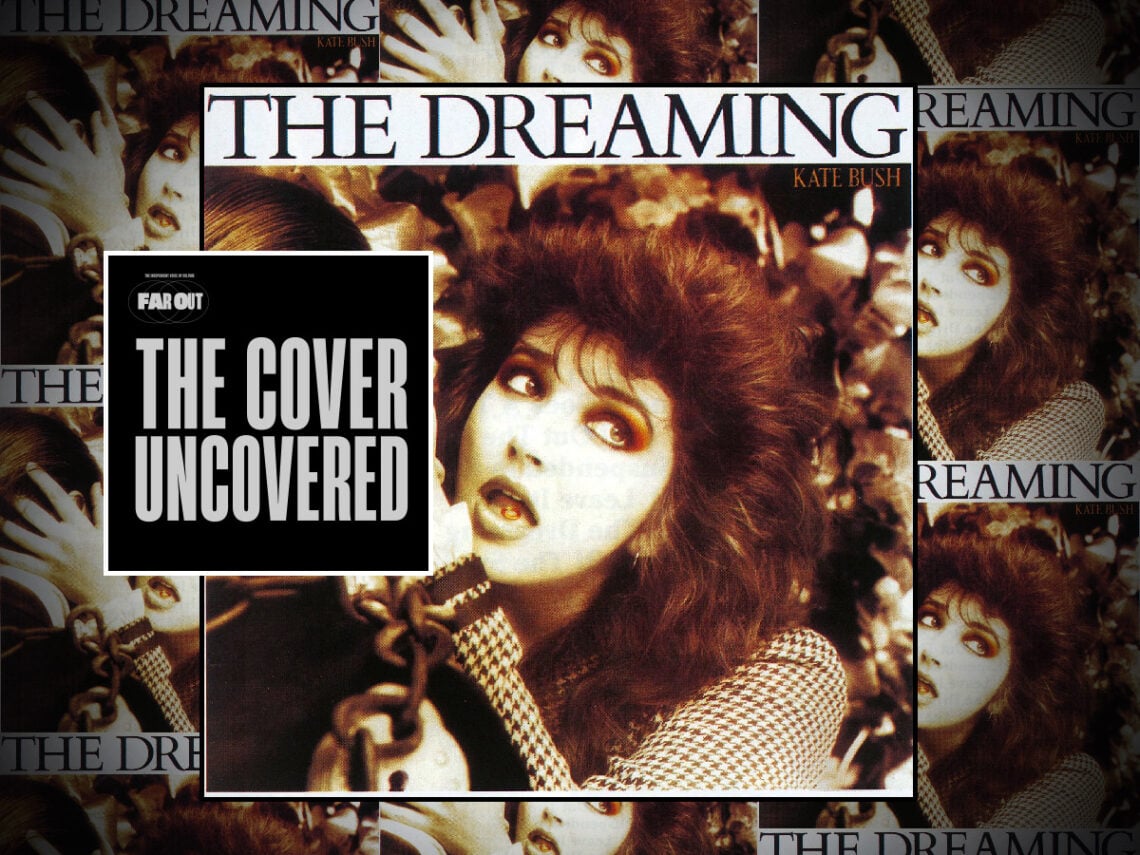
Yet, the story of famous escapologist Harry Houdini stands as a contender for the album’s key centrepiece. As well as directly inspiring ‘Houdini’, The Dreaming’s artful front cover also presents a sepia snapshot of the elusive illusionist seemingly embracing his wife Bess.

As lyrically detailed in its associated song, Bush plays the part of Bess, possessing a small key on her tongue ready to be exchanged via the ruse of a kiss in front of the audience, seizing her manacled and shackled lover, Houdini, played by engineer and Bush’s then-partner, Del Palmer.
There’s a deeper, spectral undercurrent, however. After Houdini died in 1926, Bess, despite Houdini’s strenuous efforts to debunk psychics and mediums in his career, had arranged many séances to make contact with her former love from the supposed spiritual plane.
In their arranged efforts to eschew phoney ghost whisperers, an agreed codeword, “Rosabelle believe”, would be conveyed through the medium, thus a sign that Houdini really was speaking from the grave. Reportedly, a successful contact was made in 1929 via US clairaudient Arthur Ford, secret code and all, but later claimed the password had been gleaned through some outside trickery.
Whatever the case, Bush found the story fascinating. “It is such a beautiful and strange story that I thought I had very little to do, other than tell it like it was,” Bush revealed in her fan club newsletter at the time. “But in fact, it proved to be the most difficult lyric of all the songs and the most emotionally demanding. I was so aware of trying to do justice to the beauty of the subject, and trying to understand what it must have been like to have been in love with such an extraordinary man, and to have been loved by him.”
The strange case of Houdini and Bess’ dramatic relationship is gloriously wielded on The Dreaming’s stirring cover, heralding Bush’s further cementing as a master storyteller keenly offering hints and clues beyond the peripheries of her pop songbook.
