


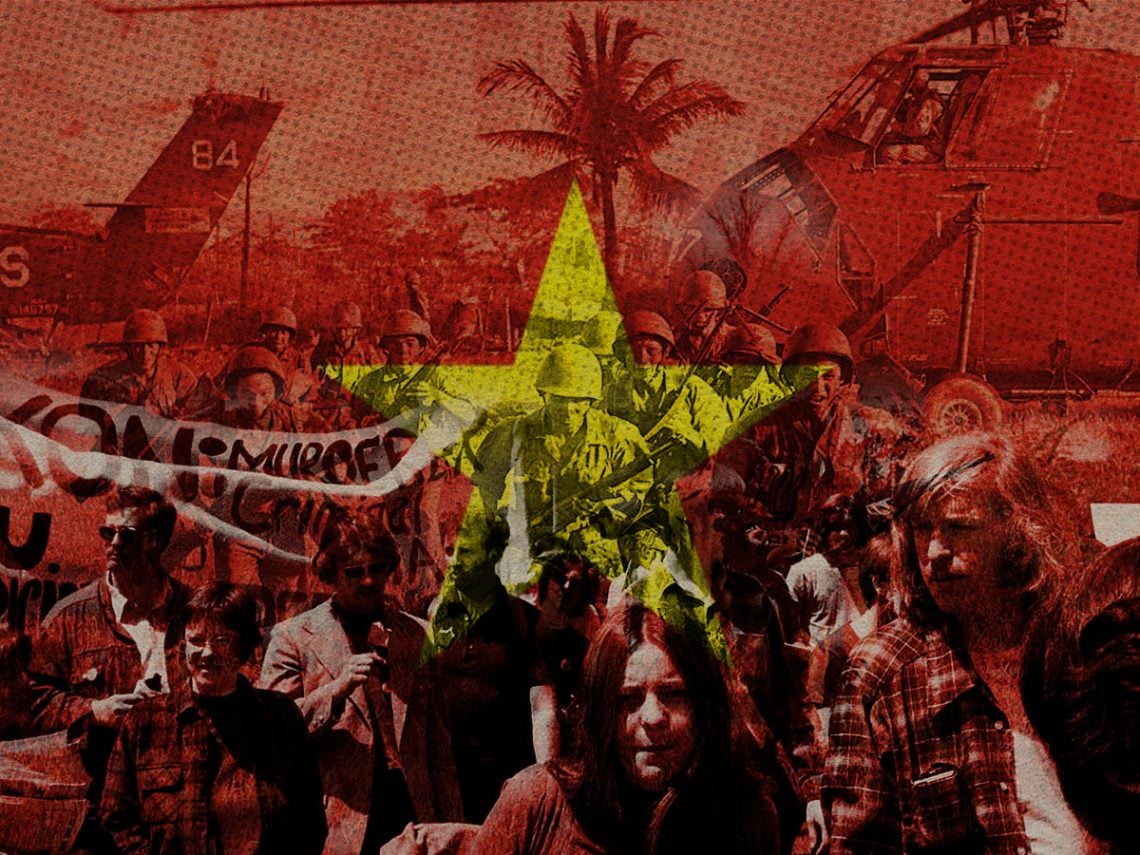
How did the Vietnam War change popular culture?

From Forrest Gump to the cover of Rage Against the Machine, the Vietnam War has permeated popular culture for decades. Of course, this is unsurprising, given that the conflict was one of the most significant and controversial happenings of the 20th century. Erupting on November 1st, 1955, and ending with the fall of Saigon on April 30th, 1975, the war had an indelible impact on the region and the world, with its effects reverberating throughout time. The second of the Indochina battles was fought between North Vietnam and South Vietnam, with the North supported by the Soviet Union, China and other communist actors. Conversely, the South was backed by the United States and their anti-communist allies.
The situation was the definitive proxy combat of the Cold War. Ultimately, the US and its partners failed in their objective to stop the perceived threat of the ‘Red Menace’, with America’s direct involvement grinding to a halt in 1973. Indicating the scope of a major failure by the US, by the end of 1975, Vietnam and the neighbouring states of Laos and Cambodia were under communist rule. This was only the geopolitical cost. Estimates of the number of casualties vary between 1,326,494 and 3,447,494. It was a disastrous war in all areas that coincided with America’s most tumultuous socio-economic period. Both aspects compounded each other, making it an episode that cannot – and should – not be forgotten.
In his consequential work, Orientalism, the late Edward Said notes something called “political society” in Western countries such as the US, Britain, and France, which was midwifed by the Vietnam conflict. He writes that because these countries are “imperial powers, their political societies impart to their civil societies a sense of urgency, a direct political infusion as it were, where and whenever matters pertaining to their imperial interests abroad are concerned”. Whilst there are various theoretical readings to be extracted from this definition of political society, for this piece, we understand it as a politicised society, whereby those in a democratic country uphold its institutions and hold them to account.
The era of the Vietnam War, particularly in the 1960s, is best described as the era of political society for the West. From the civil rights movement to feminism, subjects united in civil movements to protest what they considered the state’s failings. As the conflict in Vietnam weighed so heavily on the collective psyche, with the human and economic cost immense, people were within their rights to vocalise their thoughts. Whilst the war was vehemently opposed by some, it was staunchly supported by others. This created a schism, naturally entering the discourse, arts and popular culture. In short, it was the pressing topic of the day that affected all elements of society, despite race, gender or class.
One figure who had a major role in protesting the Vietnam War and assisting the subject permeate popular culture is the actor and Vietnam GI resistance supporter Jane Fonda. She was the star of 1968’s hit science fiction romp Barbarella and the daughter of Hollywood royalty Henry Fonda. On November 2nd, 1970, she was arrested for drug smuggling at Cleveland airport as she returned from a Vietnam Veterans Against the War (VVAW) event in Canada. The following day, she was then charged with kicking a police officer.
The debacle culminated in a now-iconic mugshot, with her fists raised in defiance at the regime. It became one of the most famous celebrity instances of the Vietnam War converging with popular culture. As for the charges, they were proved bogus, and both dismissed, with the ‘drugs’ actually vitamins. Fonda remains a campaigner for righteous causes and maintains that the arrest intended to discredit her invaluable support to the anti-Vietnam War movement.
Whilst Fonda’s actions were literally and symbolically important to the Vietnam War, making its mark on popular culture in the process, they were underpinned by the vital factor in all of this: the countercultural ethos. The counterculture was the greatest opponent to the war in America, with those who subscribed to it – mostly young people – antithetical to those who supported the battle. This meant that the schism was of a broadly generational nature, not dissimilar from the one in Britain today with Brexiteers and non-Brexiteers. Famously, the countercultural philosophy was greatly indebted to the Beat Generation of writers, Allen Ginsberg, Jack Kerouac, William S. Burroughs, and others.
These were hedonistic non-conformists who emerged in the 1950s, searching for liberation in many different areas, from sexual to racial, using their art as their weapon to establish the brave new world. Eventually, a dynamic subculture of hippiedom arose from the Beatnik social movement in the mid-1960s. At that moment, the 40-year-old Allen Ginsberg was present and would be a key player in dictating the nature of its metamorphosis and future operations.
Displaying this inextricable link to the counterculture, Ginsberg and other beat writers, such as Gary Synder, were regular contributors to the San Francisco Oracle, the underground newspaper of the movement circulated in the Haight-Ashbury neighbourhood of San Francisco, the epicentre of all things hippie. Ginsberg also had a significant organising role in 1967’s hippie ‘Be-In’, often described as the pinnacle of the movement when its euphoria and growth peaked.
Former Nirvana manager, music executive and writer Danny Goldberg – who reviewed the last gathering of the counterculture, Woodstock Festival in 1969 for Billboard – remembers Ginsberg’s role in the counterculture and protesting Vietnam as part of In Search of the Lost Chord: 1967 and the Hippie Idea. In addition to his field experience, Goldberg is in an ideal position for this analysis, working with Ginsberg on his last recordings in the early 1990s.
In the book, he notes the type of artistic protests that Ginsberg waged against the Vietnam War and its proponents. It was incredibly influential for the present issue and set an example for the future and those who would use art in protest against other issues. We see acts like Dead Kennedys and Rage Against the Machine as examples. They took the blueprint and repackaged it for their listeners, breathing new life into it.

Goldberg acknowledges Ginsberg as “an unrelenting critic of militarism” and then turns his attention to his 1966 poem ‘Wichita Vortex Sutra’, which mocked the then-Secretary of Defence Robert McNamara. The politician famously described one of his catastrophic errors in escalating the war as nothing more than a “bad guess”. This language was deemed flagrant ignorance of the hell unfolding on the ground. Additionally, in his provocative style, Ginsberg pushed the boundaries of the law in the poem and included explicit references to the alleged homosexuality of FBI Director J. Edgar Hoover and New York’s Cardinal Spellman, the latter of whom was a vocal supporter of the conflict. The openly gay Ginsberg wrote: “How big is Cardinal Vietnam? / How little the prince of the FBI, unmarried all these years!”
For context, Goldberg claims that when he asked Ginsberg if he knew Hoover was gay, he nodded. Asked why the usually outspoken artist had not been more vocal about Hoover’s sexuality during an era when he was wreaking havoc on the lives of decent people, Ginsberg offered a pertinent answer. He said he had a friend when in college at Columbia who regularly had sexual relations with Spellman. The unnamed friend once asked him if he was concerned that his sexual preferences would ruin his career if ever made public. The prelate supposedly laughed and said, “Who would believe it?”. Ginsberg told the author that in the context of “the repressive power of the establishment at the time”, the words of his poems were as far as he felt he could safely go.
In reality, this kind of artistic resistance was indeed all they could do, as the unscrupulous nature of the systems of power was well-known. Need we mention why Jane Fonda thinks she was charged with drug smuggling? This view meant that the arts took on considerable responsibility for influencing change, as in a democratic country, they couldn’t possibly arrest an artist, could they?
Furthermore, in America, people were weary following the 1963 assassination of President JFK and civil rights hero Dr Martin Luther King Jr in 1968. They needed other means of standing up as a political society besides explicit protest, so art became a common conduit. It was via this entrance that the Vietnam War started to permeate popular culture, directly and indirectly.
Music was one place where it became very pronounced. The war influenced a generation of songwriters and musicians in Vietnam, the United States and the world. The Vietnam War Song Project has identified over 5,000 songs about or referencing it – in protest and support. Concerning the anti-Vietnam protest anthems in the West, Country Joe and the Fish’s ‘I-Feel-Like-I’m-Fixin’-to-Die Rag’ became one of the most popular. Writer Joe McDonald’s sardonic lyrics perfectly captured the nihilism with which the younger generation viewed the fighting. Take the chorus, for example: “And it’s 1, 2, 3 what are we fighting for? / Don’t ask me I don’t give a damn / The next stop is Vietnam / And it’s 5, 6, 7 open up the pearly gates / Well there ain’t no time to wonder why / WHOOPEE we’re all gonna die”.
Elsewhere, The Rolling Stones’ 1969 epic ‘Gimme Shelter’ also explicitly approached the horror of the Vietnam War. “Rape, murder, it’s just a shot away” is a stark segment of the lyrics that stands out. Frontman Mick Jagger told Rolling Stone on reflection: “Well, it’s a very rough, very violent era. The Vietnam War. Violence on the screens, pillage and burning. And Vietnam was not war as we knew it in the conventional sense. The thing about Vietnam was that it wasn’t like World War II, and it wasn’t like Korea, and it wasn’t like the Gulf War. It was a real nasty war, and people didn’t like it. People objected, and people didn’t want to fight it … That’s a kind of end-of-the-world song, really. It’s apocalypse; the whole record’s like that.”
Many of the era’s other most influential musicians supported the anti-war movement, including Bob Dylan, Nina Simone, John Lennon, Joan Baez, Neil Young, John Fogerty, Arlo Guthrie, Pete Seeger, and numerous others. These artists espoused the Beat-inspired sentiment and attitude that the likes of Dead Kennedys and Rage Against the Machine utilised in the future. This set of musicians’ support of the anti-Vietnam movement is also one of the main reasons music remains an essential ally in the face of tyranny and oppression. Just look at what Pussy Riot have been doing in Russia for so long. Some punks might not like it, but there’s an inextricable link between their subculture and hippiedom.
Other areas, such as cinema, were also weaponised, with movies like Michael Cimino’s 1978 outing The Deer Hunter, Francis Ford Coppola’s 1979 effort Apocalypse Now, and Stanley Kubrick’s 1987 outing Full Metal Jacket starkly depicting the brutality of the Vietnam conflict. They use it as a lesson into what unfolded in the region whilst being generally anti-War adverts. Even Robert Zemeckis’ 1994 epic Forrest Gump – adapted from Winston Groom’s 1986 novel of the same name – miserably portrays the Vietnam War, much like the book.
Perhaps without pieces of cinema like the above – excluding Forrest Gump – we wouldn’t have had later efforts such as Kathryn Bigelow’s 2008 award-winning project The Hurt Locker. None of these films glorify war like some elements of American society and popular culture did when the Vietnam conflict raged. They’re realistic and appropriately heartbreaking. Regardless of where you’re from, these human themes are universal.
As an interesting side note, the greatest symbolic convergence of the Vietnam War and popular culture occurred during the Yippie invasion of Disneyland. On August 6th, 1970, around 300 members of the Youth International Party or Yippies – the radical youth arm of the counterculture – invaded Disneyland, California, protesting the Vietnam War and calling for Minnie Mouse’s liberation from patriarchal captivity. Known for the absurdist angle to their protests and once labelled “Groucho Marxists” because of it, the Yippies were a widely influential group, with former Dead Kennedys frontman Jello Biafra subscribing to their outlook.
Disney hired extra security, and 150 riot police were called in preparation for the invasion, which the Yippies advertised as one of their theatrical “conventions”. The radical youth engaged in a handful of provocative actions, including commandeering a raft to storm Fort Wilderness, openly smoking weed and snake dancing down Main Street, USA. An utterly bizarre cultural insurrection at the stronghold of America’s most famous entertainment company, this was a literal manifestation of the counterculture smothering popular culture.
Whether it be music, films, literature or even how we protest, the Vietnam War seared itself into popular culture, with society transformed because of it. Everything mentioned here was just the tip of the iceberg, too.
