


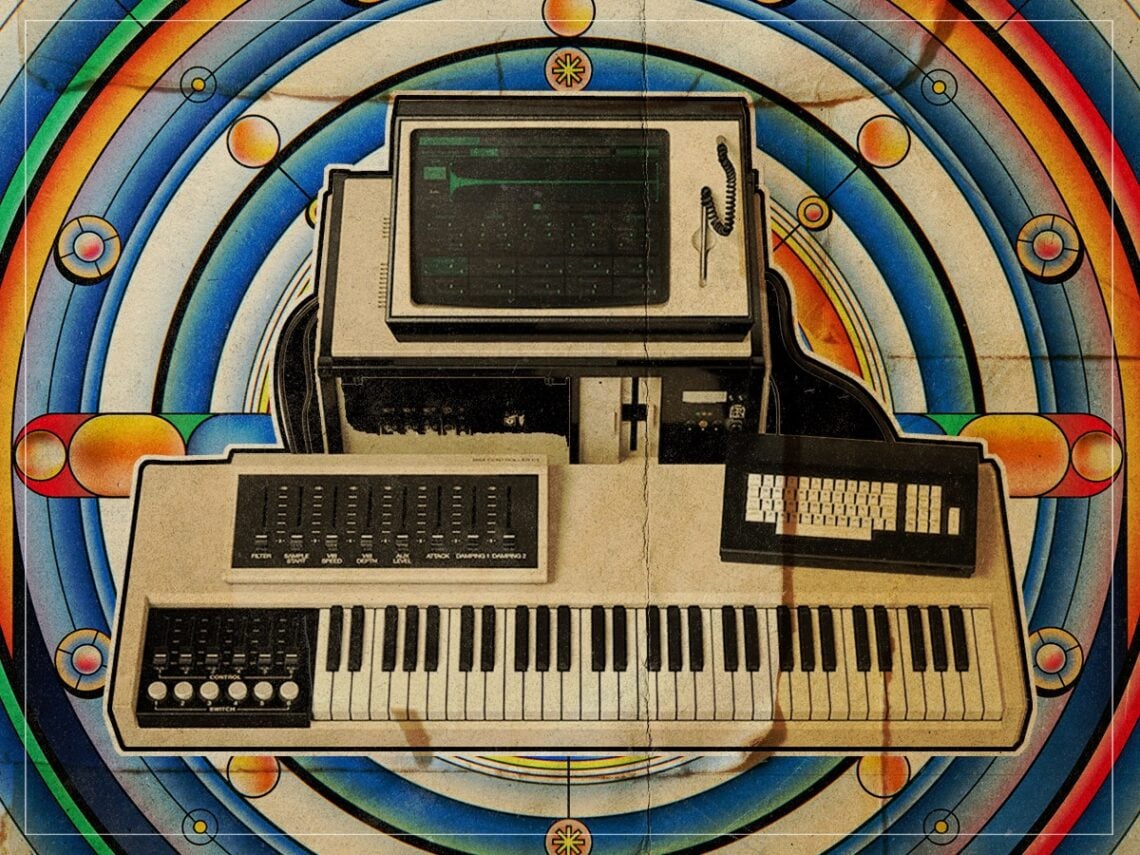
The sound of the 1980s: What was the Fairlight CMI?

Being able to identify musical instruments by sound may make one sound like an anorak, but really, anyone who has listened to pop music can basically do the same. Brian May’s Red Special is pretty unmistakable, for example. Ditto for a Hofner violin bass. Early synths are an entity unto oneself. It’s almost a parody of music nerdery to be able to identify individual synthesisers by ear, but if you’ve ever heard ‘Take On Me’, ‘Rio’ or a little number called ‘Running Up That Hill’, then you know what a Fairlight CMI sounds like.
In fact, there’s an argument to be made that the Fairlight CMI is the bedrock of music technology as we know it. It was among the first synths to come with its own workstation and, crucially, the very first commercially available sampler. That’s right, the heart of music production in the 21st century was constructed by two Australians in the 1970s. Namely, school friends Kim Ryrie and Peter Vogel.
Ryrie and Vogel cut their teeth in the nascent Australian electronics and computer industries of the mid-1970s. Ryrie was in the journalism sector, launching the magazine Electronics Today International. In 1975, he had a simple idea, one that he pitched to Vogel once they both graduated college. He asked Vogel if he was interested in making “the world’s greatest synthesiser”, to which Vogel eagerly accepted.
Starting the company Fairlight, Vogel and Ryrie aimed to build an analogue synthesiser that was digitally controlled. The leading synth at the time, the Moog, had all the ease of use of a harrier jump jet, so their gap in the market was accessibility. Their first product was the Quasar series, launched a year after Fairlight was formed. These machines had the ease of use Vogel and Ryrie were after, but the actual sounds being produced weren’t nearly at the standard they were after.
Everything changed in 1978 when Vogel recorded a second of a piano piece being played on the radio. Initially hoping to study its harmonics and synthesize them, Vogel came to a much simpler conclusion. If they just took that one note and played it back at different pitches, it sounded much better than anything they were actually creating from scratch. It sounds basic today, but Vogel was nearly singlehandedly coming up with the basics behind sampling.
He detailed his thinking in 2015 in an interview with New Scientist magazine, stating: “It sounded remarkably like a piano, a real piano. So, I rapidly realised that we didn’t have to bother with all the synthesis stuff. Just take the sounds, whack them in the memory, and away you go.” They decided that their next project would be a machine designed to do both—one that users could record sound, store the data, and then manipulate with the keyboard.
By 1979, they’d completed a prototype of their crowning achievement, the Computer Musical Instrument, or CMI. The Musicians Union struck back against them upon its unveiling, describing it as a “lethal threat” to its members. As a response to that, Vogel and Ryrie decided to demonstrate it directly to musicians themselves, unveiling the finished Fairlight CMI to Peter Gabriel at his home studio while he was working on what would later become his self-titled third studio album.
Gabriel was thrilled by the CMI, and soon, a veritable who’s who of boundary-pushing English musicians were queueing up to purchase their machine. Everyone from Trevor Horn and Kate Bush to its first UK customer, John Paul Jones, snapped up a CMI, and this continued with the company’s US expansion, with the likes of Herbie Hancock, Stevie Wonder and Joni Mitchell getting on board.
The irony of calling the CMI ‘accessible’ is that in today’s money, one of them would set you back £130,000, so this was a machine very much for the professional class. However, the software developed for it was revolutionary. Especially once their first sequencer, the Page R, came along with the second iteration of the CMI in 1982. It was the beginning of what music production would become today, a truly democratic, borderless process that anyone could try their hand at.
