


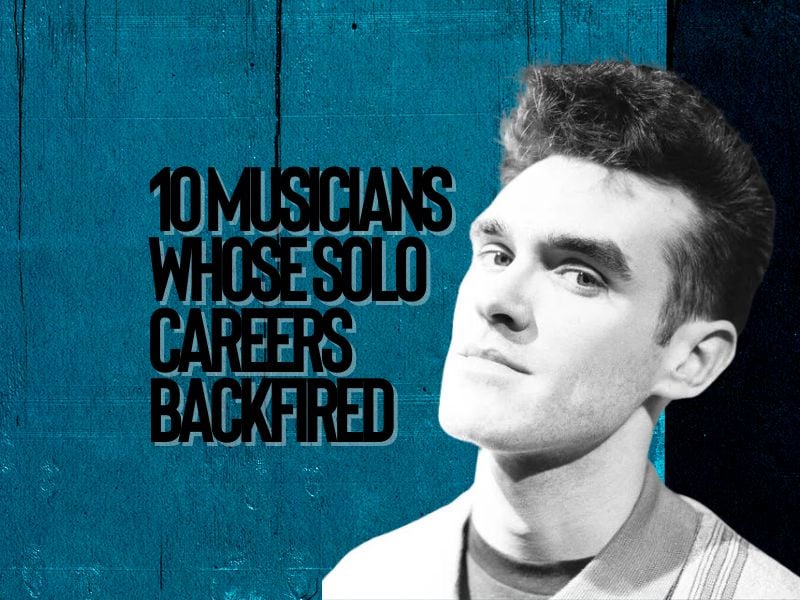
10 musicians whose solo careers backfired

Bands inevitably break up. Being part of a collective of creatives naturally brings its fair share of disagreements, rivalries and tensions. When our favourite acts split, their members often go on in search of their former success in the form of a solo career.
Sometimes these newfound solo ventures offer us musical outputs that surpass the success and quality of their bands. For instance, consider the success of Rod Stewart, Neil Young, John Lennon, Paul Simon, Michael Jackson and Paul McCartney.
On the other hand, there are some artists who we just can’t imagine performing on their own, without the aid of the fellow musicians who made them famous in the first place. It would be utterly jarring to imagine Bono on stage without the likes of The Edge, Adam Clayton and Larry Mullen Jr. behind him.
Whilst some artists, as expressed above, go on to have glittering solo careers, many others do not emulate their prior successes. As such, they should have done everything they could to keep their original band together.
Today marks the day when Peter Gabriel left Genesis, and it got us thinking of times when artists made a mistake by leaving their bands. Let’s take a closer look.
10 musicians whose solo careers backfired:
David Crosby
Part of the widely successful 1970s folk-rock supergroup Crosby, Stills & Nash (& Young), David Crosby had also been a founding member of the Byrds.
While those two groups found much success, Crosby’s solo career struggled in comparison, especially compared to those of Neil Young and Stephen Stills, which is most likely why he regularly sought to collaborate with them throughout the years.
Roger Waters
A vital part of the most significant prog-rock act of the 20th Century, Roger Waters, was Pink Floyd‘s bassist and became their chief lyricist when Syd Barrett left the band in 1968.
Waters left Pink Floyd in 1985, reportedly due to creative differences. A string of solo albums followed, including the particularly bad Radio K.A.O.S. While he maintains a healthy touring schedule, nobody would be able to match the massive appeal of Pink Floyd alone.
Debbie Harry
Blondie became arguably the figureheads of the 1970s New York punk scene, and Debbie Harry, with her trademark blonde hair and outlandish clothing, became its icon. When punk died down, and the embers of new wave burned bright, it was Harry fanning the flames.
When Blondie took a break from their output in 1980, Harry began an unremarkable solo career. In fact, many people believed that her actual name was Blondie, so tied up was she with her band. Things fell down rather quickly, and Harry returned to lead the group once more.
Peter Gabriel
Peter Gabriel rose to prominence during his time in the prog-rock pioneers Genesis. Genesis became renowned for their live theatrical performances orchestrated by Gabriel.
However, in 1975 Gabriel quit the band, wanting to focus on his family life amid band tensions. Whilst he has had undoubted success as a solo artist with ‘Solsbury Hill’ and So, it pales in comparison to ex-bandmate Phil Collins’ solo career and the prospects Genesis held at their feet. As Collins carries on, Gabriel remains a cult passion.
Ray Manzarek
When singer Jim Morrison died in 1971 in strange circumstances, the remaining members of The Doors – Ray Manzarek, Robbie Krieger and John Densmore carried on for a short while as a three-piece.
Whilst replacing as charismatic a leader as Morrison was undoubtedly difficult, some of The Doors’ music after he died is actually pretty good. Unfortunately, the same cannot be said for Manzarek’s solo output.
Sting
Sting was the bass player and lead singer in the British new wave rock band The Police, which formed in 1977. Their sound was a combination of punk, reggae and jazz. Despite the retroactive scorn, The Police were one of the archetypal sounds of the moment.
However, the band split in 1984 and subsequently, Sting launched a solo career. While it was undoubtedly financially successful, it didn’t even come close to matching The Police’s sound, and too many of the lesser-known songs concern Sting’s tantric sex experiences with his wife. His bank balance may disagree, but his artistic merit, and his collaborative album with Shaggy, say all you need to hear.
David Lee Roth
David Lee Roth is best known for his work as the lead singer of Van Halen. He has performed in the band across three stints, starting since their inception in 1974.
Roth is another where, on the surface, it may appear that he has enjoyed significant economic success. Still, much of his solo career sound is actually rather awful, particularly his cover of The Beach Boys’ ‘California Girls’.
Boy George
Culture Club were one of the most influential British groups to come out of the 1980s. They were a crucial part of the New Romantic scene, and singer Boy George’s androgyny inspired many of the 1980s acts to come.
When Culture Club disbanded in 1986, George was heavily addicted to heroin. He entered a rehabilitation programme and released several solo records over the next few years. However, they did not match the brilliance of Culture Club, and his star on the pop music front burned out.
Morrissey
Whether you’ll admit to it or not, Morrissey is one of the most inventive lyricists of the 20th Century, and you know he’d love to read that. Likewise, alongside Johnny Marr, The Smiths quickly became one of the best bands of all time, though their time at the top was short-lived.
When the Smiths split in 1987, Morrissey would embark on a successful solo career, but much of his work wasn’t of the best quality. The first two records were good, but to say it paled in contrast to the Smiths’ output would not be going far enough. Add in a run of questionable politics and an apparent desertion of the defence of the oppressed, Morrissey’s run as a solo artist feels far from his peak with The Smiths.
Noel Gallagher
When Oasis split in 2009, they did so in a flurry of four-letter words and a mist of watered-down lager. Following the band’s break-up, Liam Gallagher attempted to keep Oasis alive while Noel, his older brother, embarked on his own solo career under the guise of Noel Gallagher’s High Flying Birds.
The band may have achieved a modicum of success over the years, but no vehicle has proved a more accommodating fit for Noel Gallagher’s songs than his little brother and their band Oasis. Tours, records and sales have come and gone, but there is a nation of music lovers just waiting for Oasis’ return.
