


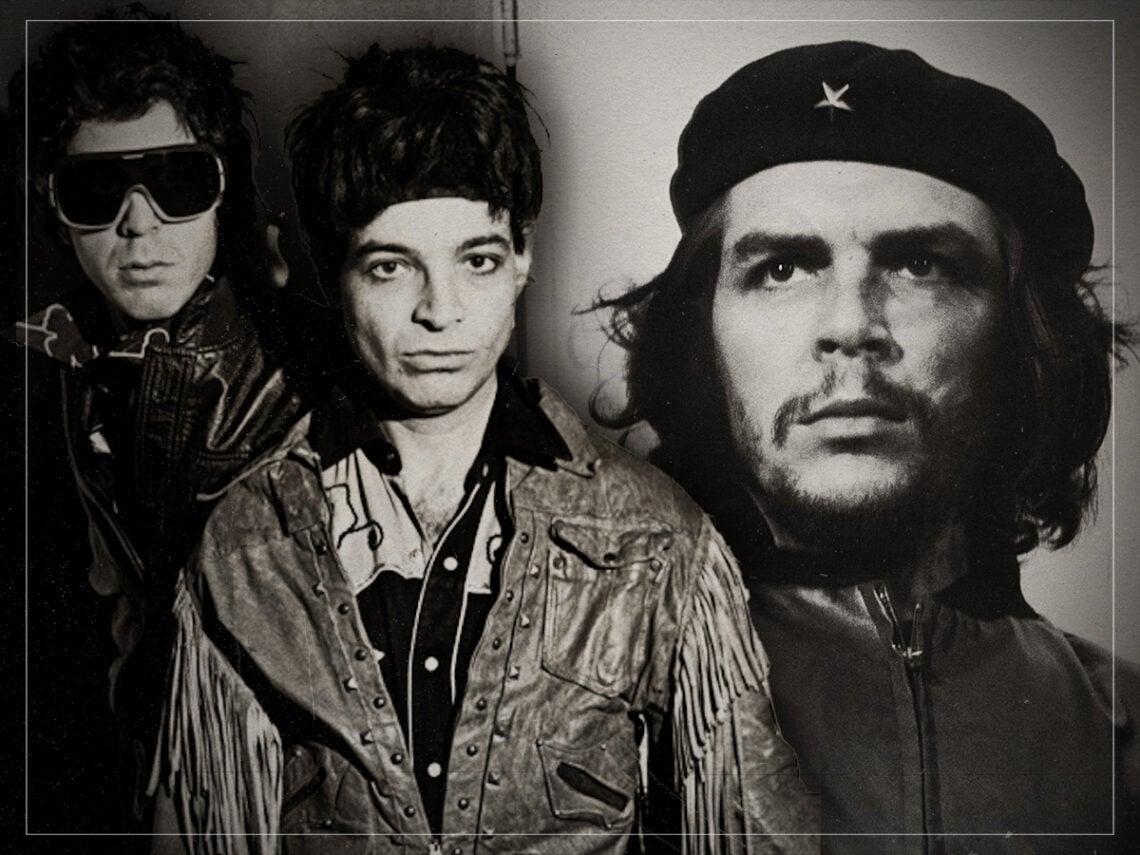
“The whole world lied”: Suicide’s dismantling of Che Guevara

Like a phantasmic avatar of America’s wounded psyche, synthpunk duo Suicide emerged from the 1970s’ scarred landscape with a mission to present the Stars and Stripes in all its grubby reality.
Capitalist failure, urban decay, the loss of 1950s innocence, the death of the hippy idyll, street-level pessimism toward the political elite, and the Vietnam War’s napalm nightmare all helped churn Suicide’s serrated songbook. Veering between eerie romance and blistering horror, backing electronics man Martin Rev provided the perfect score to such discoloured thematic wanderings, all brittle rhythm boxes and beat-up Farsifa organs that sound like the rotted remains of old rock and roll songs.
Such gristly minimalism needed a frontman like Alan Vega to wield commanding arrest during those early performances. Cutting a strange magnetism charged with the ghost of Gene Vincent, Vega would instil a visceral pang of danger in the air, all provocative theatre and whipping bike chains eager to wake up the more comfortable end of the audience up to the harsh reality out on the streets.
It took them years to finally cut a debut LP. With roots dating back to 1970, Suicide eventually released their eponymous album in 1977 during punk’s zenith, turning heads, even among the punk faithful, with their antagonistic upending of the typical band setup. Packed with immortal gems like ‘Ghost Rider’, ‘Cheree’, and the frightening murder-epic ‘Frankie Teardrop’, it’s Suicide’s haunting finale that leaves the most disconcerting residue long after the record’s stopped spinning.
Hissing with pulsing beats and thin keys, the apparitional ‘Che’ marks a closing statement to the Suicide world-view. Radiating with X-ray skeletalism, Rev wields an unnerving slice of terse drama behind Vega’s erratic coos, starkly illustrating their laser commitments in tearing the narratives and mythos veiling the complicated truths on both ends of the political spectrum, be it Uncle Sam’s moral exceptionalism or the romanticism that obscures the many dimensions of the Marxist revolutionary, Che Guevara.
“He was a hero,” Vega confessed frankly in 2002. “More than [Fidel] Castro, he was the real guy. He wanted to continue the revolution. And of course, the American government hunted him down in Bolivia and killed him. As much as I hate the guy, Bin Laden’s whole way of thinking is kind of like Che Guevara; for the Muslim world, he’s their Che.”
Suicide never hid their passionately socialist leanings. Way back in 1969, Vega worked with the left pressure group The Project of Living Artists, an attempt to combine the arts with genuine red organising back in the days of Greenwich Village’s dilapidated neglect, operating on a Trotskyist principle of creative autonomy in the midst of New York’s political radicalism of the day.
Like much of the leftist world, Vega knew Guevara’s romantic allure. An Argentine medical doctor exposed to the rank poverty and exploitation rife across America’s ‘Latin backyard’, the future Cuban military leader keenly regaled his recollection of picking up a gun over his medical kit and from then on pursuing an armed campaign against US imperialism for the rest of his life. Such heroism and moral conviction are countered by a documented ruthlessness toward perceived counterrevolutionaries, harbouring no qualms about extrajudicial executions, and fuelling persecution of Cuba’s LGBTQ+ community, painting a darker portrait of the lauded ‘champion of the poor’.
These battling facets of Guevara’s character lace ‘Che’s chilling ode. “And when he died / The whole world lied / They said he was a saint / But I know he ain’t,” Vega mewls, grappling with his admiration for Guevara’s socialist cause, a cause he gave his life to when executed in 1967, while contemptuous of the sanitised T-shirt logo he’d been reduced to across unthinking swathes of the Western progressive world.
Guevara wasn’t a saint; he was a revolutionary. A man driven to arms by the immiseration of his fellow South Americans, who poured all his efforts into education, literacy programs, and nationalised healthcare for working-class Cubans, as well as a killer who picked up a call to violence and carried out an armed campaign with hardened ruthlessness. Vega knew this about the left icon, and in true Suicide fashion, implores to take stock of the Argentine revolutionary’s full, fraught legacy, and understand who the man really was underneath the pasteurised symbol and corporately hijacked emblem he’s eternally paraded under.
