


The uncomfortable truth about dark tourism: we’re drawn to places of tragedy

There are thousands of ways to travel and see the world, and none is more right or correct than the other.
For some people, their idea of a getaway involves lounging by a pool, hammering the all-inclusive and drinking cocktails by the litre, while others find their travel fix on the summit of a mountain, watching football in some far-flung land, or sampling every continent’s McDonald’s. Then there are some, myself included, who get their kicks from dark tourism, and it’s time to stop pretending that it’s shameful and embrace it as an exploration of human nature.
The phrase dark tourism is attributed to Malcom Foley and J John Lennon (no, not that one), faculty members at Glasgow Caledonian University, who define it as “The representation of inhuman acts, and how these are interpreted for visitors”. While the terminology might be fairly young, this is far from a recent phenomenon, with PJ O’Rourke’s Holidays in Hell, published in 1988, and one of my favourite travel books, is a must-read for dark tourists.
The ancient ruins of Pompeii were a popular destination on the Grand Tour craze of the mid-18th century. Medieval pilgrimages often involved visiting sites of death and destruction, and just one day after the end of the Battle of Waterloo, the site saw its first visitors, curious to see what was left of the battlefield. The fascination with seeing the darkest, most troubling parts of the human experience is nothing new, and it’s certainly not shameful. It shows a curiosity in understanding our species, rather than just ignoring humanity’s deepest flaws.
Every few years, we get treated to opinion pieces slamming dark tourists for visiting places like Auschwitz or Cambodia’s Killing Fields, but they’re getting it fundamentally wrong. While some people almost certainly visit those sites for the wrong reasons, and there are certainly examples of tourists being disrespectful in how they act in those places, the majority are there to learn and understand.
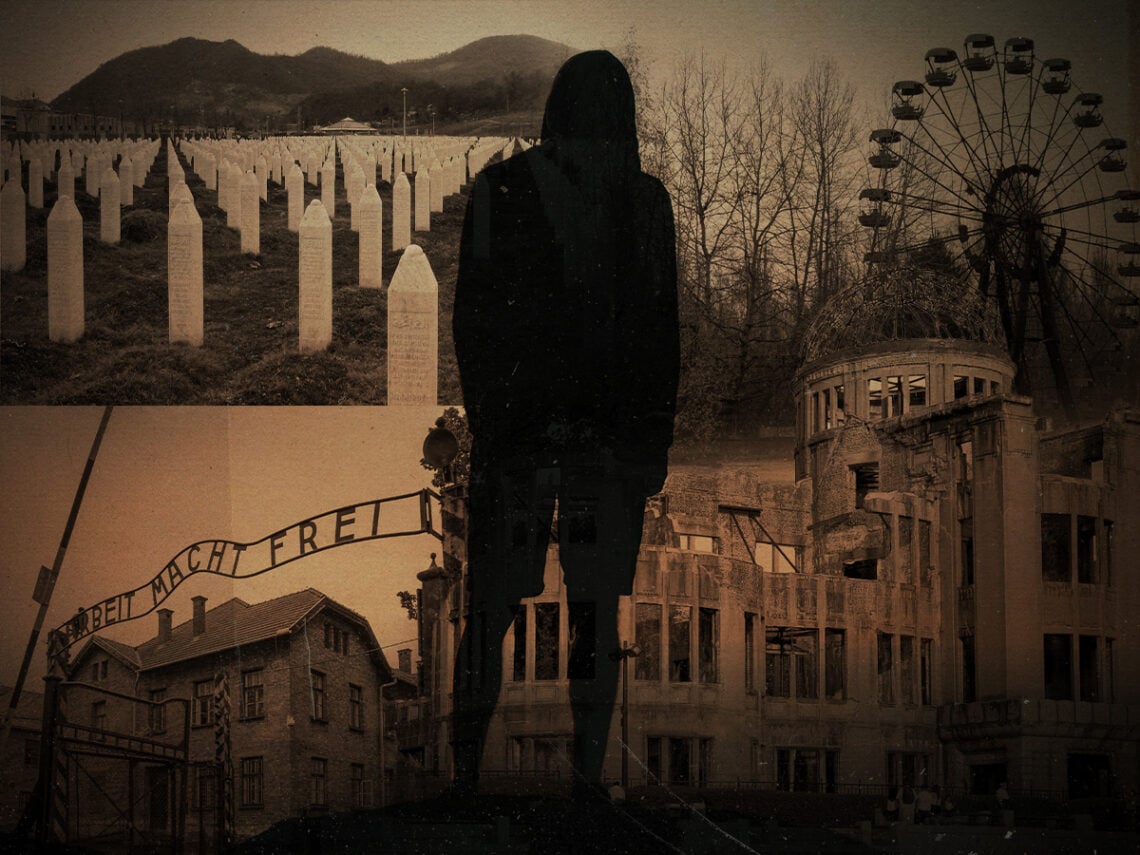
Some of the most memorable places I’ve ever visited have been those with the darkest histories, such as the severely hungover trip to Auschwitz on three hours sleep from a lads weekend in Krakow that proved truly harrowing, and then there was the time I saw the sun set against the backdrop of the Genbaku Dome, the only structure left standing after the atomic bomb was dropped on Hiroshima in 1945. These are moments I cherish, moments that allowed me to think about life, its importance and have profound conversations with myself.
Barring a few exceptions, the majority of dark tourist sites do something that conventional historical sites do not: they force us to address inconvenient history or uncomfortable truths, and without visitors, there’s an argument that some of the horrors that have happened at these places across the globe might start to be forgotten, and that simply can’t happen.


Reading about the holocaust is difficult enough, but to actually visit a concentration camp adds another dimension that no book can ever replicate. When you stand in a gas chamber, you can really feel the cold, abattoir-like nature of the crimes, which weren’t just murders but a full, industrial complex of death. Names and numbers tell you how many people died, but until you see stacks and stacks of glasses that were left behind, it’s very hard to feel the lives that were taken.
There are definitely factors that need to be discussed and addressed with dark tourism, in particular, how to stop the commodification of death, but for the most part, this is something that destinations take a great deal of time and effort to do. There are still some bad practices, most notably around some shocking selfies that you see people taking, but that is a lack of basic empathy, not an issue with dark tourism itself.
The reality is that people want to experience dark tourism because they’re drawn to the extremes of the human experience. For most of us, we live fairly normal lives, and understanding how that can break down and turn into something terrible is both fascinating and hugely educational. There is nothing wrong, nothing depraved about being curious about places that have witnessed the very worst of humanity. As for these places themselves, like Chernobyl, Srebrenica or Robben Island, they shouldn’t be roped off to protect people from their own curiosity; they should be welcoming to allow curious minds to learn and feel history in person.
