


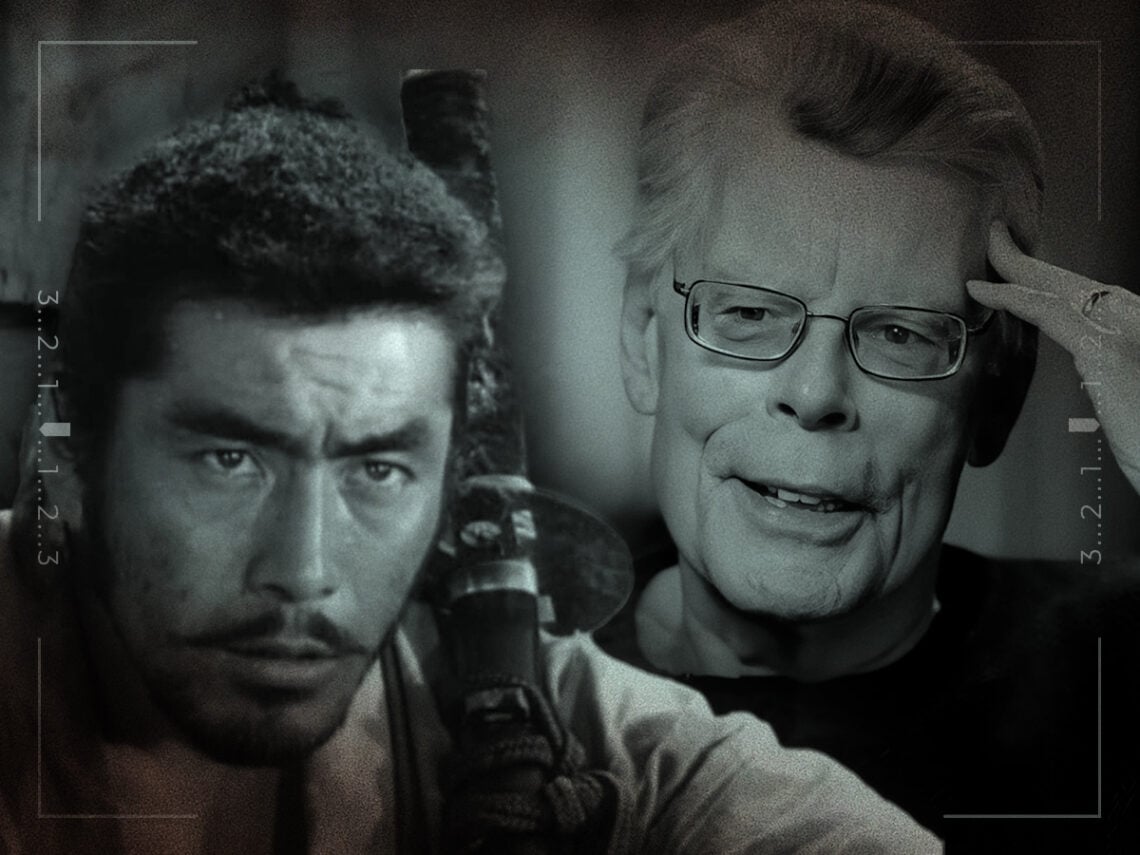
Stephen King’s secret remake of Akira Kurosawa’s ‘Seven Samurai’: “The story is the same in both”

In addition to being one of the greatest movies ever made and a timeless masterpiece from one of the finest directors to ever step behind the camera, Akira Kurosawa’s Seven Samurai states a stronger case than most to be named the single most influential film in cinema history.
For more than 70 years, the legendary filmmaker’s sweeping samurai epic has been cited as an inspiration and jumping-off point for pictures that cover the good, the bad, and the ugly of the industry. Its action sequences revolutionised the industry and ushered in a new style of onscreen kineticism, but it’s the seemingly threadbare narrative that’s made the biggest impact.
Seven Samurai is as simple as it is inspired; the titular septet are hired to defend a village of lowly farmers from an encroaching threat, and that’s about it. Obviously, that’s doing a severe disservice to a stone-cold masterpiece, but that basic setup and execution remain fertile ground for film and television to this day.
Westerns? The Magnificent Seven, its three sequels, and Denzel Washington’s remake. Sci-fi? Roger Corman’s Battle Beyond the Stars, Zack Snyder’s Rebel Moon, and George Lucas’ Star Wars. Animation? A Bug’s Life and Wes Anderson’s Isle of Dogs. Action? George Miller’s Mad Max saga and 13 Assassins, which don’t even begin to cover it.
Every big-name director in modern cinema, and long before, is influenced by Kurosawa in one way or another, and even though he’s spent his life writing original stories that inevitably become the subjects of film and television adaptations, Stephen King had no problem admitting that one of his novels was just Seven Samurai with yet another fresh coat of paint.
“In Wolves of the Calla, one of the seven books in the Dark Tower series, I decided to see if I could retell Seven Samurai, that Kurosawa film, and The Magnificent Seven,” he told The Paris Review. “The story is the same, of course, in both cases. It’s about these farmers who hire gunslingers to defend their town against bandits, who keep coming to steal their crops.”
Yep, that’s Seven Samurai in a nutshell, but King “wanted to up the ante a little bit.” His literary series had a gunslinger of its own, Roland Deschain, and in the fifth book, he’s enlisted by the natives of the village of Calla Bryn Sturgis to assist them in their generational fight against the Wolves of Thunderclap, a nefarious band of masked horsemen who routinely abduct one child from each set of twins.
Or, as King put it, “In my version, instead of crops, the bandits steal children.” On the surface, a sweeping fantasy saga has little in common with a Japanese classic that was released in 1954, but the author acknowledging that he fancied writing a Seven Samurai of his own speaks to the influence Kurosawa’s film continues to have over all forms of media.
He wasn’t the first, fifth, tenth, or even fiftieth creative to use it as a touchstone, and he’s nowhere near the last, either, based on nothing but facts and history.
