


The story of Silver Apples: the unsung pioneers of electronica

Sometimes, those who made vital musical progressions fail to truly garner the recognition they deserve on a widespread scale. Ask anyone about the development of electronic music and you’re likely to hear names like Kraftwerk or maybe Wendy Carlos, who made 1970’s iconic record Switched on Bach. Yet, there was a band that predated most of electronic music’s most significant pioneers: Silver Apples.
While these musicians listed above were also vital to the development of the genre, Silver Apples came first and proved to be highly influential in their sphere, and their impact echoes through a wide range of genres we love today. In fact, they are credited as one of the first acts to use electronic instruments in a popular music setting, subsequently paving the way for most modern music.
The band emerged from the East Village, an area of New York better known for producing jazz and punk artists thanks to iconic venues like CBGBs and Fillmore East. Led by Simeon, Silver Apples was a natural progression from his previous band, The Overland Stage Electric Band. Joined by Danny Taylor, the only member from the former group to stick around for Simeon’s more ambitious experiments, the duo started to incorporate electronic instruments, like an oscillator, into the band’s sound.
Until this point, a lot of electronic music – much of which was pioneered by women like Delia Derbyshire and Daphne Oram – remained in the realm of experimental or academic contexts. While Silver Apples’ sound certainly was experimental, the songs they released featured much more commercial appeal, blending poetic lyrics and other traditional rock instruments into their music. Thus, musicians who witnessed the band live or on record were suddenly aware of the potential that electronica had within popular music.
Their first record, Silver Apples, was released in 1968 and featured techniques and sounds that would come to define genres like krautrock, trip-hop, and the many forms of electronic music we now consume. The opening track, ‘Oscillations’, takes us on an upbeat journey through repetitive rhythms while ‘Program’ features musique-concrete techniques that were utterly ahead of their time. The latter song was even released the same month that The Beatles would go on to record their sound collage ‘Revolution 9’ (John Lennon was reportedly a fan of the band).
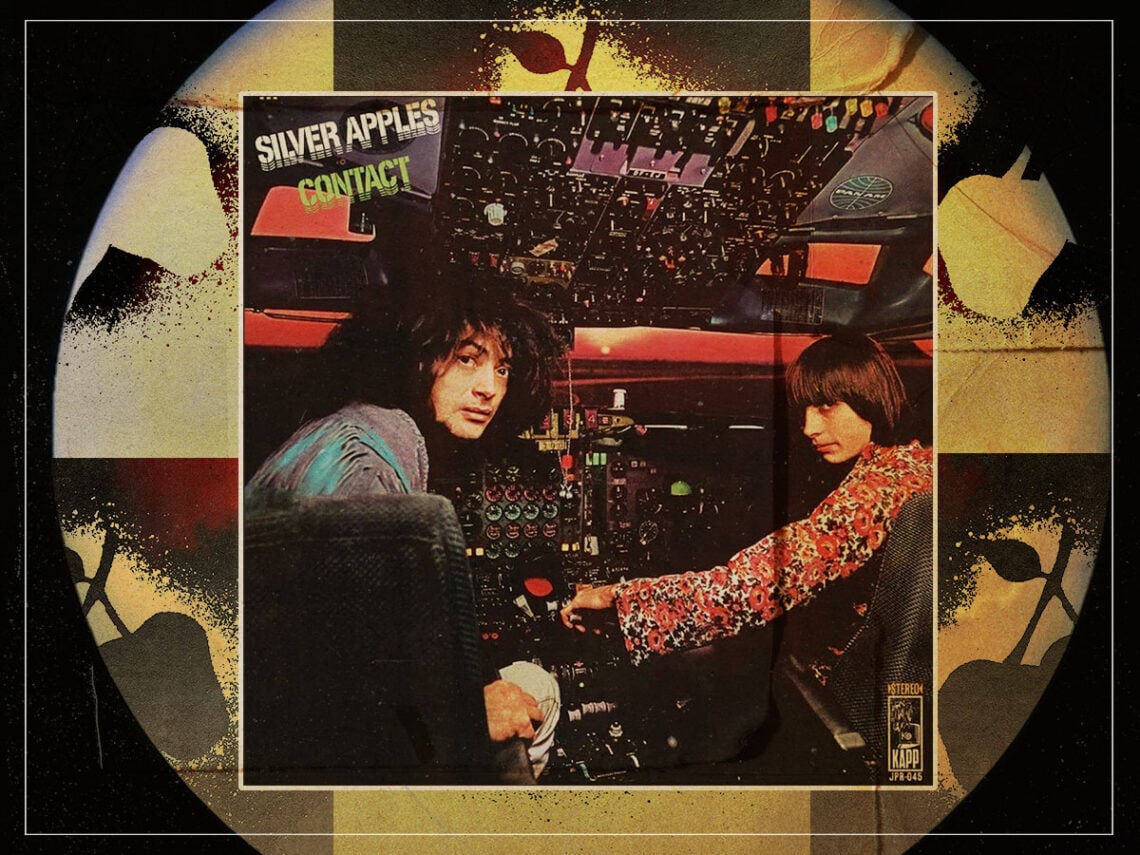
After releasing a second record, Contact, the band found themselves unable to continue recording after they were sued by Pan Am Airlines. While the company allowed the band to photograph themselves in the cockpit of one of their planes with the logo visible on the front of the record cover, they didn’t know that the back sleeve would contain an image of a crash. Sadly, the electronic pioneers who inspired Suicide to form, had to cut their career short.
Luckily, two decades later, renewed interest in the band resulted in their reunion, with Simeon initially employing new members before Taylor eventually joined. The band were finally able to be celebrated properly, and during the ‘90s, they released various albums of previously unreleased material and gained more recognition for their efforts.
Yet, whenever Silver Apples reached success, it seemed as though an unknown force was stopping them from going any further. After the Pan Am controversy initially put a halt to the band in 1969, Simeon was involved in a serious car crash in 1998, once again stopping the band from continuing. It took six years for the musician to get back to a level where he could perform again, but the following year, Taylor died.
Still, Simeon has never let these setbacks stop him from retaining hope. He toured the world throughout the 2000s and the 2010s, allowing the legacy of Silver Apples to flourish. He passed away in 2020, leaving a career full of boundary-pushing and innovative songs behind him.
