


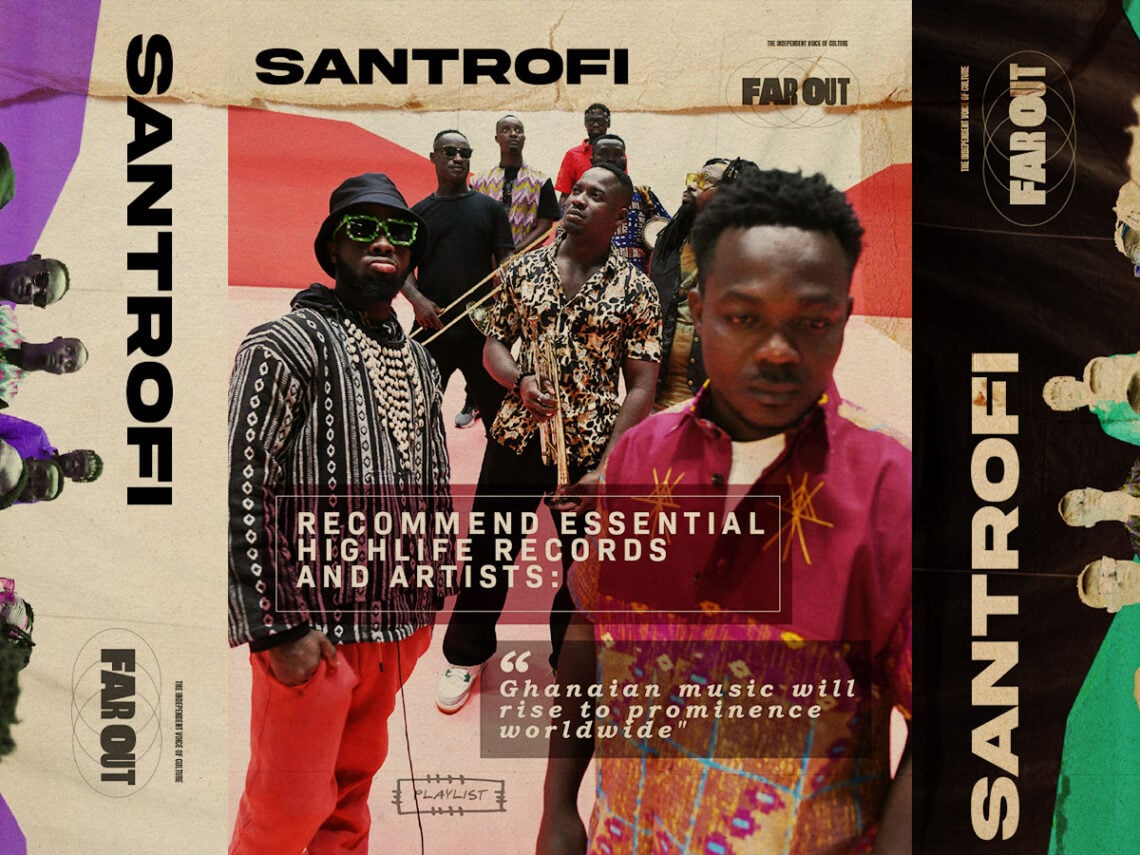
Santrofi recommend essential highlife records and artists: “Ghanaian music will rise to prominence worldwide”

The sweet trills of guitar roll through Santrofi’s sound like the breeze along a golden alleyway, rhythmic horns parp with the bustle of life, and dynamic jazz percussion taps around at a sunny pace. It’s music that causes you to shuffle—whether that’s around a dancefloor in Kumasi or a train station platform in Kensington is entirely dependent on where you reside because whether you’re as restrained as a Hugh Grant character or as fluid as an amoeba when you listen to Ghana’s leading highlife revivalists, you will be moving.
Santrofi are moving too. The band are now a globetrotting force, bringing their serene sense of sunshine and coolness to the world in a joyous little shimmy of peace, love and harmony. The eight friends that form the collective create a melodious wave that sounds like a perfect Saturday morning in May, waltzing around the picturesque edges of a boho side of town in a Cuban shirt and shades. By virtue of their footloose musicology, that waltz could be in any town in the world, too. They incorporated glimpses of everywhere they’ve been into their highlife ways.
After all, fusion has always been at the heart of highlife music. The genre first sprang up in coastal cities of Ghana, where trade brought filigreed jazz guitar colliding with percussive local ways, resulting in an arpeggiated style of playing that gave the areas a new-found Afro-Cuban flair. This origin story also injected the genre with its inherent sense of bustle and movement. There’s the sway of the sea in the rhythms, soul in the singing, and a novel sense of vibrancy in the modulating and overlapping musicality.
The latest addition to the mix developed by Santrofi derives from Asia. Following their sold-out tour of Japan last year, the group returned to Accra as the proud bearers of the nickname “the Ambassadors of culture”. Buoyed and spirited by the trip, it became clear to the group that their aim to bring highlife back from the brink was coming along swimmingly. With that in mind, we asked the gang which records inspired them to this point in their career following the release of their second record, Making Moves.
As bandleader Kojo Ofori explains, Santrofi is also exporting the highlife sound across the globe and bringing back trinkets to weave into the waltzing ways of their sanguine sound as they do so. “We brought our indigenous sound to Japan and many other places,” he says. “We feel so proud. Santrofi have played for most of the highlife legends, all the big names, so we developed enough vocabulary to be able to extend this heritage, which we think is very important. It’s a massive honour to play with many of the greats; we recorded with Crentsil just before he passed, and also, in Germany, we recorded with AK Yeboah, the father of another great musician, Kwame Yeboah.”

As perhaps the world’s leading experts in highlife music, their tales are most certainly notable, and the picks sound as sweet in the dark depths of winter as the first burst of summer nectar to a bee. Enjoy.
Santrofi recommend essential highlife records and artists:
Bandleader and bass player Kojo kicks things off with a mention of the recent passing of one of the founding members of the legendary band Osibisa. Teddy Osei, who passed away in January, started his music career in Accra before moving to London in 1962, where he later founded Osibisa and became respected as one of the pioneers of Afro-rock. Osibisa’s 50-year history has spread aspects of Ghanaian music to the farthest corners of the globe, from their 1975 hit ‘Sunshine Day’ through to the album New Dawn, which was recorded during the Covid-19 lockdown in 2020, under the watchful eye of executive producer Teddy Osei along with Gregg Kofi Brown.
Santrofi horn section Nobert and Bernard both mention the album Love and Death by highlife legend Ebo Taylor. Nobert continues, “Ebo is a global icon, loved and respected by many. He is one of the hardest working musicians to come out of Ghana and lay the path for future musicians, including Santrofi, touring in Europe”. Nobert goes on to share his enthusiasm for the rapper Sarkodie’s album Mary, citing it as “the first album he made with a live band”. Nobert explains that “it encouraged way more Ghanaians to follow his music” and launched yet another melding of sounds in the entrancing swirl of modern Ghanaian music.
The band also recommend Reggie Rockstone, a leading figure in the hiplife scene developing in Ghana. He raps in Asante Twi as well as English. As the band explain, “Rockstone is known for his use of samples of the Afrobeat king Fela Kuti, along with collaborations with Shaggy”.
Conga player and percussionist Kuntu, known to his friends in Santrofi as Manners, suggests that anyone looking for a true taste of Ghana has to check out the 1960s highlife outfit Ramblers International Band. The roving 15-piece group toured around West Africa, broadcasting a bright new blend of Latin and soul music led by perhaps highlife’s greatest tenor saxophonist and arranger, Jerry Hansen.
Manners also extolls a love for the utterly prolific Jewel Ackah and his band, the Butterfly Six, who recorded 27 albums in his career. “Jewel became known for church music in the ’80s, as well as working with other greats such as Pat Thomas and AB Crentsil,” Manners explains.
Vocalist Nsoroma highlights rapper Kweku Smoke’s albums Kweku Jesus and Born in Hell. “Smoke got all the attention of the youth in Ghana, especially the Gen Z’s because he was telling us stories in the album, which so many youths in Ghana today relate to. He talks about how you have to work hard for money and how the youth have big dreams but no money. Wherever you go, you hear Smokes’ music playing in public transport or bars,” he explains.
He then mentions King Paluta’s album Aseda, highlighting how it “made a very strong impact in Ghana”. He puts that down to a specific element of life in the nation. “Here, we naturally like to throw punches to our enemies through music,” he says. “For example, maybe you have a minor grudge against your friend; instead of the person coming and seeing you one-on-one or confronting you, he or she will rather sing music that speaks about what he or she wants to say to you.” In his book, nobody is better at this poetic confrontation-avoidance than the side-stepping Paluta.
When it comes to one of the most pervading influences on the band as a whole, the group highlights reggae superstar Rocky Dawuni. “Rocky was the first Ghanaian to receive a Grammy nomination,” they explain—a notable point of pride for the band as they make strides to match his global appeal.
Finally, the track that is currently getting the most repeats from Kojo and a good few other highlife fanatics is the swaggeringly anthemic ‘So It Goes’ by Black Sherif & Fireboy DML. “This song is being heard throughout Ghana,” Kojo says. “Some of us had the opportunity to work with Black Sherif last year, and his story is an inspiration to Ghanaians everywhere, especially musicians who might be struggling. He is an amazing artist, and I am sure the new Iron Boy album will be a triumph. I am sure Ghanaian music will rise to prominence worldwide.”
You can most certainly throw the masterful Santrofi record, Making Moves, into that mix, too.
The essential highlife records and artists, according to Santofi:
- New Dawn – Osibisa
- ‘Sunshine Day’ – Osibisa
- Love and Death – Ebo Taylor
- Mary – Sarkodie
- ‘Eye Mo De Anaa’ – Reggie Rockstone
- ‘Munti’ – The Ramblers International
- ‘Abena’ – Jewel Ackah
- Kweku Jesus – Kweku Smoke
- Born in Hell – Kweku Smoke
- Aseda – King Paluta
- ‘Download the Revolution’ – Rocky Dawuni
- ‘So It Goes’ – Black Sherif & Fireboy DML
- ‘Amina’ – Santrofi
- Alewa – Santrofi
