


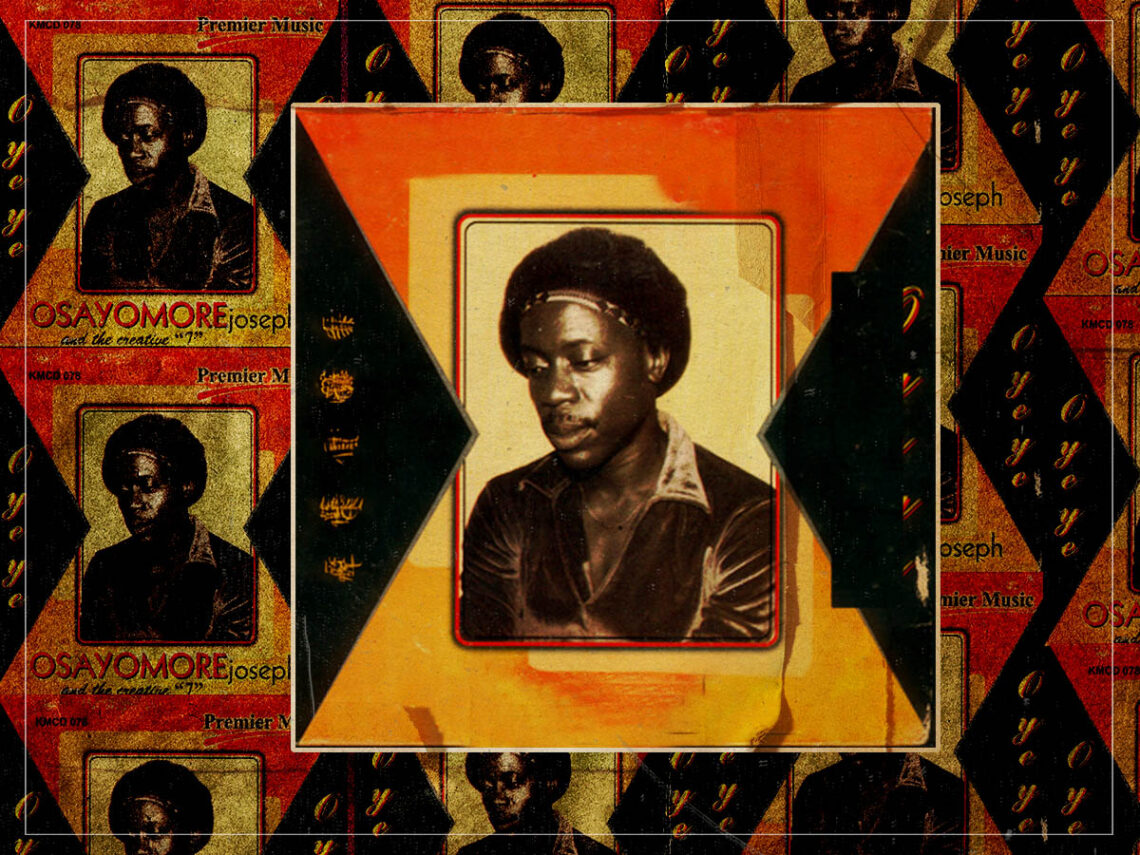
Songs of kidnapping and despair: the bold defiance of highlife pioneer Osayomore Joseph

If you ever get sick of the same bunch of stadium-filling “protest” singers preaching to the choir with vague, tired jabs at the society that made them multi-millionaires, spare a thought for Osayomore Joseph. As one of the leading lights of highlife music, he was one of the most exciting and successful musicians of his day. However, his tendency to write biting, topical lyrics criticising everything from his cultural frameworks to his own government may have made his music relatable, but it also placed a target squarely on his head in a terrifyingly literal sense.
Born in Benin, Nigeria, in 1952, conflict was intertwined with Osayomore’s music from the very beginning. At 19 years old, he joined the army while the Nigerian civil war was coming to a close. Shortly afterwards, he became a member of the officers’ mess band, taking up the flute and the guitar while developing his skills as a singer and, secretly, a songwriter. Osayomore was inspired at the time by several popular musicians like Sir Victor Uwaifo and King Sunny Ade, but especially the legendary Fela Kuti.
During an interview with NPR, Osayomore said, “Fela’s Shrine was directly opposite my military school in Lagos. I was very close to him. I would sit with him when he was blowing his sax, and I was blowing my flute.” This would inspire anyone, and Osayomore was no different. Once his time in the service came to an end, he returned to Benin to begin his musical career in 1976. By the end of the 1970s, he was a national hero who had begun making waves among the Edo communities in the UK and the US.
However, his time learning from the great Fela Kuti didn’t just make Osayomore want to pursue music; he also combined it with a growing interest in activism. When military dictator Ibrahim Badamasi Babangida came to power in 1985, a truly harrowing period of time for Nigeria followed. One full of political corruption, harsh austerity measures, and the brutal suppression of anyone who dared speak out. However, Osayomore was also a combat veteran who’d seen the horrors of the Nigerian civil war firsthand. Few things scared him, and even fewer would prevent him from speaking his mind, such as political conscience-fuelling hits like ‘The Truth’ and ‘Teacher’.
Osayomore wasn’t saying anything that wasn’t already going through the minds of all Edo people at the time, but his popularity was becoming a problem for the oppressive regime. Nothing could silence Osayomore, though. Releasing music at a rate of two studio albums a year (to a staggering total of over 100 albums released by the end of his life in 2022) and lasting long after the regime of Babangida and his merciless successor Sani Abacha came to an end. By the 2010s, Osayomore was regularly performing concerts for the Oba (ruler) of Benin, which were joyous expressions of freedom from oppression, until the terrifying aftermath of one concert in 2017.
On October 3rd, after a concert honouring a year since the coronation of a new Oba of Benin, Osayomore’s car was attacked by armed men, his wife was hit by a bullet and Osayomore himself was kidnapped and held to ransom. Despite Osayomore’s history (this was definitely not the first time an attempt had been made on his life), this was not a politically motivated attack. A deal was made, and a ransom was paid, and Osayomore did what he had always done: turn the trauma into music in the form of his 2017 record 30 Days and 30 Nights in the Evil Forest.
Despite the trauma, it would take a lot more than that to stop a man so committed to his music and speaking his truth. Osayomore continued playing live and releasing music to the very end when he passed away from a stroke in 2022. In a world where so many people are held up as counter-culture firebrands, it’s more important than ever to celebrate those who genuinely took a stand against fascism the way that Osayomore Joseph did his entire life. We could all learn from his legacy.
