


Life in the flash lane: Rock and roll’s 10 most famous vehicles

You can tell a lot about someone by what car they drive. If, for instance, you see a bright red Ferrari recklessly bombing down the highway, there is probably a rock star on the loose. After all, vehicles are often extensions of one’s personality – evocative of one’s status and ego – rather than merely a method of getting from one place to another. As such, the landscape of rock and roll has seen its fair share of iconic vehicles over the years, each telling us about the personalities of those travelling in them.
Rock and roll vehicles span the entirety of the musical spectrum. For instance, when the Ramones travelled from gig to gig on the New York City subway with their instruments in plastic carrier bags, they embodied the grassroots spirit of punk rock. On the other end of the spectrum, nothing captured the flamboyant excess of 1970s rock and roll quite like Led Zeppelin and their customised private jet.
Cars, in particular, have been used throughout the history of rock stars to represent success and status. Oasis songwriter Noel Gallagher, for example, owns a Rolls Royce, but he cannot even drive. The exclusivity and flash nature of vehicles like this often fit in quite well with the artist’s egotistical needs; they exist as a means of distinguishing the star from the listener, at least in terms of mainstream rock and roll. It’s difficult to imagine Keith Richards driving around in a Honda Jazz.
From cars that reflect the age of psychedelic art to boats that revolutionise the world of rock and roll, we are not discriminating against any vehicles on this list. So, buckle up and join us on this journey through the world of rock and roll planes, boats and automobiles as we explore ten of the most legendary examples.
Rock and roll’s 10 most famous vehicles
Jimmy’s Lambretta Li 150

The Who is an impossible entity to ignore when looking at the global presence of rock and roll, and their 1973 record Quadrophenia is among the greatest rock albums of all time. A rock opera telling the tale of a young mod named Jimmy (loosely based on the experiences of Pete Townshend), who is forced to grapple with growing up and finding his place in the world. In 1979, this tale was committed to the silver screen by Fran Roddam, and the Quadrophenia film managed to define both the era of mods and rockers and the era of punk in which the film was made.
At the heart of the film is Jimmy (Phil Daniels) and his 1967 Lambretta Li 150 Series 3. Throughout the film, the young mod is seen riding through London, tearing up gardens, and parking up in Brighton on his trusty Italian scooter, before he eventually loses it under the wheels of a post van. Although multiple replicas of the scooter have been made over the years, the original vehicle was sold at Bonhams auctions in 2008 for £36,000.
Radio Caroline’s MV Caroline

While the other vehicles on this list reflect the success and stature of their artists, the Radio Caroline MV Ross Revenge represented a musical revolution in its own right. During the early 1960s, as artists everywhere began to immerse themselves in the defiant sounds of rock and roll, mainstream radio stations in the United Kingdom outright refused to play the music that so many young people were desperate to hear. The answer came with the advent of pirate radio, with Irish music mogul Ronan O’Rahilly leading the charge.
After purchasing a Danish passenger ferry, which he named MV Caroline, O’Rahilly and a select bunch of DJs began broadcasting youth-focused rock and pop music to the nation. Originally anchored near Felixstowe, the station introduced a wealth of listeners to rock music and spawned countless artists and music obsessives in the process. It might not be as flashy or speedy as some of the vehicles on this list, but Radio Caroline is certainly deserving of its iconic status.
Keith Moon’s Ferrari Dino

Keith Moon was almost solely responsible for the myth that drummers are the wildest member of any rock band. In every aspect of his existence, Moon represented an endearing sense of chaos and anarchy, and his history with cars certainly reflects this. Like any self respecting rock star, Moon owned numerous legendary sports cars over the years, but his 1972 Ferrari Dino 246 GT stands out among the rest.
He bought the car after The Who’s frontman Roger Daltrey bought himself a Dino, but Moon – ever the opportunist – went halves on his Ferrari with Peter ‘Dougal’ Butler, a friend and mechanic. However, the partnership was less than harmonious.
“Moon and I had the Dino for only four weeks,” Butler once remembered. “Then I got a call. Moonie says, ‘Dougal, you ain’t gonna believe this but, well, there was a couple of bikers outside, nice fellas, and they just wanted to have a go with the Dino. So, I let them. But unfortunately, they didn’t see the roadworks sign, and they put it straight down a fucking ditch! Complete write-off!’” The fate of Moon’s Dino after the crash is unknown, but the most likely scenario is that it was scrapped.
Ken Kesey’s Further/The Electric Mayhem’s bus

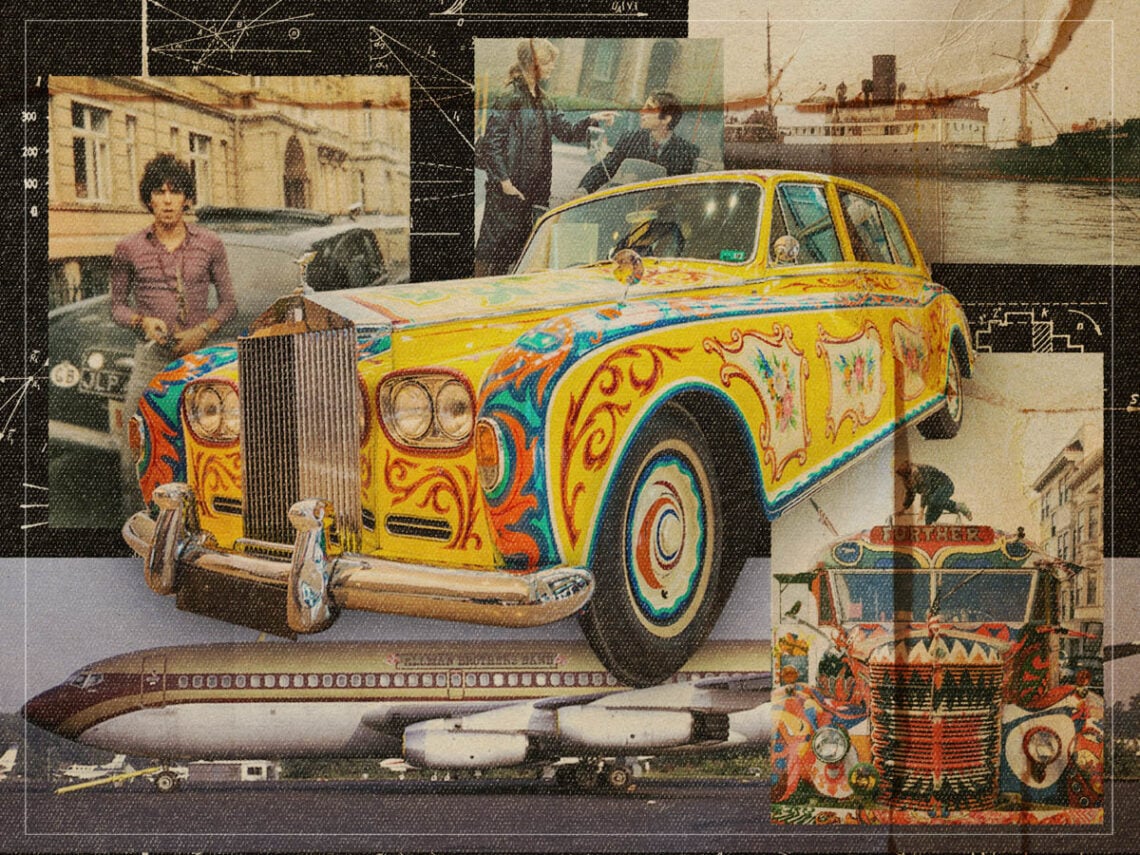
Rock and roll’s psychedelic age changed the landscape of the genre indefinitely, with countless artists, musicians, and writers expanding their minds and creating expansive work as a result. Ken Kesey was among those writers who defined 1960s counterculture rock, and he was synonymous with the 1939 International Harvester school bus, named ‘Further’, that he painted in a psychedelic livery to carry around his ‘Merry Band of Pranksters’.
Kesey, the bus, and the various drug-fueled trips taken by ‘Further’ were later featured in Tom Wolfe’s 1968 work The Electric Kool-Aid Acid Test, which was instrumental in establishing the hippie counterculture. The bus made its final trip in 1969 to Woodstock before being stripped and left to rot in a swamp on Kesey’s farm in Oregon.
Years later, in 1979, the spirit of ‘Further’ was revitalised by felt in The Muppet Movie. Jim Henson was always tuned into popular culture and rock and roll, and the homage of ‘Further’ was used to transport Dr. Teeth and The Electric Mayhem band – which features parodies of Janis Joplin (Janice) and Keith Moon (Animal) within its ranks. Although numerous remakes and replicas of the bus have been featured in Muppets projects over the years, the original bus from 1979 was sold multiple times during the early 2000s and was eventually destroyed in a fire.
Led Zeppelin’s Starship<br>

Private jets are commonplace within music these days, but that wasn’t always the case. When Led Zeppelin reached the dizzying heights of hard rock stardom during the early 1970s, they were in need of something much more luxurious and personalised than a run-of-the-mill passenger aircraft. The answer came in the form of a Boeing 720 aircraft named ‘The Starship’, which had been bought from United Airlines by Bobby Sherman for touring artists to lease out.
Led Zeppelin quickly became the plane’s leading customer, with the band enjoying the built-in bar, television, armchairs, bedroom, shower room, and electronic organ. In fact, the Starship became so synonymous with Led Zeppelin’s US tours that it was rendered in two different custom livery for the band, one in 1973 and one in 1975. Elsewhere, the plane was used by The Rolling Stones, Alice Cooper, Bob Dylan, and Elton John, to name only a few.
Keith Richards’ Bentley Continental

The Rolling Stones represented the pinnacle of wild rock and roll rebellion during the 1960s, so it only seemed fitting that each member of the group had their own statement car. While Mick Jagger opted for the timeless beauty of the Aston Martin DB6, the Stones’ anarchic guitarist opted for a 1965 Bentley S3 Continental ‘Flying Spur’. Keef bought the classy blue Bentley in 1965 and quickly modified its interior to contain a secret compartment for hiding drugs on the way to and from the band’s concerts.
Christening the car ‘Blue Lena’ after jazz musician Lena Horne, Richards adored the vehicle. In his autobiography, he wrote, “Having this car was already heading for trouble, breaking the rules of the establishment, driving a car I was definitely not born into. ‘Blue Lena’ had carried us on many an acid-fuelled journey”.
One such journey saw the Bentley take Richards and Anita Pallenberg to Marrakech in Morocco, which is often cited as the trip that drove a wedge between Brian Jones and the rest of the band. Richards ended up crashing the Bentley into a tree in the mid-1970s after falling asleep at the wheel. Years later, in 2015, it was sold at auction for $947,285.
The Monkees’ Monkeemobile

Progenitors of 1960s bubblegum rock, The Monkees are a divisive band in rock and roll circles. Sure, they might have been manufactured and marketed, and their songs weren’t the greatest, but their television show was an iconic part of 1960s culture. A key part of that television show, which ran from 1966 to 1968 on NBC, was the Monkeemobile. Designed by Dean Jeffries, the outlandish vehicle used a 1966 Pontiac GTO as its base but was heavily modified and customised to include a split windshield, convertible top, three rows of seating, and a parachute.
Reportedly, the original incarnation of the Monkeemobile featured a supercharged engine and more weight towards the rear of the vehicle, allowing it to pop wheelies on screen. Two versions of the car were constructed, one for the television show and one to tour around the nation with The Monkees. The screen version was left in Australia during one of the band’s tours and later ended up at a hotel in Puerto Rico. Since then, it has been restored and is owned by a collector in New Jersey. Meanwhile, the other version of the car was purchased by George Barris – who designed the 1966 Batmobile – and was later sold at auction in 2008 for $360,000.
Elvis Presley’s Cadillac Fleetwood Series 60

America’s youth was captivated by the advent of rockabilly and rock ‘n’ roll during the 1950s, but cars soon became an integral part of that moment in youth and music culture. Cadillac has always represented the height of American automotive luxury, and their cars became coveted by rock’s leading man, Elvis Presley. The King bought his first Caddy in 1955 – a 1954 Fleetwood Series 60 – but it did not last long before bursting into flames in Arkansas some months later. Undeterred, the singer purchased another Cadillac Fleetwood Series 60, which became inseparable from the rock and roll image of Presley.
Originally, the Cadillac was blue, with a black roof. However, the success of Elvis’ ‘Baby, Let’s Play House’, which mentions a pink Cadillac within its lyrics, caused the singer to repaint the car in a baby pink colour. A few years later, a white roof was added. Elvis owned numerous different cars over the years, a lot of them being Cadillacs, but the pink Cadillac Fleetwood remains his most iconic. Currently, the car is on permanent display at Graceland in Memphis, Tennessee.
Janis Joplin’s Porsche 356 SC<br>

“My friends all drive Porsches,” sang hippie queen Janis Joplin in her song ‘Mercedes Benz’, but, ever a woman of the people, it wasn’t long before the singer joined her friends in Porsche ownership. In 1968, the Big Brother and the Holding Company singer bought a second-hand 1965 Porsche 356 SC for a modest $3,500 (around $30,000 in today’s money). Originally, this beautiful feat of German engineering came in an uncharacteristically dull ‘dolphin grey’, which was an optional extra from the factory.
Joplin needed a car befitting of her expansive and psychedelic personality, so she recruited her road manager, Dave Richards, to give the car a psychedelic makeover. Richards, who was paid $500 for his troubles, painted a mural over the car titled ‘History of the Universe’, which made Joplin’s Porsche instantly recognisable and an icon of the hippie age. Joplin’s Porsche has lived an eventful life and was once stolen from outside a concert in San Francisco.
Years after the singer’s tragic passing, the car was returned to Joplin’s family, where it was eventually restored to its factory colour by Michael Joplin, Janis’ brother. Thankfully, the family later decided to go back to the car’s psychedelic origins, commissioning Jana Mitchell and Amber Owen to recreate Richards’ mural. For years, the car was on display at the Rock and Roll Hall of Fame before being sold at auction in 2015 for $1.76million
John Lennon’s Rolls Royce Phantom V

By the mid-1960s, Beatlemania was in full effect, and The Beatles were the biggest band on the face of the planet. At that point, you can no longer catch a public bus or train. So, in 1964, John Lennon purchased a used Rolls Royce limousine and, despite not passing his driving test until the following year, quickly ordered a bespoke Rolls-Royce Phantom V from the factory. Originally, the car came in a matte black finish, but the paintwork became damaged while The Beatles’ songwriter was away in Spain filming the Michael Crawford movie How I Won the War.
Instead of repainting the car in its original black, Lennon instead chose bright yellow and recruited artist Steve Weaver to cover the outside of the vehicle in a psychedelic livery inspired by Romany art. This finish was much more fitting for Lennon, and it arrived just as The Beatles were entering their psychedelic phase, with records like Sgt. Pepper’s Lonely Hearts Club Band on the immediate horizon.
Lennon was a notoriously bad driver, having only passed his test in 1965. Being a Beatle didn’t give the songwriter much chance to practice his roadgoing skills, and he famously crashed an Austin Maxi in Scotland in 1969, causing him to miss the beginning of the band’s Abbey Road sessions. Thankfully, the yellow Rolls Royce has had a less tumultuous life.
In 1977, Lennon and Yoko Ono donated the car to New York’s Cooper-Hewitt Museum, who later sold the car at auction for $2.3 million in 1985. Shortly thereafter, it was donated to the Royal British Columbia Museum in Canada, where it has remained ever since.

Never Miss A Beat
The Far Out Led Zeppelin Newsletter
All the latest stories about Led Zeppelin from the independent voice of culture.
Straight to your inbox.