


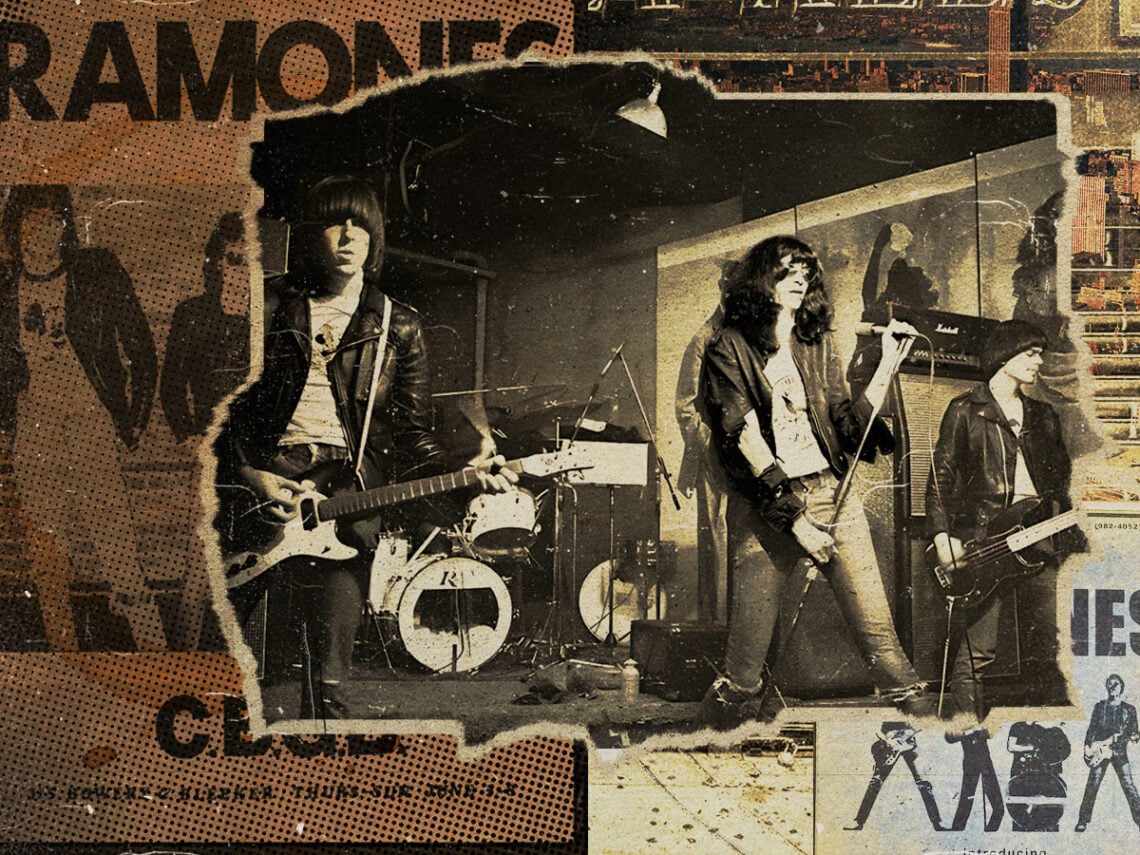
A travel guide to the Ramones’ New York City

No band had more New York City in their DNA than the Ramones. A foursome of gutter punks that could have only come from the streets and apartments throughout the five boroughs, the members of the Ramones were old-school New Yorkers. They even had thick accents to prove it. By and large, all of the band members were born and lived most of their lives in the city.
That means that New York has some unique checkpoints in the history of the band. If you want to see the house Dee Dee Ramone bought in the Whitestone neighbourhood of Queens, it’s still there. If you want to relive where Johnny Ramone got his skull fractured outside of his East Village apartment building, that’s a bit gruesome, but you can go there. It’s hard to say where, but you could probably guesstimate the street where Dee Dee copped enough heroin to inspire ‘Chinese Rocks’.
There are even a few areas that have been remodelled to pay tribute to the legendary punk rockers. Joey Ramone Place sits on the Bowery, just a short walk away from the original CBGBs. The Ramones Way sits at 67th Avenue in Forest Hills, the same neighbourhood where all four original band members grew up.
If you’re looking to go on a Ramones-themed sightseeing adventure while in New York City, here are six essential stops that you have to make.
Forest Hills
The roots of the Ramones start in the neighbourhood of Forest Hills in Queens. It was there that Jeffrey Hyman, John Cummings, Douglas Colvin, and Thomas Erdelyi met and became Joey, Johnny, Dee Dee, and Tommy Ramone, respectively.
If you really want the full Forest Hills experience, you can check out the Birchwood Towers, the apartment complex where Joey grew up, and most of the band hung out as teenagers. Forest Hills High School was where all four members attended, and it makes for a solid visit as well. If you want the full Ramones experience, try and cross Queens Boulevard without getting hit by a car.

53rd and 3rd
The legendary street corner canonised in punk history thanks to Dee Dee’s ’53rd and 3rd’, the meeting point of 53rd Street and 3rd Avenue in Manhattan was notorious as a pickup spot for male prostitutes and drug dealers throughout the 1970s. Dee Dee himself was supposed to have turned tricks at the corner, although he flipped back and forth between describing the song as autobiographical or not.
Today, like much of Manhattan, 53rd and 3rd has cleaned up and become a much safer area. There’s a TD Bank on the corner that is sometimes colloquially referred to as “Dee Dee Ramone Corner”. You probably won’t be able to pick up a prostitute there anymore, but on the upside, you also won’t get murdered like the victim in ’53rd and 3rd’ did.

CBGBs
No tour of the Ramones’ New York City is complete without seeing the original location of CBGBs, the club that became ground zero for the punk rock explosion in New York. The Ramones were one of the first bands to occupy the space, playing with fellow upstarts like Television, Blondie, and Talking Heads. The legend of the Ramones largely starts at CBGBs.
Today, the space has been taken over by a John Varvatos store, zapping all of the countercultural charms from the space. A few parts of the original venue were retained in the redesign, but all of the punk DIY elements of the space are now gone. Embedded in the sidewalk is a simple ‘CBGB ’73’ carved in the concrete, just so you know where you are.

Radio City Music Hall
The luxurious and pristine Radio City Music Hall might seem like the exact opposite of the Ramones’ punk ethos. If you go to see The Rockettes high kick their way through the Christmas season, you’re unlikely to pick up on any punk rock vibes.
But just above the theatre sits the Plaza Sound Studio, the studio where the band recorded their iconic debut LP, Ramones. Producer Craig Leon even got access to the hall’s gigantic pipe organ, which he included in ‘Let’s Dance’. With just a week’s worth of work and $6,400 spent, the Ramones came and went from Radio City in record time.

Arturo Vega’s Loft (6 East 2nd Street)
At various points throughout their career, the members of the Ramones leaned heavily on their peers throughout the punk scene of NYC. One of them was Arturo Vega, a Mexican-born artist who designed the band’s logo and helped with stage lighting throughout most of their career.
Both Joey and Dee Dee briefly lived in Vega’s loft on 2nd Street in Manhattan, just a stone’s throw from CBGBs. The loft would become the setting for ‘Chinese Rocks’, and when the Ramones recorded their version of the track, they gave Vega a shout-out in the line “Hey, is Artie home?”

Rockaway Beach
Once your long day of Ramones tourism is over, you’ll probably want to find a relaxing spot to take it all in. Luckily, there’s a casual location that still has a strong connection to Ramones lore. That would be Rockaway Beach, the titular surfing spot frequented by Dee Dee Ramone.
Later memorialised in the Rocket to Russia single ‘Rockaway Beach’, the shoreside location in Queens is well-known even outside of its association with the Ramones. While it may be hard to picture any of the leather-clad members of the Ramones busting out a surfboard and taking in some sun, Rockaway Beach is still an essential Ramones checkpoint in NYC.

