


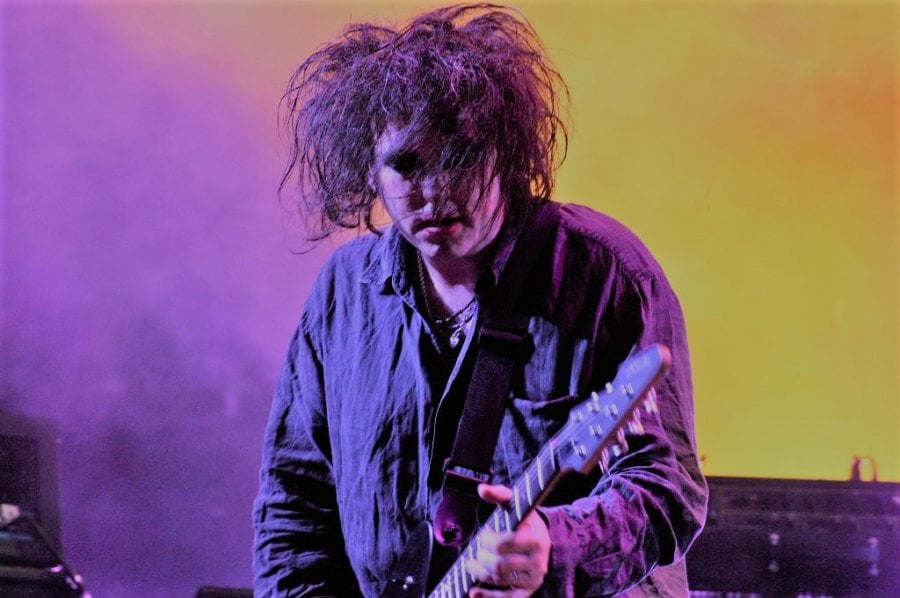
Robert Smith on other bands loving The Cure and the “bizarre” music media

As far as rock musicians go, Robert Smith and The Cure rank at the top of the pile in terms of artistic credibility and influence. From John Frusciante to the most recent wave of post-punk, many covet Smith and the rest of the Crawley’s band’s efforts, and it’s not hard to understand why.
Although their career has been a meandering one in terms of personnel and inter-band relationships, when it comes to creativity, their output has been nothing if not consistently scintillating. They were one of the first acts to understand that to stay relevant, artists have to keep progressing, meaning that they can be regarded as post-punks, goth pioneers, psychedelic heroes, and a host of other things, including, albeit briefly, baggy guitar heroes and this multifaceted nature has stood them in good stead against the passage of time.
Many of music’s most treasured musicians to rise in the wake of The Cure have cited them as having a defining influence on their work, with Interpol, whose brand of atmospheric post-punk is equally as emotive as many of The Cure’s finest pieces, keen to discuss the impact of Robert Smith over the years.
When speaking to Blitz Magazine in 2010, Interpol frontman Paul Banks gushed with praise about The Cure, explaining: “The Cure is the band that all of us in Interpol can say influenced us. When I was younger I listened to them a lot. Carlos (Dengler) as well. Actually, he took a straight influence from this band on the way he played the bass and the keys. To me, Robert Smith is also one of these examples: you can’t be Robert Smith if you’re not Robert Smith. It’s one of the bands with the deepest influence on Interpol, because we all like them. They’re legendary.”
When sitting down with SPIN at Coachella in 2004, only months before their eponymous record’s release, Smith discussed The Cure’s influence on other groups like Interpol, as well as older acts such as Pixies and Dinosaur Jr. whom the band had toured with in the past. Smith expressed: “I enjoy the idea that other people and groups like what the Cure do. And through the years, people do come up to me. When we played with people like the Pixies in the late 80s, or Dinosaur Jr. who did a cover”.
The Cure frontman explained that Pixies’ cover of ‘Disintegration’: “Yeah, it was really cool. I thought they were fantastic. I was worried about being blown off stage by the Pixies because they were so good. And just walking up to Frank (Black) or J (Mascis), I’ve thought, ‘We have a connection.’ Like when you meet a [rock] writer, it’s like you kind of share an unsaid thing. It’s really nice having people in other groups who like what you do. Since the Grammy nomination, a paradigm shift hit London. Last year, suddenly, we were given a Q award, which I wasn’t going to accept. I thought, ‘How petty will that be?’ [It seemed like] they were jumping on the bandwagon.”
Continuing his analysis of the music media’s true intentions, the ever-perceptive Smith said: “The Rapture and Interpol say [the Cure’s] the coolest thing ever, while Q Magazine had not done an interview with the Cure in ten years. I thought, I can be cynical and say ‘Fuck off,’ or I can accept the [award] and it will probably be quite a good thing. It was probably the first awards ceremony I’ve been to in more than a decade? The whole thing was so bizarre, and suddenly the whole room is giving me a standing ovation”.
“At that moment I actually realized what had occurred in the previous like eighteen months. The award that we were getting wasn’t for what we had done. Because a whole lot of bands out there suddenly say they like what we’ve done, the media has to take notice. It reached a kind of critical mass point. But we’re not doing anything different,” he concluded.
