


Artificial floor-fillers: Riker Records and the bizarre rise of AI in northern soul

As the world continues to march towards a horrendously dystopian future dominated by artificial intelligence, the music industry is feeling the pinch of robotic influences.
From murky AI-generated bands generating revenue on streaming sites to artificial videos of John Lennon clogging up social media feeds, the technology is worryingly inescapable. However, if there is one corner of the musical world which can surely escape its clutches, it would be northern soul, right?
Built upon unshakably analogue foundations of enterprising young DJs in search of impossibly rare, forgotten vinyl records recorded years prior by similarly forgotten American soul artists, the northern soul scene is unlike any other. It might have begun back in the late 1960s and early 1970s, from the talcum-powered dancefloors of local social clubs, dancehalls, and now-iconic venues like The Twisted Wheel or The Torch, but northern soul is still going strong to this day.
On any given weekend in the 21st century, you can quite easily find a plethora of soul events happening up and down the country, with the only major difference being the age of the attendees. In fact, in the half-century that the northern sound has been getting people moving, the only significant technological advancement to hit the scene has been the advent of USB-based DJs, and even they are often viewed with suspicion by some northern soul purists (admittedly, it takes one to know one).
Another key aspect of the northern soul scene is the finite nature of its material. The singles that have been blasted over PAs for decades were largely recorded during the 1960s and 1970s by a select group of obscure and overlooked artists, and pressed on a limited number of vinyl discs. Sure, there is a near-constant stream of reissues hitting the market, and labels like Kent do an incredible job of uncovering never-before-heard soul singles, but there is very little in the way of ‘new’ northern soul records, in terms of new recordings.
In recent months, though, through murmurings on select soul forums and social media posts, I have been encountering a wealth of soul songs and artists that I had never heard of previously. All with cryptic names, claiming to be new but with an artificial sheen of retroism attempting to recreate the sounds of 1960s-era Detroit, Chicago, or Philadelphia. After some investigation, this strange new breed of soul singles all came from rural Worcestershire and the AI-enhanced record label, Riker Records.
Still, those singles raised a plethora of questions, the most pertinent being: Who is creating AI northern soul singles, and what for? The answer to both of those came in the form of Colin Day, the man behind Riker.
As Day explained to me in an interview with Far Out, Riker Records came about pretty unexpectedly. “I had a long career in production, writing and producing jingles for radio and TV,” he told me. “When that work started to fade, I was noodling on guitar most evenings– all to no real purpose.”
“Then one day, my wife, Emma, laid down a playful little challenge: could I write a song? It was a playful thing, you know?” The product of that experiment was a long titled ‘Why’d It Take So Long’, recorded with a team of session musicians with Day on vocals, but, in his own words, “I couldn’t get those vintage tones I was after — and my vocals didn’t help — so I shelved it.”
“Late nights, early mornings – and the results were shockingly good: the arrangements, the tone, the vocals. A few overdubs later – some guitar here, percussion there — and they really came alive.” Therein lies the basic origins of Riker Records, according to Day. “There was no master plan,” he affirmed. “It started as private love songs, grew into experiments with new tech, and just snowballed.”
So, just how much of a Riker release comes from the mind of Colin Day, and how much comes from a computer? “A Riker record is like a layer cake – it’s made with AI, but not by it,” the producer explained. “It all starts with the song, and most of these have been in my locker for a long time. The lyrics, chords, melody – I’ve worked all that out on guitar. That’s the foundation. The next layer comes in the studio with the naughty toddlers in the corner – the AI tools. It’s a collaboration.”
Day went on to explain that vocals and arrangement are largely handled by AI software, but the technology is not the be-all, end-all. “As with any AI, it can misbehave,” he said. “I often say it’s like a bastard of a bandmate – one who mostly does his own thing and almost never listens, but every now and then comes out with a moment of pure genius.” Admitting, “It’s the human touch that brings it to life.”
Behind those tech experiments, though, Day is driven by a lifelong obsession with the northern soul scene. “The love of soul music – and the scene – came first,” he revealed. “My brother-in-law had most of the big [Twisted] Wheel sounds and gave me a proper education. I did my first all-nighter at VaVa when I was 15 and then had a good ten or twelve years on the scene.” Adding, “I can’t say I gave my whole life to it like some – my career took over – but once it’s in your blood, it never leaves you. It’s still a massive part of who I am.”
Nevertheless, the advent of Riker’s AI-influenced northern soul singles has divided opinion within soul circles. While some – including northern soul stalwart and former Wigan Casino and Blackpool Mecca DJ Ian Levine – have lent their support to tracks like ‘(You Made Me) A Better Man’ by the aptly named Mighty Intangibles, others have understandably pushed back against the presence of artificial intelligence within the scene.
“I’m not out to be divisive,” Day told me. “I just want to share something I’ve made with love and see if anyone else digs it too.” He went on to explain, “Nobody is more passionate or protective of their music than a soul fan – and I totally get that. I understand it, and I respect it. What I’m doing is using old-fashioned human creativity with incredible new technology to create something new that sounds vintage. They’re almost sculptures in sound – and that’s a lot to get your head around. But I’ve never claimed that Riker Records should be held in the same regard as traditional soul music – that would be absurd.”
To his credit, too, the label has donated what would traditionally be an artist’s royalty share on Riker sales to the Stax Music Academy over in Memphis. “A way of giving something real back, helping a new generation of young soul singers, musicians and producers find their voice,” as Day put it.
Still, the rise of AI in music – not exclusively in the case of Riker – raises an important ethical question. After all, artificial intelligence is trained on pre-existing material created by other artists and producers, none of whom are credited either in the software’s output or on any of these AI-enchanced releases.
Not to mention the environmental implications of AI use, with its data centres and training models contributing significantly to global emissions, and the climate situation continuing to worsen as AI continues to dominate conversations across the globe. “I’m no expert on AI or the ethics of it, but I think everyone knows it’s both exciting and scary as shit,” Day told me.“These tools are improving every day, and the thought that we’re still at the very beginning is mind-blowing.”
“AI has actually been part of music production for years on the mixing and mastering side,” he continued, highlighting the idea that AI is not necessarily a new invention. “But these new systems let us tap into musical creativity itself in ways we’ve never seen before. And yes, there are questions about how these systems were trained,” he conceded, “but when you think about it, everything’s a remix […] Musicians have always built on what came before.”
While there is a lot of truth in that last statement; even the most iconic tracks of northern soul were often attempting to emulate the sounds of Motown or Stax, for instance, the idea that AI-enchanced production and generated vocals could be considered a remix is certainly a point of contention – as is Day’s idea that AI is leading to “fascinating new ways to create original music”. It raises questions about the very meaning of originality, given that AI is trained exclusively on other people’s work.
Riker Records might have started out life as a fun, inconsequential project spurred on by Day’s wife, along with his own career in production, but is AI-enchanced music really the future of music creation? Ultimately, probably not.
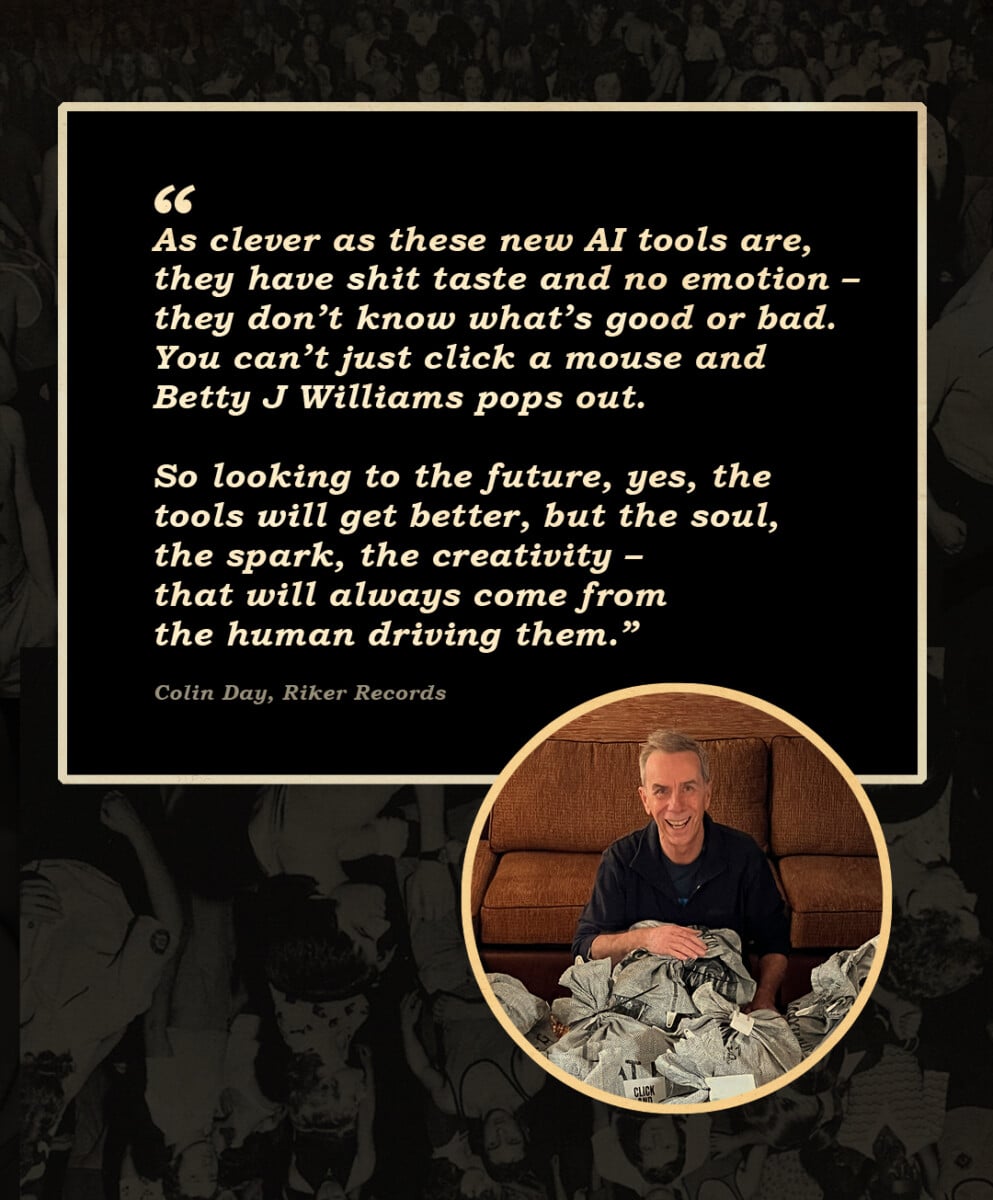
Day himself told me, “As clever as these new AI tools are, they have shit taste and no emotion – they don’t know what’s good or bad. You can’t just click a mouse and Betty J Williams pops out.” Concluding, “So looking to the future, yes, the tools will get better, but the soul, the spark, the creativity – that will always come from the human driving them.”
The consensus seems to be, therefore, that the future of the northern soul scene is safe in the hands of dusty crates of vinyl and human-driven dancefloors, free from the influx of any backdropping robots. Whether or not anybody would be able to pick up on a Riker release being slipped into a set remains to be seen, as the label continues to release both LPs and DJ-focused slices of seven-inch, but, as Colin Day himself admitted, those mysterious AI-infused tracks can never and will never replace the human emotions at the heart of northern soul.
So, the likes of Frank Wilson, Sandi Sheldon, and Gloria Jones can rest easy in the fact that their northern soul throne isn’t going anywhere, regardless of the current AI boom.
