


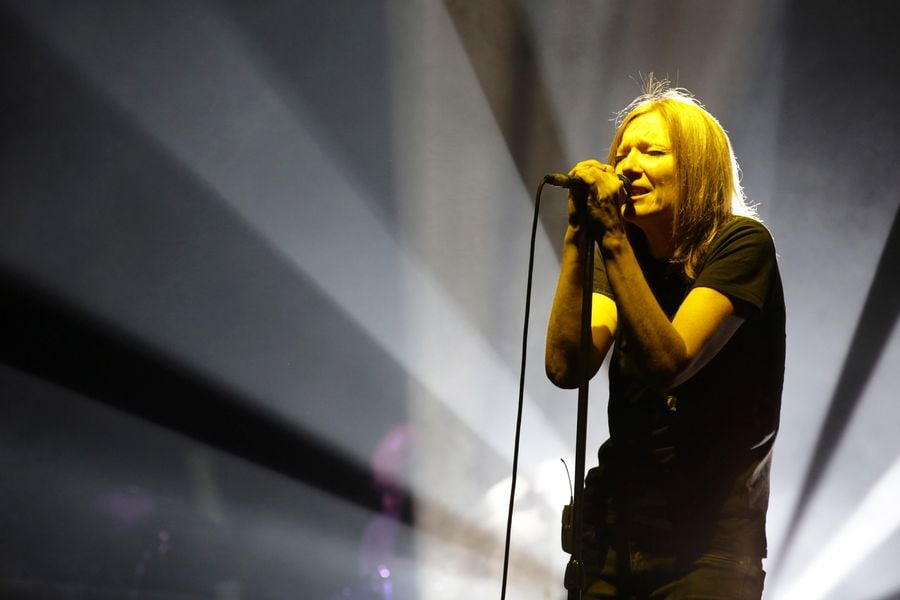
Ranking every Portishead album from worst to best

A thriving Britpop scene dominated the British music scene during the mid-1990s, with the likes of Blur and Oasis championing the charts. However, a unique and melancholy sound was emerging from Bristol, one that blended techniques most commonly associated with hip-hop alongside searing strings, echoes of classic spy movie soundtracks, and the hypnotic vocals of lead singer Beth Gibbons.
Portishead formed in 1991 after Gibbons met Geoff Barrow at an Enterprise Allowance event. Naming the band after the town Barrow resided in for many years, the pair recorded their first song, ‘It Could Be Sweet’, which eventually made it onto the band’s debut album, Dummy. Gibbons and Barrow met jazz guitarist Adrian Utley shortly after, who worked as a co-producer and contributor for their debut album before becoming a full-time member upon its release.
The critical acclaim that met Dummy cemented Portishead as one of the most important and pioneering bands of the mid-1990s. The album’s sublime and intricate use of textures and samples creates a sonic landscape of misery, longing, mystery, and melodrama. Bubbling with tensions between softness and hardness, delicacy and darkness, Dummy is a flawless example of crafting an all-enveloping atmosphere through sound. The album exists in a self-sustaining world of its own, full of hard-cutting beats and wistful melodies.
Following the success of Dummy, the rather elusive band released two more studio albums and a live album. Despite their long hiatuses and infrequent live performances, Portishead have remained a hugely influential band, proving that quality triumphs over quantity. Forever ahead of their time, Portishead sound just as fresh today as 30 years ago, when they acted as a pioneering force for the innovative trip-hop movement, alongside the likes of Tricky and Massive Attack.
Ranking Portishead albums from worst to best:
4. Roseland NYC Live (1998)
Portishead do not have a bad album to their name. In fact, Roseland NYC Live is one of the greatest and most underrated live albums of all time. Recorded during a performance at the Roseland Ballroom in Manhattan, the album features tracks from the band’s debut album Dummy and their self-titled sophomore release. Their performance injects a new dimension into the fabric of the tracks by using additional orchestral arrangements that add a greater layer of intensity and textural depth.
Highlights include Sour Times, which contains one of Gibbons’ most impressive vocal performances, culminating in a passionate explosion of raw, unfiltered screeches of “nobody loves me/ It’s true/ Not like you do” alongside Western-inspired guitar that is even more evocative than the original album version. Only You is another standout, demonstrating Barrow’s impressive turntable scratching techniques, which accompany a brooding beat that gives rise to brewing strings and keys.
3. Third (2008)
Portishead’s most recent studio album, aptly titled Third, was their first in 11 years. Their return did not disappoint, despite its slight shift away from their iconic trip-hop style. After the release of Portishead in 1997, Barrow felt disconnected from creating music and struggled to produce anything he felt content with. However, after co-producing The Coral’s album The Invisible Invasion with Utley, he began to feel inspired again. By the end of 2007, most of the album had been written, consciously moving towards new instruments and production techniques.
Barrow stated that “the basic thing was to sound like ourselves, not to repeat ourselves”. Thus, the band experimented with switching instruments and stripping away many of their trademark features, such as turntable scratching. Taking inspiration from the repetitive nature of the krautrock genre and incorporating psychedelic guitars, break-beats, glitching electronics and synths, Third is dark and intense, at times suffocating, but inevitably, incredibly masterful, pulling sounds and rhythms from the most unexpected of places, yet seamlessly blending into one cohesive body.
Standout tracks include ‘We Carry On’, which features a trance-inducing metronomic looping sound that pays homage to Silver Apples and Neu! ‘The Rip’ is easily one of Portishead’s most tender-sounding tracks, which builds into a euphoric synth explosion. However, one of the most memorable tracks and one of the band’s greatest creations to date comes in the form of ‘Machine Gun’, which sonically impersonates its title, using pounding industrial beats that thrash in juxtaposition to the haunting echoes of Gibbons’ voice in the background.
2. Portishead (1997)
After releasing such a critically-lauded debut album, Portishead faced the difficult task of following it up. Taking a three-year absence, the band returned with a darker and more grimey sound, with many of the tracks fizzling with vinyl cracking, giving it a vintage sound that contrasted the coarse electronics and hip-hop-influenced unsteady beats. The album emanates a sophisticated, cinematic sound that could work as an alternative soundtrack to a 1950s film noir.
Lyrically, Gibbons is more defiant and confronting. She attacks capitalism through poetic musings on its all-powerful, oppressive nature. ‘Half Day Closing’ explores how “the money talks and leaves us hypnotised” and ‘Western Eyes’ suggests that “with Western eyes and serpents’ breath, we lay our own conscience to rest”. Gibbons’ societal critiques are wrapped up in other-worldly sounds, particularly on ‘Half Day Closing’, which ends by evoking the feeling of an alien landing on earth and witnessing the consumerist mess we humans are living in, achieved through the whirring vocal effects and distant cosmic synths.
Here, Portishead is united by its silky-smooth vocals performed by Gibbons. However, Gibbons’ vocals are not laid over the instrumentation in a perfectly polished fashion. Instead, they melt into the often abrasive textures of the soundscape, sometimes becoming one with the synths and guitars or becoming distorted and duplicated in haunting echoes.
1. Dummy (1994)
Dummy is where it all began. Released in 1994, the album won the band a Mercury Prize the following year, beating Oasis, PJ Harvey and fellow trip-hop artist Tricky. The album is noted for its innovative production and attention to detail, weaving rich breakbeats with the buttery textures of Gibbons’s voice, who sings of desire and despair. The band incorporate wide-ranging samples from Johnnie Ray’s ‘I’ll Never Fall in Love Again’ to Lalo Schifrin’s ‘The Danube Incident’; the sonic palette of Dummy is well-rehearsed, taking pre-existing sounds and morphing them into melancholic, twisted entities.
Taking an unconventional approach to production, the band recorded the album onto vinyl records which were manipulated on decks to extract the samples. Furthermore, they would also use interesting techniques to distress the records, such as “putting them on the studio floor and walking across them and using them like skateboards” and a broken amp as a recording device.
Gibbons’s vocals shine through on Dummy, and it’s hard to imagine the raw and almost-physical instrumentations accompanied by anyone else’s voice. Breathy, sensual, playful, and brooding all at once, Gibbons gives her all. However, ‘Glory Box’ becomes the standout of the album. Using a sample of ‘Ike’s Rap II’ by Isaac Hayes, the smooth strings are punctured by Gibbons’ sharp and often unusual delivery of her lines. Accompanied by an evocative guitar riff, the suggestively-titled ‘Glory Box’ is arguably one of the sexiest songs of all time. Dummy remains a masterpiece almost 30 years on, demonstrating how far the limits of production can be pushed.
