


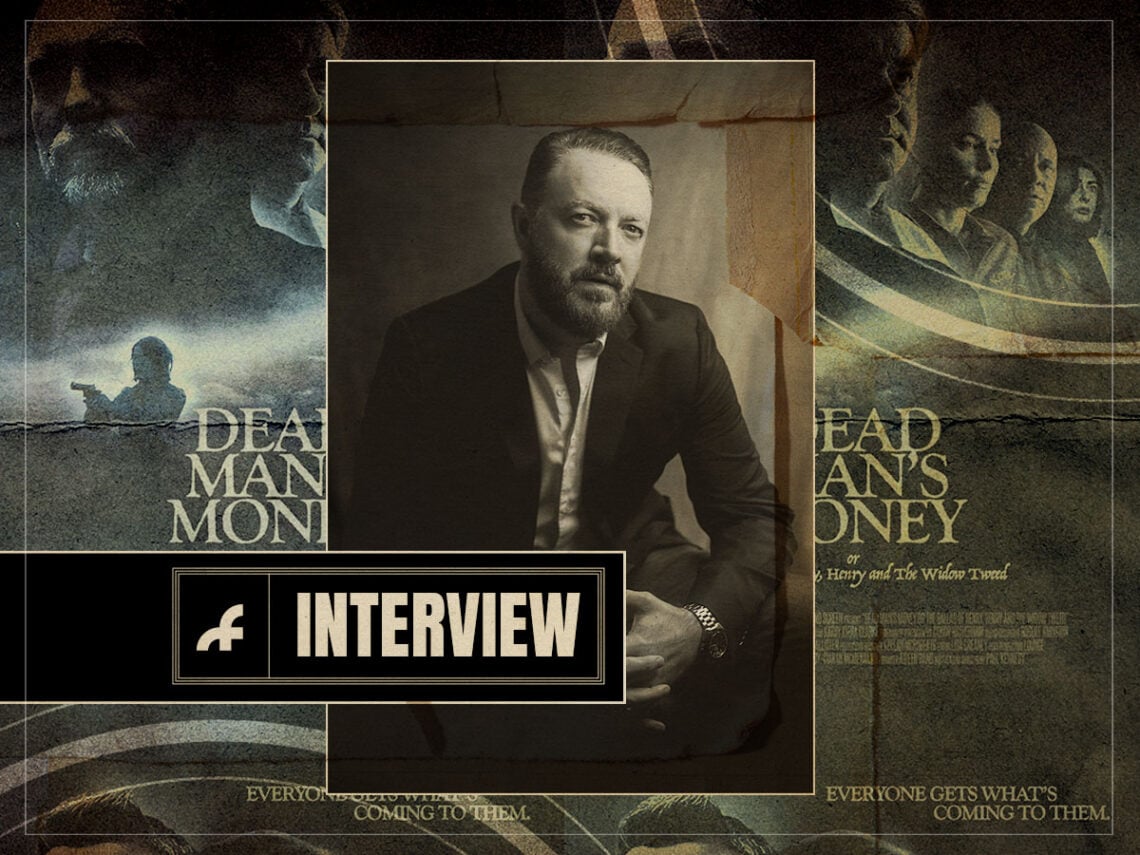
Paul Kennedy on how the Coen brothers inadvertently helped invent Northern Irish “neo-horror” with ‘Dead Man’s Money’

When actor Paul Kennedy decided to direct his second feature film in his native Northern Ireland, he didn’t realise he was about to stumble upon a new genre.
As an actor, Kennedy had starred in low-budget local productions such as Mandrake and Nightride, as well as TV shows like Outlander and Miss Scarlet & the Duke, which all led to him landing the plum role of Lord Jasper ‘Ironrod’ Wylde in HBO’s Game of Thrones spin-off House of the Dragon. However, he still longed to get back behind the camera after his first crack at directing with 2013’s Made in Belfast. So, he did what any independent filmmaker does with a project they’re passionate about: he put it together himself.
Kennedy began writing a script about ‘Young’ Henry, a man who runs a pub with his wife Pauline while waiting for a substantial inheritance of money and land from his uncle ‘Old’ Henry. When a new woman comes into his uncle’s life, though, Henry and Pauline put a scheme in motion to ensure she never sees a penny of what they believe they have coming to them.
The film’s plot has a lot of thematic similarities to Macbeth, but Kennedy admits he didn’t set out to make a modern update of the Bard’s classic play. He elaborated, “When I got halfway through it, I was like, ‘Oh, this is quite similar.’ I think I was probably subconsciously influenced by the Scottish play. It was never like an overt thing.” Kennedy realised that, as written, Pauline was very much a Lady Macbeth character, pushing her husband into something he couldn’t come back from. In the process, though, she unlocked something dark within him and found it was actually she who couldn’t handle the guilt.
Once he had assembled his cast, which included Ciarán McMenamin, Judith Roddy, and Pat Shortt, he made the film but started to realise something else. With its unique mix of rural black comedy, bleak drama, and supernatural elements, he began to feel like he was operating in unknown genre territory.

“For me, the movie is a neo-horror,” revealed Kennedy. “It’s a very new genre, and there’s not a lot of movies that operate in that space.” The filmmaker then noted that it was only after reading about this new genre in some dark corner of the internet that a lightbulb went off in his head. He smiled: “I found one article about it once, and I was like, ‘That’s what I’m making. It describes it perfectly.'” Frustratingly, though, Kennedy says he hasn’t been able to focus on the article since and even fears that it’s been scrubbed from the internet somehow.
In the end, though, perhaps this is a good thing for him and Dead Man’s Money. After all, now he can claim to be the inventor of a new genre – and if he’s not the true inventor, he’s at the very least the first person to apply it to Northern Irish film.
As he racked his brain to explain better how his film qualifies as a “neo-horror” instead of a neo-noir or straight horror, Kennedy reasoned, “Yes, it’s a drama, but it has the traditional horror beats – jump scares and the like – and that’s what I tried to do with this.”
He explained that he was always cognisant that, even though the film may seem like a black comedy for a significant portion of its runtime, the movie does take a hard turn and doesn’t shy away from the darkness of what its characters do. He said, “Let’s never forget, this is a movie where a man is very violent. Let’s just leave it at that.”
Indeed, while shooting the film’s most pivotal scene, Kennedy knew he didn’t want it to appear farcical. He wanted the violence to shock the audience, as they’d been watching a rural black comedy until that point, and now the film had become something else entirely. This was when the Coen brothers popped into Kennedy’s head—and it unlocked a deep-seated inspiration even he wasn’t aware of until that moment.
Kennedy mused: “For me, with the Coen brothers, there’s a recurring theme where characters just keep digging themselves deeper and deeper into trouble, and they can’t get themselves out. And that was a big part of this as well.”
He realised that Dead Man’s Money shares a lot in common with the Coens debut film Blood Simple, both in terms of its narrative and the almost overwhelming sense of dread it establishes at all times. Perhaps the Coens established the bones of the neo-horror in 1984, and Kennedy unconsciously absorbed its constituent parts as a young Northern Irish teenager watching the film on VHS. However, when I suggested they’d make a great double feature, he joked, “I might do it sometime – watch Blood Simple and then Dead Man’s Money. Although, you know what? I’ve seen Dead Man’s Money about 100 times!”
Kennedy explained that he thinks Northern Irish audiences, in particular, have responded to the film’s mix of black comedy and horror. To him, it says a lot about how people have chosen to deal with growing up in a country so often defined by political violence. He added: “It kind of epitomises this place, I guess. Because we would see horrific stuff on the news, all our lives growing up, and our way of dealing with that is through dark humour and through community.”
“I think the movie really does that, you know,” Kennedy continued. “There is a sense of atmosphere to the village. There is a sense of community. There is a sense of everybody knowing everybody else’s business. But there’s also a sense that there’s darkness here and that darkness could rear its head at any time. And I think that’s probably a byproduct of where we grew up.”

Indeed, gallows humour is such a defining aspect of Northern Ireland that Kennedy revealed he was convinced to change the film’s original title by a particularly cutting local audience: the taxi drivers of Belfast. He chucked, “I’m getting taxis to and from the edit suite, and they’re always asking, ‘What are you doing?’ You’re like, ‘Oh, we’re making a movie.’ And they’re like, ‘Oh, yeah, what’s it called?’ and you say, ‘Henry, Henry, and the Widow Tweed.'” He pauses for effect before deadpanning, “That sounds shit.”
In the end, Kennedy admitted that this title was a smidge too theatrical, and the film’s eventual title hit him like a bolt from the blue when he was editing a pivotal scene. When Roddy delivered the line, “You sit there, and you do nothing while he’s being played for a fool by an old woman who’s fluttering her eyelashes because she wants to be looked after by another dead man’s money,” he knew he had the title. He smiled, “If we had called the movie Dead Man’s Money from the start, she would never have delivered that line like that, you know? It would have been too much.”
When asked what the differences are between putting together his own independent film as a writer/director and his day job as an actor on House of the Dragon, Kennedy exclaimed, “It’s night and day. When you’re making something like Dead Man’s Money, it’s a real labour of love. There’s no trailers for the actors. The catering is the best we can do with the money that we have. But everybody’s there on the understanding that we’re just trying to make an indie movie, and if it hits, it hits. If it doesn’t, I just want to make filmmaking a fun experience for everybody on set.”
He added, “We all knew that if we mucked in properly, there’s a chance that we could make something that we would be proud of.”
On the other hand, working on a huge HBO production is “like another planet.” He explained that, before this show, he’d never worked on anything made by a major American studio, and when he first arrived at the Warner Brothers studio lot, it made him geek out.
“I love it,” Kenney confirmed. “I love the job. And it’s just a little bit surreal. I’ve done it for a couple of years now and been in two seasons. It’s great to feel like part of the family, to turn up and have those people to play with, and to work with the directors that they bring in.”
In truth, simply being an actor on the show and not someone shepherding the entire production is a holiday for Kennedy’s head. He said, “I’m just an actor on it. I don’t have to worry about anything but being present in the scene. I just have to be Lord Jasper Wylde for the day or for however long we’re shooting, whereas on Dead Man’s Money, I have to do all the spreadsheets of the cash flow. I’ve got to do the finance plan. I’ve got to work with the producer to do all the casting. I’ve got to liaise with all departments, and we’ve got to look after the money, and we’ve got to make sure we bring the thing in on time and under budget.”
Does Kennedy have any ambitions to level up his directing, though? For instance, would he be interested in directing an episode of House of the Dragon?
His eyes lit up when asked this, and he confirmed, “I would love to do that. I think it’s a little bit beyond my capabilities right now, but I would love to do that. I know the cast, and I’ve had this relationship with them, so it’d be weird, but it’d be very cool”.
