


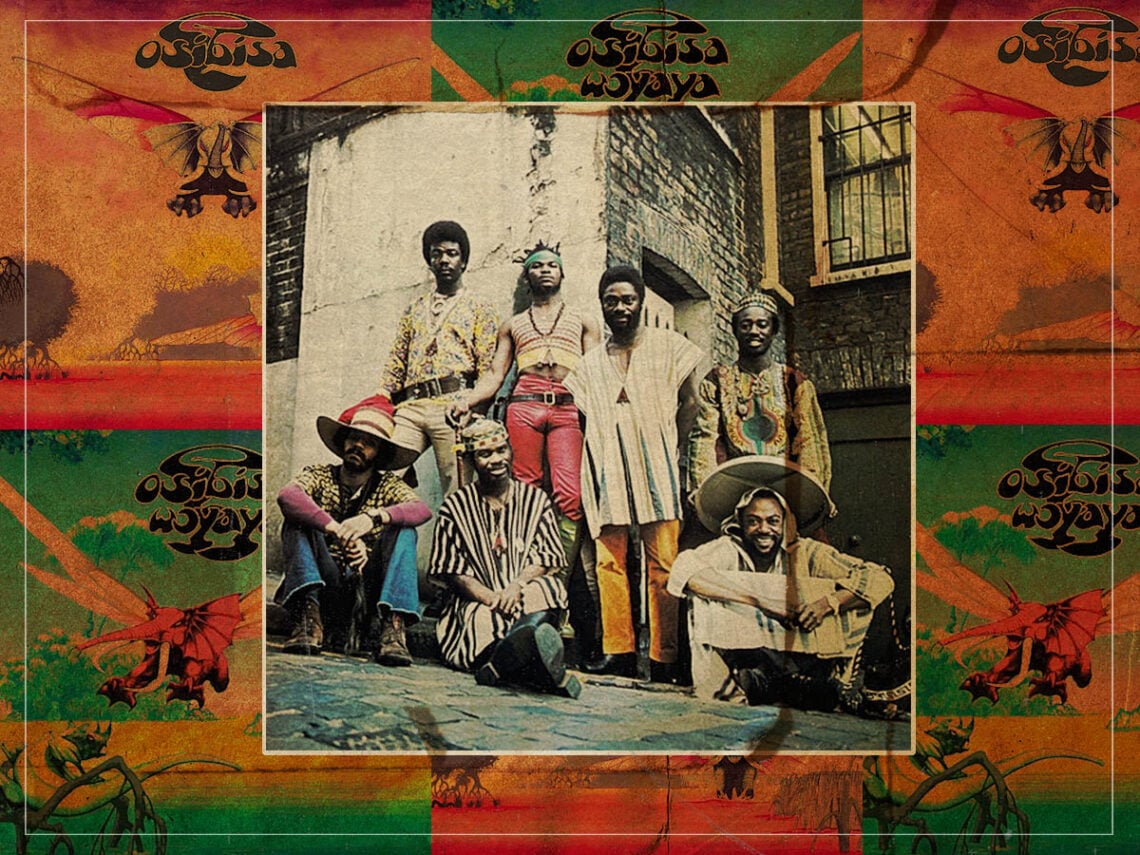
Osibisa: the London band that brought Afro-rock to the masses

A lot of misconceptions surround the perpetually rose-tinted landscape of London during the 1960s. There is a particularly nostalgia-driven image that the city was awash entirely with pop music, mini skirts, and youthful freedom. In reality, though, London was home to a much more diverse society than the ‘swinging sixties’ image gives it credit for.
Away from Carnaby Street, a new era of multi-culturalism was blossoming all over the city, which brought with it entirely new avenues of artistic and musical expression, with groups like Osibisa leading the way.
Immigration has always been a key aspect of Britain’s societal fabric, but the post-war period saw a particular influx of people from places like the Caribbean, West Africa, and South Asia. Inevitably, when these diverse cultures found their way into the towns and cities of the United Kingdom, a change took place. Often, the blending of these cultures with traditional British culture resulted in something entirely new – such as the skinhead subculture, which was born from a blending of white working-class culture with a love of Jamaican ska and rocksteady music.
Among the most exciting sounds to come from this new age in London was that of Osibisa. Composed of three musicians from the Caribbean, and four from West Africa, the band have their roots in Ghanaian highlife music, with bandleaders Teddy Osei and Sol Amarfio incredibly experienced within that genre. The pair had played in highlife groups around Ghana going back to the 1950s, but Osei relocated to London in 1962 to study, and quickly convinced his bandmates to follow suit.
Rather than continuing to play exclusively highlife music, Osibisa took advantage of their new surroundings and the diverse sounds that were on offer in London. Taking on elements of funk, soul, rock, jazz, and rocksteady, the group quickly developed an uncompromisingly original sound which set them apart from virtually every other band in London at the time.
At the time, African music was not widely known among mainstream audiences in England, let alone the sounds of Ghanaian highlife music. So, by blending their roots in West Africa with the popular sounds of rock and funk, Osibisa provided an accessible route for audiences to discover the infectious euphoria of West African rhythms while also establishing themselves as the progenitors of an innovative new sound.
Osibisa seemed to appeal to a wider demographic than most other groups of the time, finding favour with the spaced-out hippies of Eel Pie Island, the rock obsessives of Carnaby Street, as well as London’s growing population of West African and Caribbean expats. Spurred on by this broad appeal and momentous musical talent, Osibisa achieved mainstream success fairly quickly, with their self-titled debut album reaching 11 in the UK album charts upon its release in 1971.
That very same year, the band followed their debut with the record Wɔyaya, which, again, reached number 11 on the album charts. Although, admittedly, their commercial appeal took a steady downturn after that album, the fact remains that Osibisa were able to take the core sound of Ghanaian highlife music and prove its mainstream appeal among Western audiences.
In the years that followed, their sound would come to be known as ‘Afro-rock’. Countless artists have adopted the Afro-rock sound, blending the traditional sounds of West Africa with modern rock and pop influences, but it was the pioneering force of Osibisa that first introduced that idea into the mainstream musical consciousness.
