


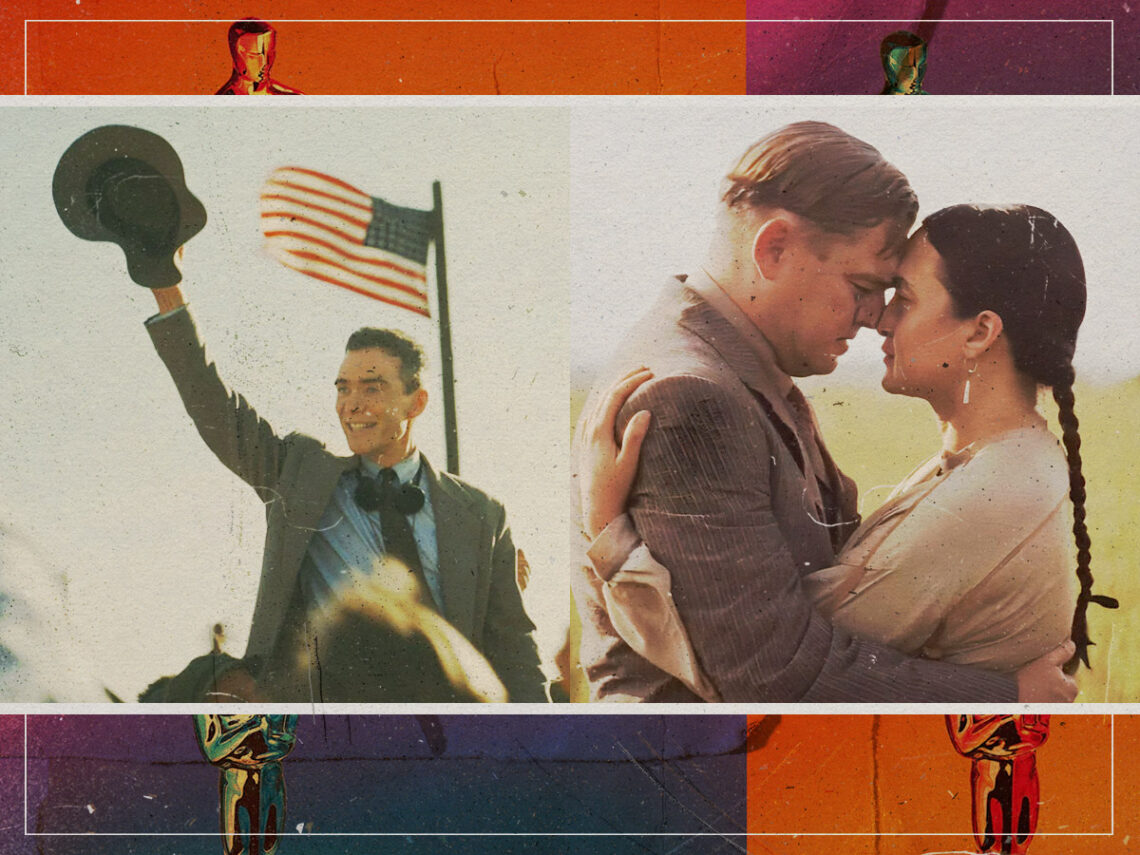
Oscars 2024: the perfect album for every ‘Best Picture’ nominee

As the Oscars 2024 approach, and we all secretly pray for another infamous Will Smith slap moment, the movies chosen by the Academy fall under the microscope once more. This year’s mixed bag is indicative of the transitional phase that cinema finds itself in. It feels as though the dust is settling on the streaming age, and the split between commercial and indie cinema isn’t quite so stringent.
This has resulted in a diverse spread of movies up for ‘Best Picture’. On the one hand, you have big-budget epics like Christopher Nolan’s atomic biopic Oppenheimer. On the other, you have The Holdovers, a ‘nice little film’ in the best possible way. Pitched in between, there are the likes of American Fiction, the uber art house effort The Zone of Interest, and Barbie, the greatest film about a doll since Toy Story 3.
As is always the case with cinema, each of these movies interacts with the art and society that preceded them. Sometimes, you can make leaps between films and compatible records. Just as a bottle of wine can be best glugged with a particular meal, metaphysical links can be made between music and movies that walk a similar line.
Below, we have pondered the intense drama of Anatomy of a Fall and found a brutal folk offering to match and mused over the madness of Poor Things and come up with a suitably perturbing partner. Along the way, we’ve actually learnt more about the movies than when we first watched them, illuminating the pitfalls and masterstrokes that take time to dawn.
A compatible album for ‘Best Picture’ nominees:
American Fiction – Master of Puppets (Metallica)
Back in 2000, Spike Lee gave the world Bamboozled, the story of a frustrated Black writer who proposes a minstrel show in protest against his snubbed attempts to showcase the truth of his culture. In an infuriating turn of events, the show becomes an inadvertent smash. While there’s plenty of scope to discuss the vital rhetoric of the disparity between Black American history and the way minorities are treated in contemporary society, and, if anything, such discussions are all the more prescient, American Fiction treads dangerously close to a watered-down Bamboozled, hamstringing its artistic impact for anyone who has seen both.
That is not to say that American Fiction is without merit. It is sleek, funny, and has important things to say. However, it frequently finds itself in the peculiar position of trying to be a more refined, modernised version of Lee’s premise, and yet comes across as hammy in the moments where it elucidates its points a little too clearly.
In some ways, this makes it akin to Master of Puppets by virtue of the fact that it is highly accomplished, boldly political, and admirably unafraid to have fun in the process. Still, it just isn’t quite as potent or cool as Black Sabbath’s Paranoid, from which it is derived.
Anatomy of a Fall – Blood on the Tracks (Bob Dylan)
Procedural dramas and true crime are not meant to be quite as personally invasive as this. As you watch Anatomy of a Fall, you find yourself very gingerly glancing at your other half and find them gingerly glancing back at you. Despite the darkness, there is a disquieting relatability that will likely shake all but the most deluded of couples. Beyond that, a performance of awe-inspiring brilliance adds a vital dash of heart that serves to heighten the tragedy of it all.
Bob Dylan’s classic Blood on the Tracks was also meant to be a deeply personal and specific album. It was also meant to be folk, but there’s a solid strain of the blues in there, breaking typical form with a harsh muscularity. Dylan himself even told Mary Travers, “A lot of people tell me they enjoy that album. It’s hard for me to relate to that. I mean … people enjoying that type of pain, you know?”
Well, Bob, much like Anatomy of a Fall, ‘enjoyment’ in the typical sense would be the wrong word; ‘captivating’ is much more fitting. The reason that enjoyment may, nevertheless, be derived is that both works have a delicious sense of melody that whisks you along on a devilish ride.
Barbie – Barbie OST (Various Artists)
Admittedly, this feature is a little thrown off by musicals. Nevertheless, I’d quite happily say that Hamilton is a match for something strictly middle class like Michael Bublé, Les Misérables, likewise, is something equally strictly middle class like Genesis, and the mainstream madness of Cats shares a kinship with Kate Bush. However, it is the triumph of Barbie (and its soundtrack) that there’s never really been anything quite like it.
Cynics might call it a toy commercial, but if that’s the case, then please let cinema be flooded with a stream of movie-length adverts henceforth. It might be an advert in the sense that it seems market-tested to match maximum enjoyment, but the popcorn fun is poised perfectly with pertinent social commentary. The songs match that ethos, elevated by genuinely masterful performances.
So, ultimately, you can’t help but laugh at Ryan Gosling’s truly comic vocals on ‘Push’, but in the process, you’re a little wiser to the mechanisms that perpetuate misogyny. And, like the film, even those who really want to hate it will be wrapped up in the album’s catchiness for at least a few moments.
The Holdovers – I, Jonathan (Jonathan Richman)
It’s as refreshing to see The Holdovers nominated for ‘Best Picture’ as it would’ve been to see I, Jonathan, swoop a worthy plethora of awards upon its own release back in 1992. Both are simple, wholesome fun that brighten our dismal days—but simple, wholesome fun rarely draws plaudits despite the fact that the art that adheres to such principles can often become a far more transcendent force in our life than anything more typically highfalutin.
Better still, by aiming to be easily resonant and relatable, both The Holdovers and I, Jonathan, dish out messages as deep and true as anything academic that you can grasp in a sitting. Similarly, they also don’t entrench themselves in a single lane. Album and movie alike have their own humble duality by pairing grief, comedy, dancing, daring, dislocations and dirty ankles in a manner that makes you almost glad that life is tragic for the humanity it inspires in response.
It’s unlikely that either masterpiece will ever win anything. Still, these lovely retro-fied creations are likely to be the most revisited comforts on this list, showcasing the power of deeply the human individual performances from all involved over sober, serious grandiosity.
Killers of the Flower Moon – Live at Monterey (Jimi Hendrix)
So much unbelievable talent but such little time to actually sit through it. Jimi Hendrix and Martin Scorsese are the sort of folks worthy of the cliché: ‘In a league of their own’. But sometimes, when you’ve mastered an art form to such an extent that you can make it do what you want, you end up doing as you please. While the creative virtuosos out there might be asking, ‘Well, what’s wrong with that?’, the ordinary punters would counter, ‘I’ve got work in the morning, and all you’ve been doing for the last half hour is set fire to your guitar’.
No matter how stunning the cinematography is or how intriguing the prescient subtext may be in Killers of the Flower Moon, there’s a nagging part of your attention that says, ‘Yeah, but I wish we were watching Scorsese’s 100-minute masterpiece The King of Comedy, and we’d be in bed before midnight’. A similar feeling can be experienced whenever you delve into Hendrix live. It’s awesome, but a part of you wonders, ‘Is this just too awesome for me?’
Both film and album hamstring their own majesty by rather gratingly insisting upon themselves. Simply put, it’s not the death or art for it to consider its audience every now and again. So, both movie and record alike might be epic, but on a Tuesday night, they’re also tediously over-indulgent.
Maestro – Imagine (John Lennon)
There’s a conducting scene in Maestro that Bradley Cooper spent six years rehearsing; he needn’t have. The conceit of this is a waste of time akin to buying a box set of the news, and it even bellies the art of ‘acting’. In fact, it only serves to trigger the cynical thought that the whole thing was a long-winded promotional gimmick. But aside from that, it’s a solid film about a fellow with a fairly interesting life, featuring a great performance.
The fact that it is pleasantly passable is likely to be agreed upon by nearly everyone who views the movie. Still, it is through sheer commercial will and orchestrated pretence that Maestro has somehow tried to foist the narrative that it is actually a classic. Much like Imagine, the bold way it has been presented and the narrative behind it says more than the art itself ever declares.
That doesn’t make either the film or album bad – how could ‘Oh Yoko!’ and ‘Jealous Guy’ feature on something bad – but there’s just a hint of cheesiness and a lack of real interesting invention that stops both of them from being the classic they’re parading as. If both were at your party, you might be tempted to say, ‘Lighten up’.
Oppenheimer – Dark Side of the Moon (Pink Floyd)
Accomplished, intelligent, stylised, and in desperate need of brutal editing, both Dark Side of the Moon and Oppenheimer are works fated to be consigned as masterpieces forevermore while simultaneously being unfit to function in modern reality. This predicament is thanks to flaws that their creators are well aware of but seemingly see their strengths… unlike most of the punters present.
In the case of Dark Side of the Moon, it’s tedious seconds wasted on till noises (‘Money’), the interminable tick of a draining clock (‘Time’), or a minute of sustained hum (‘Us and Them’) that wastes listener’s sweet seconds. With Oppenheimer, it’s long stares into the distance and drawn-out build-ups that only serve to offer blessed toilet-break opportunities.
And yet, objectively, it’s hard to argue with the purists who claim that both are masterful triumphs. It’s just for me, in both cases, the main personality on display beyond skill is a soporific dullness—quite a feat when it comes to a nuclear bomb that changed the course of human history and an album that shot for the stars. Both seem to say that if you want to talk about the world, then you best be deadly serious and end up waffling on without ever actually saying all that much in the way of groundbreaking thoughts.
Past Lives – Dragon New Warm Mountain I Believe In You (Big Thief)
Life is full of thoughts of what could have been, but it is equally rammed with revelations where you find yourself gladdened that things didn’t work out the way you once wanted them to. Sometimes, these two polarities intersect and breed an internalised confusion. Past Lives ponders upon what happens when that internal itch is openly shared among partners—what happens when the safety of comfortable norms is tested? In the process, the movie amounts to a wholesome, true-to-life masterpiece, resplendent with good advice.
‘I’m happy, but could I be happier’ is a deeply human predicament. It is also one so nettlesome and difficult to convey that art rarely grapples with it, favouring more defined extremes for the sake of safe, linear coherence. However, both Past Lives and Big Thief’s project boldly venture into this typically messy territory and come out with a delightfully neat and affirming conclusion. Things aren’t supposed to be straightforward – how could they be? – these two works of art create warming masterpieces in making that point.
Much like Past Lives, it dares to ditch the usual platitudes of love songs. Instead, it courts squabbles, skeletons, and the tricky business of living in the moment. But it does all this in a melodic and sweet manner that never feels fraught or too much like a diary entry made public. By doing so, it delivers messages that stretch beyond relationships and even weaves in concepts like entropy and the cosmos.
Poor Things – Artpop (Lady Gaga)
You get the sense that Poor Things would like to think it was a Laurie Anderson album or the work of some other revered avant-gardist who uses weirdness and experimentation to pose bold questions. But because the film itself doesn’t really seem to know what those questions are, it’s hard to grant it that level of credit. The subtext on display beneath the quirky surface here is as simple as a woman discovering herself. In the process, it conveys the agency she has in opposition to the men who try to confine her.
However, it lacks the story and coherence to truly drive that point home. In the end, the commentary it attempts to espouse is lost in the mess of its own manufactured daftness. While it pulls this daftness off wonderfully – you’d have to be visually impaired or blander than a rich tea biscuit not to credit the aesthetics of the film – it’s clear that the male creators (it’s written and directed by a male, based on a book by a male), know more about this than the garbled feminism crux.
This makes the movie reminiscent of the densely quirky Artpop, right down to the problematic moments showcased on songs like ‘Do What U Want’. Away from the messy pretext that they both share, there are also moments where the forced absurdity feels like a posh kid in their first week in art school trying to ram their edginess down your throat in a manner that makes you gag and mutter, ‘Ah, grow up’.
The Zone of Interest – Bunyi Bunyi Tumbal (Hulubalang)
What’s genius on paper might not play out in practice. The premise of The Zone of Interest is one of merit. The notion of subverting the usual cinematic horrors of the Holocaust by focusing on the simple banality of domestic life unfurling just a wall away from untold evil is a clever and refreshing way to frame the shocking truth of the tragedy from a German perspective: we can all busy ourselves towards being bystanders in the face of comatose upheaval. With ingenious sound design, this point is made in a manner that is both true to the terror and faithful to the normalised glibness that played a hand in it.
It doesn’t take long to recognise the clever conceit that Jonathan Glazer has conjured there and why it is presently very important. But recognising that and sitting through nearly two hours of it comfortably are two very different things. Once you have grasped the depth of the set-piece, there is little else to string you along. The film itself seems to realise this, but its bid to offer a story proves a little bit messy, and at that stage, no matter how much you’re admiring it, you can empathise with the folks getting up and leaving because they’ve had enough.
The impressive sonic experimentation of Bunyi Bunyi Tumbal is a worthy partner of The Zone of Interest. The record finds Hulubalang presenting the Indonesian war archives from the point of view of Dutch colonisers, whereby the terror of harrowed vocal samples, bleak field recordings, and the intrusion of industrialised instrumentation punctuates equanimous exotic soundscapes. That reads as original and impressive on paper, but whether it connects beyond its written synopsis is another matter. Likewise, 20 minutes to get to grips with it might be enough.

Never Miss A Tale
The Far Out Bob Dylan Newsletter
All the latest stories about Bob Dylan from the independent voice of culture.
Straight to your inbox.