


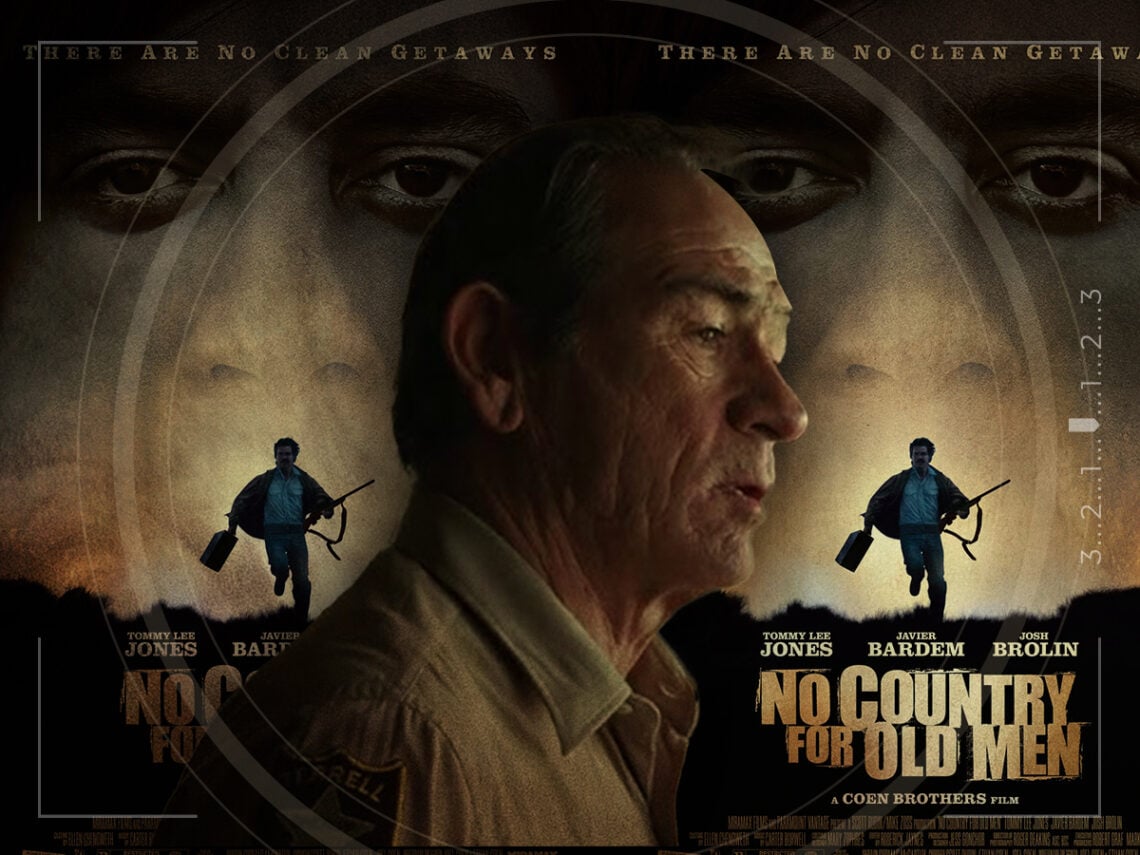
‘No Country For Old Men’ explained: What do Sheriff Bell’s dreams mean?

Hit ‘play’ on a Coen brothers movie and you’re bound to be surprised by where it takes you. You might think you’re starting a comedic period drama set in rural Mississippi, only to discover that it’s a musical based on Homer’s The Odyssey. Or maybe you decide you’re in the mood for a movie about writer’s block, only to find yourself floundering in some sort of buddy horror movie steeped in religious allegory and possibly fascism.
Some of their movies are more straightforward. Fargo is, more or less, a crime comedy-drama about Midwestern eccentricities. True Grit is a relatively faithful adaptation of Charles Portis’s novel. Then, there’s 2007’s No Country for Old Men, which falls somewhere in between inscrutable and straightforward.
Based on Cormac McCarthy’s 2005 novel of the same name, it follows a hapless Vietnam War veteran in West Texas who stumbles upon a suitcase full of money and is hunted by a serial killer and a local sheriff. It garnered near universal acclaim, winning four Academy Awards, including ‘Best Picture’, and raking in $171 million at the box office off of a budget of $25m.
You can easily watch the movie and get swept up by the nerve-shredding suspense and Roger Deakins’s breathtaking cinematography, but there are layers of deeper meaning, from the question of fate versus free will to the crumbling mythology of the Wild West.
What happens in ‘No Country for Old Men’?
Set in 1980, the film follows Josh Brolin’s Llewelyn Moss, a Vietnam veteran-turned-welder who lives in a trailer park with his wife, played by Kelly McDonald. While hunting one morning, he stumbles upon a recently concluded gunfight over a drug deal. Everyone has been killed, except for a fatally wounded man who begs Llewelyn for water. Instead, he leaves, taking home a suitcase full of $2million in cash that he finds a short distance from the scene.
That night, Llewelyn suffers a crisis of conscience and decides to go back to the desert to give the man some water. This fateful decision sets everything in motion. Llewelyn is discovered at the crime scene, and psychopathic hitman Anton Chigurh (Javier Bardem), whose weapon of choice is a captive bolt pistol connected to an oxygen tank, begins to track him. Meanwhile, soon-to-be-retired sheriff Ed Tom Bell (Tommy Lee Jones) is also in pursuit.

As he flees Chigurh, Llewelyn is drawn deeper into violence and danger until he is eventually killed. Chigurh murders everyone in his path without a shred of remorse, often leaving the fate of his victims up to a simple coin toss. In his final scene in the movie, Chigurh leaves the home of a woman he has just killed, only to be hit by a car that has run a red light. Stumbling out of his automobile, Chigurh limps away, injured but still alive.
In the final scene, Sheriff Bell sits at his kitchen table with his wife (Tess Harper) and details two dreams he had the night before. In the first, his father gives him some money, which he loses. In the second, he’s riding through a snowy mountain pass when his father appears with a horn filled with fire. In the dream, the sheriff knows that his father was going on ahead of him to make a fire “somewhere out there in all that dark and all that cold,” and that whenever he caught up to him, his dad would be waiting for him.
So, what do those dreams actually mean?
The first dream harkens back to a scene in which Sheriff Bell visits his cousin Ellis (Barry Corbin), an invalid living on his own in the desert. They discuss their family’s history in law enforcement in the lawless West. When Bell confesses that he feels outmatched by the violence consuming the world around him, Ellis tells him that he can’t outrun fate and that the place they live has always been subject to savage, senseless violence. “This country is hard on people,” he says, and then adds, “You can’t stop what’s coming.”
Bell’s dream about losing the money his father gave him can be interpreted as an extension of his sense of inadequacy. His dad passed down his family’s legacy in law enforcement, and despite decades of fighting violence in his community, Bell feels that he wasn’t able to live up to the task. On a broader scale, it reflects his failure to live up to the mythology of the Old West. He isn’t the valiant lawman of John Ford westerns who protects his town from marauding outsiders. He did what he could, but still believes that, left to his own devices, left to the chaos of the world, he fell short.
The second dream provides a softer perspective, and one that enforces a sense of mythical order. Rather than his father leaving him alone in a chaotic world of random violence, he strides confidently in front of him, leaving his son behind but upholding a beacon of warmth and security for his future. In this version of the world, Bell is not left to his own devices but is simply marching toward a pre-ordained destiny shaped by his father.
The sheriff’s dreams illustrate the two sides of the coin that the film has explored in various ways up to that point, from the obvious coin tosses that Chigurh uses to determine his victims’ fates to the proverbial coin toss in which Llewelyn decides to go back to the crime scene with water. Is the future determined through a series of random events, or is it inevitable? As the conflicting dreams suggest, Bell is no more certain of the answer than the audience.
