


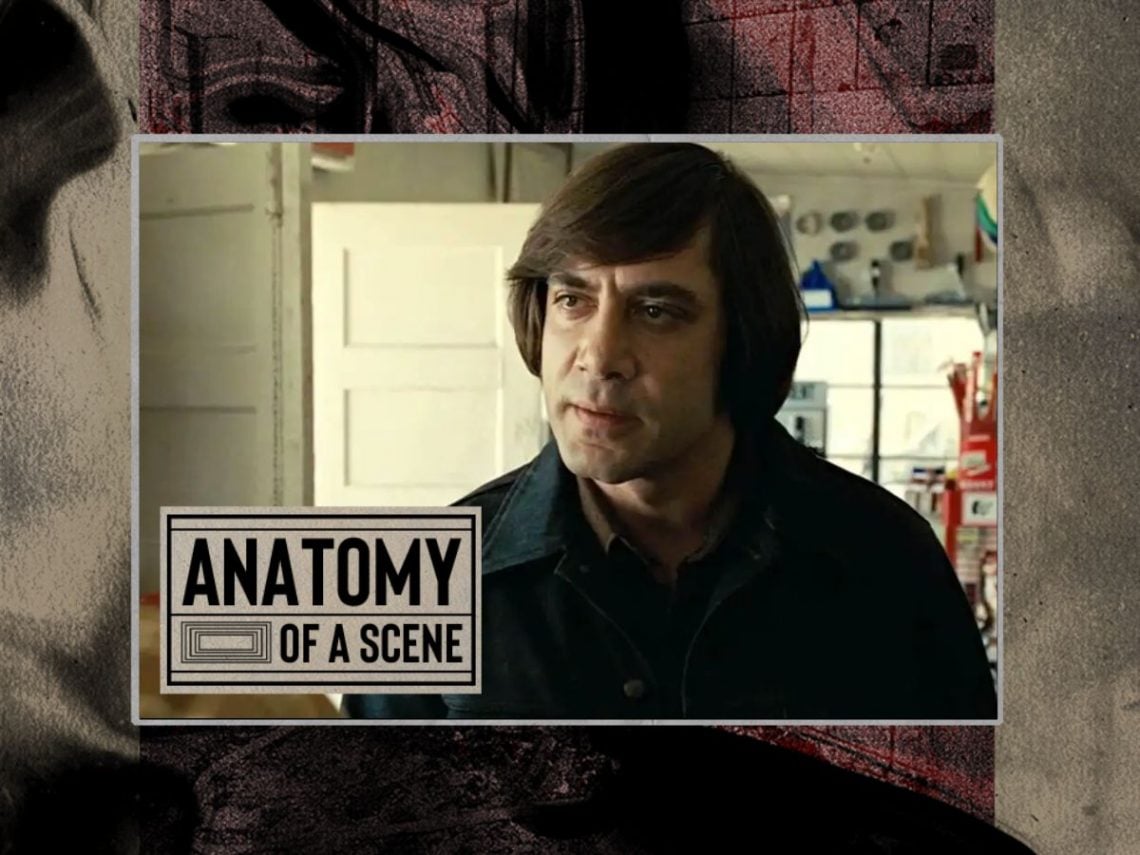
Anatomy of a Scene: The coin toss in ‘No Country for Old Men’

The Coen brother’s 2007 adaptation of Cormac McCarthy’s novel No Country for Old Men ranks among the most atmospheric films ever released. It’s an allegorical, almost dream-like critique of the ever-expanding limits of the neoliberal world order and the destructive impact the shifting epoch has on its unexpecting denizens, even those closer to home – in the supposed developed world.
Undoubtedly one of the Coen’s finest films, it boasts star turns from Josh Brolin, Tommy Lee Jones, Kelly MacDonald and Javier Bardem, with Brolin’s protagonist Llewelyn Moss, Jones’ world-weary Sheriff Ed Tom Bell and Bardem’s deathly spectre, Anton Chigurh, forming a triptych that wrestles for screen time and influence over the plot and audience, each with much and little to say.
Moss represents the chance and opportunity that the new world offers and the existential implications that financial and other forms of risk bring. Ed Tom Bell is the old world embodied, grappling with the reality that he and it are quickly becoming obsolete, and Chigurh, whilst on the face of it plainly a murderous sociopath, is the great leveller personified. It has been argued that he is the Angel of Death, but it is clear that he is much more than this. He is the bloodiest possible reading of the haphazard nature of human existence.
After all, Cormac McCarthy once said: “There’s no such thing as life without bloodshed. The notion that the species can be improved in some way, that everyone could live in harmony, is a really dangerous idea. Those who are afflicted with this notion are the first ones to give up their souls, their freedom. Your desire that it be that way will enslave you and make your life vacuous.”
For Chigurh, the Coens wanted to cast someone “who could have come from Mars”, and with Bardem, that is exactly what they got. He brought a steely alienness to the character, which McCarthy’s original creation, adding a hefty dose of realism that’s enough to perturb even nihilists.
Given the wholly emotionless spirit of Chigurh, this has made him one of the most revered – and feared – cinematic villains, with the coin toss scene in the Texaco petrol station going down as a masterclass in building nail-biting atmosphere. Here, chance plays the role of the decider as we watch the unsuspecting owner flip the coin at Chigurh’s behest, not knowing that his life hangs in the balance.
What the elderly owner does not know is that Chigurh has already left a trail of death in his wake, garroting a police officer with his own handcuffs and killing a motorist on the side of the road with his weapon of choice, the cattle gun. The latter is a remarkably prescient comment on the bovine essence of human nature.
When Chigurh gets to the Texaco station, he takes exception to the owner’s attempt at small talk and is particularly irked by his open admission that he came to own the business through marriage.
When speaking to GQ in January 2022 for a video breaking down his most iconic characters, Bardem reflected on Chigurh and the coin toss scene, noting that something much more profound drives his actions: “The challenge was to create this person who would feel nothing. He will follow his own ethics, no matter what, and he will do it against his own will; I guess that’s the crazy part. Like if something beyond his control or over him is telling him how to act, and still we don’t know what it is. As an actor, that’s the world that I kind of created for myself to justify Anton Chigurh’s actions.”
He explained: “Because in the book, he’s not described as well, he comes, he destroys, he disappears, so you have to really understand a little bit of what’s going on in your mind in order to execute those horrible actions. Like, for example, in the gas station scene, I was always thinking that there was a superior voice and order that was making the decision through me. So this is not something personal against that person or that person, it’s like; there are things that must be done in terms of creating a better world – which he thinks is a better world. And in this case, it’s a world where people don’t marry into businesses, they own or earn own their own businesses.”
Not only are Bardem and Gene Jones, who played the proprietor, more than convincing in their respective roles, with Jones carrying off the country bumpkin owner perfectly, some simple but effective camera work aids them. Primarily shot from the over-the-shoulder perspective, it is intended to be confrontational, so we acutely understand both the jeopardy the owner is in and just how terrifying Chigurh is.
The longer it goes on, the more we become uncomfortable, just as Chigurh’s current quarry does. Then, the directors manage to take it to the next level with the use of the wrapper, which Chigurh places on the counter after hearing that the owner came to own the business through marriage, unfurling on its own from the force of his grip, adding an aural element to this already hair-raising moment.
Asking the old man what’s the most he ever lost on a coin toss, digging in his pocket, Chigurh produces a quarter. He flips it and instructs him to call it, despite the man protesting that he needs to know what they’re calling for. Evoking the argument that he is indeed death, similar to that in The Seventh Seal, Chigurh tells him: “You need to call it. I can’t call it for you. It wouldn’t be fair.”
The attendant maintains his point, saying, “I didn’t put nothin’ up”, to which the eerily serene Chigurh responds with his most iconic line: “Yes, you did. You’ve been putting it up your whole life. You just didn’t know it. You know what date is on this coin?”
After the manager says no, Chigurh continues: “Nineteen fifty-eight. It’s been travelling twenty-two years to get here. And now it’s here. And it’s either heads or tails, and you have to say. Call it.” Again, the proprietor insists that he needs to know what he stands to win before Chigurh responds definitively: “Everything.”
Luckily for the proprietor and us, he picks the right side of the coin and walks away with his life. Not before Chigurh leaves him with a chilling final point. He tells him not to put the coin in his pocket as it is now his lucky quarter, “or it’ll get mixed in with the others and become just a coin. Which it is.”
He then departs, concluding one of the most profound yet utterly bewitching moments we’ve ever seen in cinema. Whilst it answers some of the broader existential questions the film raises, it also presents us with more, a testament to the work of both the Coen brothers and Cormac McCarthy.
